admin
admin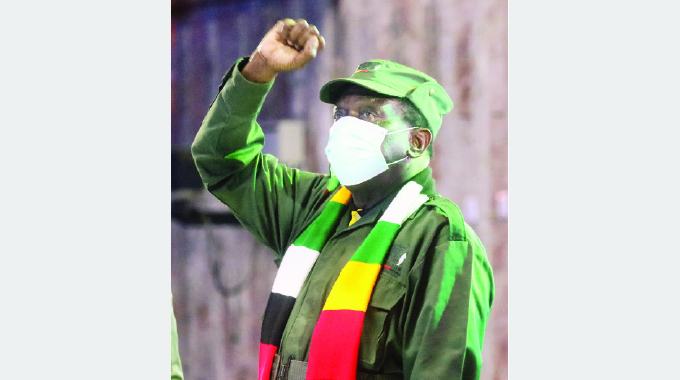
Nobleman Runyanga-Correspondent
The Zanu PF War Veterans League held its inaugural elective conference last weekend.
One of the outstanding features of the event was the green liberation war time garb which the party’s First Secretary and President, Dr Mnangagwa and his deputies, Dr Constantino Chiwenga and Colonel Kembo Mohadi turned out in on Saturday.
The combat gear emphasised the role played by the war veterans during the liberation struggle.
The three members of the party’s Presidium, themselves distinguished war veterans in their own right, personified the continuous role of war veterans in leading and building the country and the region.
They showed that the war time slogan, “Iwe neni tine basa (You and I have a duty to serve our country),” did not and should not have ended with the end of the liberation struggle in 1980.
President Mnangagwa and other leaders in Government and other key sectors of our country continue to uphold and advance the liberation movement ethos beyond defeating the enemy militarily and are extending it to cover the unique challenges of the post-war period.
The post independent African political landscape has been characterised by the West’s use of its local opposition lackeys to push its imperialistic designs in exchange for money or promises of assistance in unseating and replacing the revolutionary political parties.
This is the reason why Western countries such as members of the European Union and the United States and organisations such as the Jeremy Smith-led Vanguard take a keen interest in elections in Africa.
However, events in the past decades have amply demonstrated that the West, in whatever guise, is no match to Southern Africa’s revolutionary movement.
In South Africa, the white-dominated Democratic Alliance (DA) experimented with appointing black politician and businessman, Mmusi Maimane, to lead it from May 2015 to October 2019 in the vain and misguided hope of attracting more black supporters from that country’s revolutionary party, the African National Congress (ANC), but to no avail.
In April 2021, former DA leader, Tony Leon, described Maimane as “a failed experiment”.
Where the abuse of democratic means of regime change like elections have failed, some individuals such as the Centre for Applied Non-violent Action and Strategies (CANVAS) director, Srdja Popovic, have gone to the extent of using local people in protests, which resulted in the illegal removal of elected leaders as happened during the Arab Spring demonstrations which ousted Egypt and Tunisia leaders among others in 2011.
In Zimbabwe, alert security agents led to the arrest of the Citizens Manifesto co-ordinator Tatenda Mombeyarara, Centre for Community Development in Zimbabwe Advocacy Officer, George Makoni, Nyasha Frank Mpahlo of Transparency International Zimbabwe and executive director of Community Tolerance Reconciliation and Development (COTRAD), Gamuchirai Mukura in May 2019 at the Robert Gabriel Mugabe International Airport.
The four reportedly received CANVAS training in Maldives and the Czech Republic.
They were supposed to train MDC Alliance members in protests, which the political party intended to use to get back at Zanu PF for its own deserved electoral loss the previous year.
The plan fell flat on its face due to the alertness of the Zimbabwean Government which is led by the revolutionary Zanu PF.
In March 2004, the same Zimbabwean Government foiled a coup bid by a group of mercenaries led by Simon Mann, which was on its way to effect a coup in Equatorial Guinea.
The mercenaries were arrested at the Robert Gabriel Mugabe International Airport. The group was funded by the late former British Prime Minister, Margaret Thatcher’s son, Sir Mark Thatcher.
The flopped coup, which is also known as the Wonga Coup, was calculated to replace Equatorial Guinea’s President Teodoro Obiang Nguema Mbasogo with exiled opposition politician, Severo Moto.
Perhaps the most brazen attempts by the West to reverse the independence of African countries was in 1975.
Mozambique got her independence from Portugal on June 25, 1975 and Angola got hers from the same colonial power November 11, the same year.
The following year, the Rhodesian government, fearing that the newly independent Mozambique would provide bases and inspiration for Zimbabwean freedom fighters, formed the Mozambique National Resistance (RENAMO) to cause political instability in that country.
After Zimbabwe became independent in 1980, RENAMO continued to operate as a rebel outfit until 1992 thanks to the South African apartheid government.
The National Union for the Total Independence of Angola (UNITA) was formed by the late Jonas Savimbi on March 13, 1966 as part of the Angolan nationalist movement and fought for independence alongside the ruling Popular Movement for the Liberation of Angola (MPLA), but turned rebel after independence.
For a solid 27 years, Angolans did not enjoy their independence as UNITA fought the government with assistance of the South African apartheid government and the United States.
Eventually, Savimbi was killed on February 22, 2002 and his rebel outfit was vanquished. The 1990s were characterised by economic hardships which forced some African Governments to approach the US-dominated International Monetary Fund (IMF) for financial assistance. In most cases, this was granted on the condition that the countries agreed to the institution’s strict conditions.
In 1991, Zimbabwe adopted the IMF-prescribed Economic Structural Adjustment Programme (ESAP) which caused many challenges through retrenchments and other negative consequences. The US attempted to use this difficult period to unseat elected governments led by revolutionary political parties. It used people who were affected by the austerity measures such as trade unionists.
In Zambia, the West succeeded in dislodging the late Kenneth Kaunda and his United National Independence Party (UNIP) from power in 1991 using the late Frederick Chiluba of the Western-backed Movement for Multi-Party Democracy (MMPD).
It is, therefore, not surprising that when the effects of ESAP bit the Zimbabwean people in the 1990s, it was the trade unionist, the late Morgan Tsvangirai who the US and the West used to foment and lead protests like the January 1998 riots which were sparked by a bread price hike.
The UK-based Westminster Foundation for Democracy (WFD) then put on the table a kitty to fund the formation of an opposition party to take advantage of the momentum created by the food riots in the hope of using future protests to unseat Zanu PF.
This was achieved on September 11, 1999 when the MDC was formed.
It was fashionable at the time to have opposition names which included words like movement and democracy to excite young people, but despite all that 23 years later, the MDC and all its various factions and formations remain at sea as to how to pip the revolutionary Zanu PF from the power pedestal.
Elections, which were held in the southern and eastern African regions over the past few years, have demonstrated that despite possessing limitless financial resources and willing local lackeys to fight African Governments for a few dirty dollars, the West has failed to reverse African countries’ independence and replace them with their own pliant stooges from the opposition. Not even 22 years of evil and punitive sanctions against the innocent people of Zimbabwe for repossessing their land could unseat Zanu PF.
The misguided plan and hope was using the people’s pain to rise against their Government, but this could not undo the political chemistry between the revolutionary party and the people.
When Dr Lazarus Chakwera of Malawi won that country’s presidential election in June 2020, Zimbabwe’s then MDC Alliance leader, Nelson Chamisa, was quick to claim that he would win Zimbabwe’s presidency in 2023.
Full story on www.herald.co.zw
It was only after he was told that Dr Chakwera contested on the Malawi Congress Party ticket, that country’s revolutionary party, that he realised his error and cringed into his shell. During the August 9, 2022 Kenyan general elections, Chamisa and his new political outfit, CCC were backing Raila Odinga, who was supported by the West.
Before the results were announced, Chamisa was already excitedly claiming that Odinga’s temporary lead during the vote counting process was “a sign” for his own 2023 win.
When William Ruto was eventually announced as the winner, Chamisa had an egg on his face.
Although Ruto did not contest on the Kenyan revolutionary party, KANU’s ticket, he enjoyed the support of the region’s revolutionary movement.
Having been put in his place, when Angola held its general elections on August 24, 2022, and President João Lourenço and the ruling MPLA party romped to victory, Chamisa and his Western handlers read “the sign” correctly this time around and kept quiet.
Chamisa realised that the regional electoral tide was not in favour of Western puppets.
South Africa is set to hold its general elections in May 2024.
Admittedly, the ANC has conceded some ground to the opposition in some past local government polls. Despite its current internal ructions, the revolutionary party is expected to retain power in 2024.
Revolutionary parties were born out of the need to fight for the people’s freedom from the shackles of colonialism. Since then, they have been about the people and addressing their anxieties and concerns.
That is why they have never called for sanctions against the people they expect to lead.
This is the reason why SADC resolved in August 2019 to set aside October 25, every year as the Anti-Sanctions Day in solidarity with Zimbabweans.
This is why the US and the UK’s efforts to use regional leaders such as South African President, Cyril Ramaphosa, against Zimbabwe have failed dismally.
The political chemistry between revolutionary parties and the people is the main reason why Chama Cha Mapinduzi (CCM) of Tanzania, FRELIMO of Mozambique, ANC of South Africa, MPLA of Angola, SWAPO of Namibia, Zanu PF of Zimbabwe and the BDP of Botswana have been in power since independence.
As Zimbabweans gear themselves for the next elections in less than a year’s time, they should get into the ballot booth in full knowledge of the fact that only revolutionary political parties have the needs of the people at heart.
They should remember that no amount of Western funding can buy revolutionary parties to sacrifice their people for political expediency as does Western-backed opposition parties.
They should remember that the West is no match for the Southern African revolutionary movements.



 Online Reporter