Online Reporter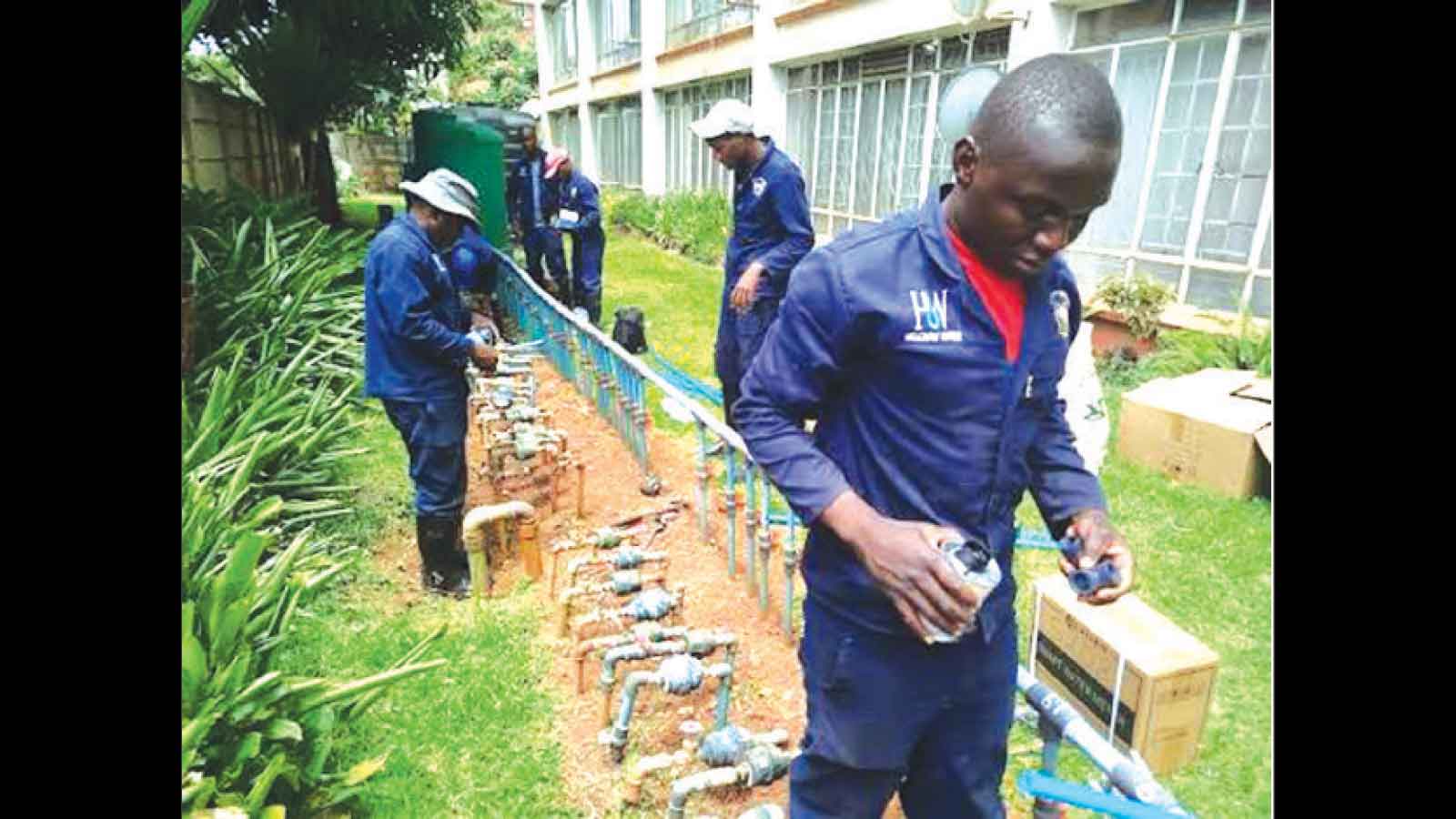
Farai Jere
NON-REVENUE water was estimated at about 60 percent, meaning a substantial proportion of treated water was being lost or was not being properly accounted for.
The challenge was, therefore, not simply one of insufficient water production. It involved the entire water supply chain — from production and distribution to metering, billing, revenue collection and management of the network.
Helcraw Water’s intervention is designed to address these challenges in an integrated manner.
The rollout of the smart prepaid water meters, in partnership with the City of Harare, is a key intervention aimed at improving water availability through efficiency, accountability and sustainability.
By enabling real-time monitoring of water consumption, the system encourages responsible usage at household level, reducing wastage and ensuring more equitable distribution across the city. This is particularly important given that NRW currently stands at about 60 percent, largely due to leaks, bursts, unmetered connections and estimated billing.
With smart metering, faults such as leaks and abnormal consumption can be detected early, allowing for quicker response and reduced losses, with a target to bring NRW down to 35 percent.
At the same time, the system enhances billing accuracy and revenue collection efficiency from 48 percent to a projected 90 percent by eliminating estimates and introducing digital, prepaid billing supported by mobile and banking platforms, as well as customer self-service through the customer interface unit (CIU).
Modernising Harare’s
water system
The project is further supported by ongoing investments in water production and infrastructure rehabilitation, creating a more resilient supply system. Currently, the Morton Jaffray Water Treatment Plant produces about 350 megalitres (ML) per day, but upgrades are expected to increase the capacity to 520ML within the next three years.
In parallel, approximately 500 kilometres (km) of distribution pipelines are being rehabilitated — with about 65km already completed — to reduce losses and improve delivery across both high- and low-density suburbs.
These combined interventions aim to increase water supply coverage from 48 percent to 75 percent, while aligning improved production capacity with efficient distribution and consumption.
Ultimately, the smart meter rollout goes beyond billing reform; it forms part of an integrated approach to modernising Harare’s water system, ensuring more reliable and sustainable water availability for residents.
Since the programme began, Harare has started moving towards a more modern and data-driven water management system.
Smart prepaid meters provide real-time information on consumption, allowing abnormal consumption and potential leaks to be identified earlier and enabling quicker intervention. There has also been tangible progress on physical infrastructure.
About 65 kilometres of the distribution network have already been rehabilitated as part of the broader programme.
These works are aimed at reducing losses from bursts and leaks and improving the efficiency of water distribution.
The programme is also linked to improvements in water production, including at the Morton Jaffray Water Treatment Plant.
So far, we have procured four pumps for the plant that will bring a major change in the production of water.
We have also installed a compressor that plays a major part in ensuring Morton Jaffray increases its water production capacity.
While the full impact will become more evident as the programme expands, the combination of production upgrades, pipe rehabilitation and smart metering is intended to create a more reliable and sustainable water supply system.
Scope
The programme is much broader than the replacement of conventional post-paid meters with smart prepaid meters. The smart water metering system is supported by digital billing and improved customer-service systems.
The first phase targets approximately 320 000 smart prepaid meters across Harare in the next three years.
The programme will subsequently expand into the wider Harare Metropolitan area, including Chitungwiza, Epworth, and Ruwa.
On the infrastructure side, Helcraw Water is rehabilitating the distribution network by replacing old galvanised steel and ageing asbestos pipes with modern PVC systems.
Approximately 500 kilometres of the distribution network are targeted for rehabilitation over the next three years.
The programme also includes upgrades to the Morton Jaffray Water Treatment Plant, digitalisation of water-management systems, real-time data collection and analysis, improved billing and customer-service systems, and measures aimed at improving revenue collection.
In the longer term, the project is expected to scale up further, including the development of new treatment plants in line with population growth in urban Harare.
Challenges
One of the biggest challenges with Harare’s existing water network is the ageing nature of the distribution infrastructure. The network contains old asbestos and galvanised steel pipes that are vulnerable to bursts, corrosion and leaks. Many of these pipes are damaged and have not yet been replaced.
The wider system is also affected by a high number of estimated meters, unmetered customers and pipe bursts. These factors contribute to non-revenue water.
The challenge is, therefore, both physical and operational.
Water can be lost through leaking or burst infrastructure, while water that is consumed may also not be accurately captured because of inadequate metering and estimated billing.
Over 82 000 meters have been installed so far. The rollout has been strategic, with installations carried out in Warren Park and parts of Mabelreign, Westlea, Belvedere, Avondale, Southerton, the Avenues, Ashdown Park, Aspindale, Westgate, Milton Park, Sunningdale, Marlborough, Cranborne, Arcadia, Crowborough, Hillside, Marimba Park and Budiriro 1, 3 and 5.
The programme is continuing in other areas across Harare.
Because the rollout is phased, the project team is able to incorporate feedback from residents and address operational challenges before moving into subsequent areas.
The long-term objective, however, is widespread coverage and an integrated smart water network across the city.
Billing discrepancies
The transition from a post-paid system to smart prepaid metering is a significant change for both residents and the water utility, and the rollout has encountered operational challenges.
Some of the challenges relate to legacy infrastructure.
Ageing asbestos and galvanised pipes can experience bursts and leaks, and these infrastructure problems can affect the performance of the smart metering system.
There have also been instances of vandalism and tampering, as well as the need to ensure that residents understand how the new system works.
Helcraw Water is addressing these challenges through infrastructure upgrades, public education, strengthened customer support and dedicated teams that assist residents with queries, troubleshoot problems and provide guidance on meter use.
Some of the reported discrepancies can be linked to undetected leaks within the household water system.
Leaking pipes, taps or other plumbing fixtures can cause undetectable water loss that smart meters record as regular consumption.
The advantage of the smart metering system is that it gives us better visibility of consumption and can help identify unusual usage patterns that may point to a leak.
Where residents have raised concerns, our technical team has been assisting with investigations and troubleshooting to establish the cause and resolve the problem.
We are also continuing to strengthen customer support and public awareness so that residents can identify possible leaks early and report them for assistance.
It is important for residents to understand that the smart meter records water that passes through it; therefore, if there is a leak after the meter, that water can still be registered as consumption even if it has not been intentionally used by the household.
The smart prepaid water meter programme represents a broader effort to modernise water service delivery in Harare.
The intervention combines technology, infrastructure investment and community engagement to address longstanding challenges across the water supply chain.
Ultimately, the objective is not simply to change how residents pay for water.
It is to build a more efficient, accountable, sustainable and technology-enabled water management system for Harare.
Farai Jere is the chairperson of Helcraw Water. He was responding to questions from Zimpapers Politics Hub’s Kuda Bwititi.