admin
admin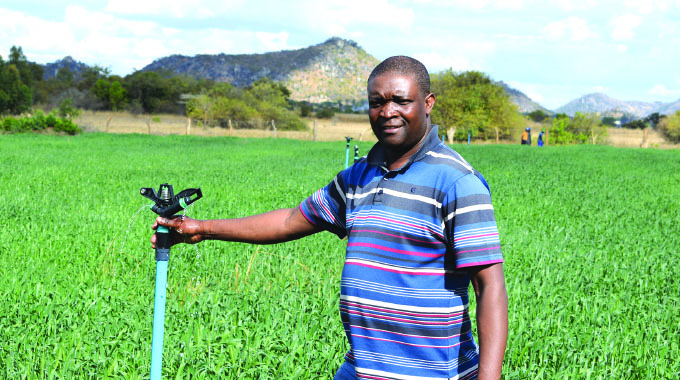
Precious Manomano Herald Reporter
The condition of winter wheat crop is satisfactory countrywide, with the Government urging farmers to employ good agronomic practices to enhance productivity.
In all the wheat growing regions, the bulk of the crop is at late vegetative stage, early booting stage and booting stages and is in good condition. Top dressing fertiliser application for the late planted crop is underway.
This season, Zimbabwe planted wheat on a record 90 192 hectares, just exceeding the target of 90 000ha.
Zimbabwe expects to produce 420 000 tonnes of wheat this year, which is well above the 375 000 tonnes achieved last year and the 360 000 tonnes required for national demand. Last year was the first time self-sufficiency was reached since wheat growing started in 1966.
After last year’s record wheat harvest, another year of more gain should see Zimbabwe achieving modest reserves to cope with any future serious disasters, but with exports now being considered.
Lands, Agriculture, Fisheries, Water and Rural Development Permanent Secretary Dr John Basera, recently indicated that good agronomic practices were the only way to unlock the massive agriculture potential so that the country achieves five tonnes per hectare.
“Good agronomic practices are the only ways to increase productivity so we are now coming back as the bread basket of Southern Africa.
“My team is rolling out seminars on good agronomic practices to enhance crop performance as well as irrigation to enhance productivity. This initiative is underway,” he said.
Dr Basera said 57 percent of the crop was coming from A2, 13 percent A1 and 11 percent from large-scale farmers.
Strong partnerships in the agricultural sector would help boost production and the economy at large, he said, adding that all the successes achieved were a result of partnerships. More partnerships are required to ensure growth and transformation.
This season, the Government was well prepared to support wheat as it was working closely with important stakeholders such as Zesa and Zinwa, to ensure uninterrupted power and water supply for irrigation to handle the largest-ever crop.
Tobacco Farmers Union Trust vice president Mr Edward Dune said timely distribution of inputs and the good rains received, were a positive development for wheat production.
“Farmers are anticipating more than last year’s output. We are looking for a bumper harvest this season,” said Mr Dune.
Zimbabwe Commercial Farmers Union (ZCFU) president Dr Shadreck Makombe said a good harvest was expected this season.
“We have enough water so we encourage our farmers to irrigate 33 mm of water per week. This season is promising, so irrigate wisely and preserve water so that we achieve another bumper wheat harvest,” he said.
A record wheat harvest is expected in Mashonaland West after recording the highest wheat hectarage of 27 000ha from a target of 32 000ha set for the province.
Mashonaland Central Province is the second highest with 15 400ha out of a target of 18 200ha followed by Mashonaland East, with 15 600ha, surpassing its target of 14 000ha.
A farmer at Mema farm in Banket, Mr Cleopas Mhakayakora, recently said this year, they are focusing on improving quality and productivity.
“We are sure that this season we can do it again because electricity and water, which are the major elements in wheat production, are readily available.
“Some of the fertilisers do not respond well to the type of our soils so this year we made an arrangement with experts to prepare fertilisers that suit our soils. Our crop has changed and we are hoping that this year we can produce between 6 to 7 tonnes per hectare,” he said.
Another farmer, Mrs Rudo Makoni of Makonde, said veld fire and quelea birds were the other threats to wheat production, but said if control measures were implemented and strengthened, a bumper harvest was likely to be achieved.
“We are happy that so far, no serious power cuts are taking place so we appeal to authorities to implement measures that will control veld fires and quelea birds because these are the only menace that we are afraid of,” she said.
Government has been targeting increases in wheat production to meet the national requirement in line with the Agriculture and Food Systems Transformation Strategy, the Agriculture Recovery Plan and the National Development Strategy 1 and in pursuit of the vision of becoming an empowered and prosperous upper middle income society by 2030.



 Online Reporter