Online Reporter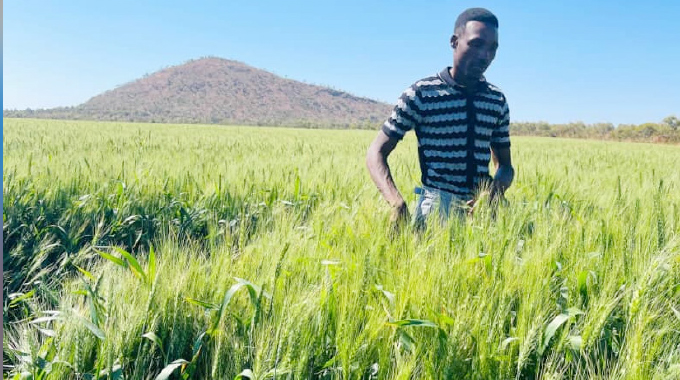
Patrick Chitumba, [email protected]
WHEAT farmers in the Midlands Province are optimistic about a bumper harvest this season, thanks to the consistent availability of water and electricity for irrigation.
The winter wheat crop, spanning over 12 000 hectares, is currently progressing through various critical growth stages, from flowering to grain-filling.
The province’s major winter wheat production areas include the Sherwood Block and surrounding regions in Kwekwe District, with additional contributions from irrigation schemes in Mberengwa, Lower Gweru, and Shurugwi.
At the forefront of the production drive is DCK Farm in Kwekwe, owned by Douglas and Claris Kwande (DCK Investments), which has planted 600 hectares. According to farm manager Mr Duncan Magaya, the crop is progressing well.
“The crop condition is generally fair to good, and the wheat is at late vegetative, booting, and heading stages. We are anticipating a bumper harvest because we have both Zesa and sufficient water for irrigation,” he said.
Another major contributor is Precabe Farm, owned by the First Family, which has also planted over 600 hectares under winter wheat.
Much of the winter wheat crop in the province has been financed through the Government-guaranteed CBZ Agro-Yield Programme, with additional support from private contractors and the Presidential Winter Wheat Scheme.
The country is targeting a record harvest of 600 000 metric tonnes this season, as part of its broader agricultural transformation strategy, which includes mechanisation, input support, and climate-smart farming.
Midlands Provincial Director for Agricultural Rural Development and Advisory Services (Ardas), Ms Busiso Mavankeni, confirmed that 2025 has so far been a successful season for winter wheat growers.
“Generally, from Kwekwe’s Sherwood Block — where most of the wheat is grown — to other areas across the Midlands Province, the winter wheat crop is looking healthy, and we are anticipating a bumper harvest,” she said.
Ms Mavankeni also noted that the Government has intensified efforts to combat quelea birds, which are notorious for damaging cereal crops.
Drones and motorised sprayers have been deployed, and extension officers are actively locating roosting sites for mass spraying by the Migratory Pests Unit.
“The chemical recommended for quelea bird control is fenthion, and we have it in supply. Farmers are also encouraged to use traps such as mass trapping and nets to capture the birds,” she said.
Ms Mavankeni urged farmers to remain vigilant against weeds, pests, and diseases. She advised the use of post-emergence herbicides and weekly scouting for armyworms, aphids, and rust diseases.
“In terms of irrigation and water management, farmers are urged to maintain soil moisture. Irrigation scheduling should be based on temperature and moisture loss at each specific farm, with general guidance to irrigate every 10 to 14 days,” she said.
Seedco sales agronomist Mr Ronnie Chigombe said the crop across the country is looking promising.
“The wheat crop is looking healthy nationwide. Well done to farmers for adhering to good agronomic practices as advised by Agritex officers. Farmers should continue scouting for pests and diseases and apply control measures when necessary to achieve the desired yields. Maintaining irrigation schedules is key to ensuring the crop reaches its full potential,” he said.
Permanent Secretary in the Ministry of Lands, Agriculture, Fisheries, Water and Rural Development, Professor Obert Jiri, recently reaffirmed the Government’s preparedness to protect the crop from pests, particularly quelea birds, emphasising that timely intervention is crucial to safeguard the impressive progress made so far.
To boost service delivery, President Mnangagwa recently equipped Agritex officers with new vehicles, enabling them to better support farmers across the country.