admin
admin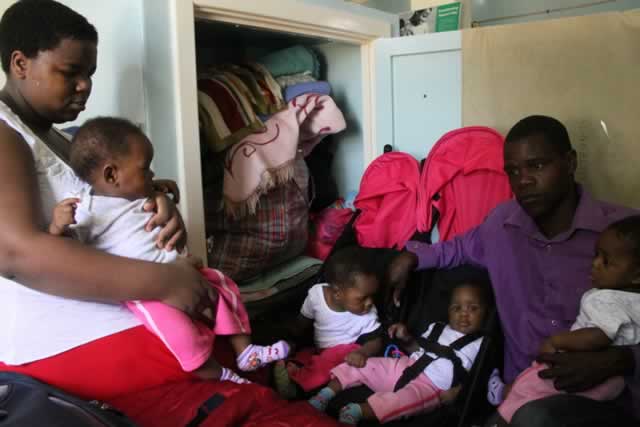
Abigail Mawonde and Ruth Chipayi Feature Writers
Alice Mutasa, a Harare mother who hogged the limelight last year after giving birth to quadruplets, is a soldier without a sword.
She has had to endure nine months at Harare Central Hospital looking after her quad0ruplets, even though they are all healthy and do not require much medical attention.
She does not remember the last time she cooked her favourite dishes at home, freely interacted with relatives and friends, went to church with others, was intimate with her husband, took care of her son and most importantly lived together as family like it was in the past.
In a normal situation in Zimbabwe, the birth of a child is met with much celebration, but Alice and her husband Misheck Mutasa were left tense and worried about the quadruplets.
The couple has been struggling to make ends meet.
“I do not know how we will bring up our four children. I don’t have a job. Whatever my husband earned as a vendor was never enough to look even after the daily expenses of both of us. Now we have the burden of these children,” Alice says.
A burden, she calls them yet she loves her four little princesses dearly.
Her husband is a vegetable vendor at Mbare Musika and gets an average of $10 on a good day and next to nothing when business is low.
“We live in a tiny room in Mbare. We can’t afford to rent a bigger place for the healthy upbringing of our four children,” Alice says.
“Renting in a bigger and spacious home will leave us with hardly any cash for our daily expenses.
“It will be a difficult job to bring them up.”
Her first born child, Takudzwa aged four, has been living without motherly guidance for months as Alice is devoting most of her time to taking care of the quadruplets.
“It is almost nine months since I have been here. Every day I look forward to going home to take care of my son who is four-years-old.
“For nine months I have not seen him and it pains me. I am depriving him of motherly love,” says Alice.
“No one is taking care of our son as my husband is always at Mbare Musika selling vegetables to raise money for the upkeep of the family. This pains me a lot.”
The quadruplets — Charlene, Charnel, Chantelle and Charmaine were born through normal delivery on May 19, last year at Harare Central Hospital weighing 2,5kg, 2,3kg, 2,1kg and 1,6kg respectively.
However, the quadruplets are still living in a Harare Central Hospital ward after health officials condemned their one roomed rented accommodation in Mbare as not conducive for the babies.
The Herald visited the hospital recently to get first hand information regarding the upkeep of the children.
We also visited the tiny one room the couple calls home in Mbare.
The babies looked very stable and healthy, thanks to Harare Central Hospital’s hospitality. The hospital has waived the bill for the family.
Alice has not walked alone. Well-wishers have come in handy, donating pampers, clothes, porridge and milk formula among other things.
Her husband is desperate for a job to help him feed his family.
“I went to school up to Grade 6 and dropped out due to lack of funds. My wife is also a school dropout for the same reasons,” he says.
“I am desperately looking for a job, any job, even if it means working in tobacco barns or sweeping the streets.”
For almost nine months, the toddlers have not experienced life outside hospital.
They have reached the crawling stage and for now their life revolves within the confines of a hospital ward.
Fatigue has crept in and hospital life has become unbearable for Alice.
“I can’t wait for the day I will be able to get out with my four children,” she says.
“A hospital is not a conducive environment for the growth of children as you see many children with various ailments dying and some living with unbearable conditions.”
Despite the confined life, Alice is at least grateful for the support she has received from well-wishers and the hospital.
“This, at least has eased some of the family’s financial burden,” she says.
“I am happy. The hospital has been very kind and staff here have been very supportive.”
Without the hospital’s gesture, the quadruplets could have joined the growing list of children who die under the age of five due to poverty and other diseases.
Many children die during delivery from various complications. But the Harare Central Hospital team of doctors has at least ensured that the quadruplets remained in good health for nine months.
Alice is optimistic, though, that one day, she and her husband will develop a stand they were allocated by the Ministry of Local Government, Public Works and National Housing in Stoneridge Park, in Waterfalls.
“I hope we will one day build a house and be able to raise our children there,” she says.
“I look to God for guidance.”
Harare Central Hospital spokesperson Mrs Philisia Mandeya said they were willing to continue accommodating the quadruplets.
“We discharged them from the hospital last year after birth but because they do not have suitable accommodation we decided to keep them until they find space appropriate for the children.
“They are not going to pay the hospital since the children are still under the age of five and this is according to the government regulations,” she said.
Mrs Mandeya added that the children are safer at the hospital.
“In the event of a disease outbreak while in hospital, I can guarantee safety of the children since they are living is an area where we keep other children who we will be monitoring for growth.
“It is an area where they will not be exposed to any disease as it is always clean for the sake of children’s hygiene,” she said.
And, it seems while the birth of quadruplets creates buzz in the media, it brings untold hardships and worry among the mothers.
Poverty, emotional strain and other challenges can be a nightmare for mothers giving birth to quadruplets.
But Alice seems to be soldiering on. With each daybreak, she hopes that one day they will leave hospital, enjoy her conjugal rights and take care of all her five children and husband.



 Online Reporter