Zambia has just emerged from another electoral cycle, which saw the incumbent, Hakainde Hichilema, extend his stay in office by another five years.
After notching a convincing and impressive 61 percent share of the vote, compared to his closest challenger Brian Mundubile, who only managed to garner 38 percent, this should be a triumphant and celebratory moment for Hichilema and his United Party for National Development.
Yet, it is anything but.
The script, as it is often wont to do in a climate of brutal and bristling political contestation, has taken a darker turn.
Zambian police have since invited Mundubile, who has gone into hiding, for a “cup of coffee”, amid reports he might be charged with treason. Kikikiki.
Eleven opposition figures have also been arrested, while a former Cabinet minister, Mutotwe Kafwaya, was shot and killed on opposition premises on August 14.
The United Nations High Commissioner for Human Rights has even issued a statement expressing grave concern over arbitrary arrests in the aftermath of the polls.
This is just half the story.
In typical mischief that has often characterised opposition politics, no sooner had the last vote been cast than Mundubile publicly announced that his party (National Reconciliation Party for Unity and Prosperity)’s tallies purportedly showed that he had won the election.
The suspension of vote counting by the Electoral Commission of Zambia ostensibly over concerns with violence and “theft of marked ballot papers in ballot boxes” did not help matters as it fed into conspiracy theories that the authorities were buying time to cook the figures and engineer a victory for the incumbent.
Taken together, all this intrigue is the kind of stuff that makes even the most seasoned observer reach for a stiff drink.
It will taint and stain what otherwise was a relatively peaceful election and have the adverse impact of raining on Hichilema’s parade.
So, here was an election that international observers described as largely peaceful and produced a clear winner with a comfortable margin.
Yet within days, the country descended into post-election acrimony, with opposition figures in hiding, arrests being made and the entire democratic process threatening to unravel.
It is quite clear that the election did not resolve tensions but amplified them.
Rivalry beyond the grave
But the history goes deeper.
The Chiluba-Kaunda confrontation of the late 1990s, which saw the former detain his predecessor and founding president, only to relent after Julius Nyerere mediated, is instructive.
And still fresh in our minds is the Lungu and Hichilema heated political duel.
The feud began when Hichilema was still in the opposition while Lungu was president and persisted when the roles were reversed.
And it seems that even in death Lungu is still not willing to make peace with his successor.
His body still remains “exiled” and unburied in South Africa a year after he passed away following a prolonged legal dispute between the Zambian government and his family over his final resting place.
All these are symptoms of a political culture where elections are treated as winner-take-all contests in which the victor may pursue their opponents with the zeal of a prosecutor rather than the magnanimity of a statesman.
But one does not need to be a rocket scientist to recognise this pattern.
It is the same script that has played out across the continent, and even beyond, from Lagos to Nairobi, from Harare to Lusaka.
The mechanics may vary — different actors, different stages — but the tragedy remains remarkably consistent.
Nigeria’s 2023 election, for example, was hijacked by hate speech so pervasive that social media became less a platform for debate and more a megaphone for division.
Ethnic jabs, religious slurs and political threats transformed what could have been a contest of ideas into a tribal battlefield.
Voters were urged to think not with their conscience but with their creed.
Ominously, in Kenya, civil society groups have sounded the alarm about identity politics threatening to polarise communities ahead of the 2027 elections, warning that political discourse has shifted dangerously away from development issues towards personality-driven and ethnic-aligned narratives. History, we are reminded, has a cruel habit of repeating itself — the ghost of the 2007 violence still haunts the Kenyan political landscape.
Zimbabweans know this pattern all too well. At the turn of the millennium, the emergence of the Movement for Democratic Change (MDC) — which was funded by white former commercial farmers and some Western countries that were desperate to forestall the then-nascent Fast-Track Land Reform Programme — marked the beginning of some of the heady days in local politics.
Far from being healthy contestation, the adversarial politics created a wedge that was conveniently exploited by the West.
Unfortunately, this opened the door for the debilitating sanctions that have plagued Zimbabwe for nearly three decades as well as the country’s international isolation.
An era of rapprochement
However, the advent of the Second Republic led by President ED has engendered a refreshing era of rapprochement, both at home and abroad.
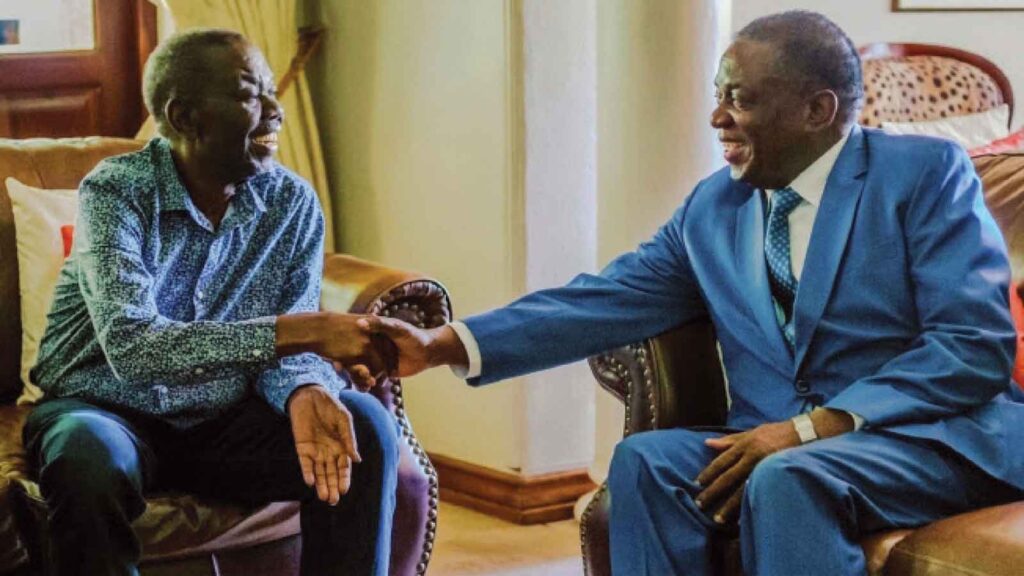
The soothing image on January 5, 2018 of ED visiting the ailing MDC leader Morgan Tsvangirai at his Harare house will forever tug at the heartstrings of everyone who was lucky enough to witness the political spectacle.
Against the bleak backdrop of bitter rivalries and post-election convulsions, ED has ushered in a refreshing — and, to the cynics, utterly confounding — era of political rapprochement.
Since assuming the reins of power in 2017, he has consistently demonstrated a willingness to work across the political aisle for the good of the nation.
In his inauguration speech, he called for unity and tolerance, urging Zimbabweans to discard the toxic politics of the past and find strength in their diversity.
This has been a guiding principle of the Second Republic.
We saw it in the establishment of the Political Actors Dialogue (Polad) in 2018, a platform created to foster dialogue among all political parties, allowing them to contribute to policy formulation and lobby the Government on national issues.
We also saw it when he recently hosted legislators from both ZANU PF and the main opposition CCC at his Pricabe Farm.
We saw it last week when so-called opposition members were breathing through the wound following the appointment of Brilliant Dube — a former opposition member — as one of the new 10 senators by the President.
So, if Brilliant is as brilliant as they previously made us believe, what stops the President from deploying her to a non-political role to serve her country.
Does it mean national appointments should be parochially dictated along party lines?
This would be a tacit approval of “cadre deployment”.
It is clearly through this gesture that ED has insidiously cultivated a productive political environment of bipartisan cross-party support.
All told, the political architecture of the Second Republic, as envisioned by its leadership, is not about crushing dissent but about channelling it into productive governance.
It is about detoxifying our politics so that we can focus on what truly matters: building a prosperous, united and developed Zimbabwe.
The Good Book has a lot to say about this kind of statesmanship.
The Book of Proverbs, that wellspring of earthly wisdom, counsels us: “When a man’s ways please the Lord, he maketh even his enemies to be at peace with him” (Proverbs 16:7).
Solomon, the wisest king who ever lived, understood the dangers of constant political turbulence. In Ecclesiastes, he observed: “To everything there is a season, and a time to every purpose under the heaven” (Ecclesiastes 3:1).
And let us not forget the words of the Psalmist: “Behold, how good and how pleasant it is for brethren to dwell together in unity!” (Psalm 133:1).
Isaiah 1:18 adds: “Come now, and let us reason together, saith the Lord.”
This is the spirit of the Second Republic —a willingness to reason, to engage, to build and to heal.
Future-proofing our politics
In its wisdom, the current political leadership has since enacted a set of governance reforms — the Constitutional Amendment Act No. 3 — that have been met with the predictable chorus of criticism from those who seem to believe that the only legitimate form of democracy is the one that keeps them perpetually in campaign mode.
In essence, the amendments extend presidential and parliamentary terms from five to seven years and replace direct presidential elections with a parliamentary electoral college system.
Now, Bishop Lazi is under no illusion that any constitutional arrangement, no matter how elegantly crafted, is a panacea for political dysfunction.
However, elections, as a prescribed cure, have all too often proven to be the disease.
The recent Zambian experience reminds us that, however well-conducted, elections cannot in themselves heal a divided society.
The social fabric is torn not by the mechanics of voting but by the deeper fractures of ethnicity, inequality and mistrust.
As Zimbabweans, we have taken this bold step towards reforming our governance structures.
But we must be clear-eyed about the challenges ahead and build institutions that can withstand the pressure of political competition and cultivate a political culture that values ideas over identity.
The “new politics” is here to stay, and it offers our nation a path away from the destructive cycles that have plagued our continent for too long.
Bishop out!