admin
admin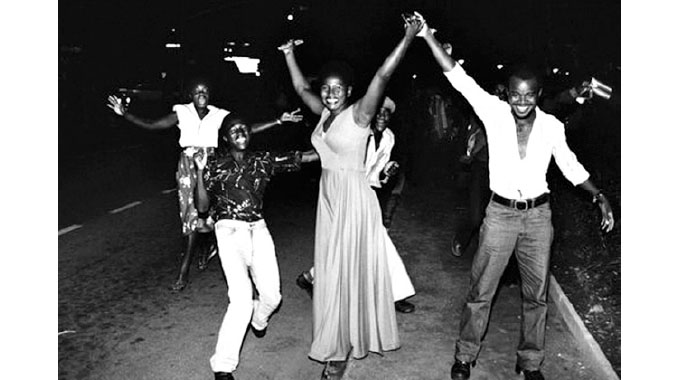
Isdore Guvamombe-Assistant Editor
Back in the village, in the proverbial lands of milk, honey and dust or Guruve, the dough of Zimbabwe was baking in the high ovens of life.
As the night slipped away on April 17 1980, a cross rhythm of drumbeats rose in tempo to a crescendo, serenading everything to a throbbing end of an era.
The drummers smacked the rhythm out of the cattle hides that topped the drums, the resultant sounds serenading the night into Zimbabwe. It was a befitting departure from felon Rhodesia.
The village was a live as a huge fire lit the yard and it had two more purposes. It warmed the place and indeed disciplined the drums, for, each drum that misbehaved and made a discord was taken to the fire where it was given a zealous hot lick, until it tuned its vocal chords correct.
Elders with cotton tuft hair sat around a bonfire, intermittently leaving their stools, to participate in the dance and song. Each time one of the elders partook that stunt, the crowd cheered in awe, for, it is a rare spectacle to see autochthones in deft footwork.
Karitundundu, the ageless village oracle of knowledge and wisdom sat in spectral gait, his figure bringing to the celebrations something gothic, ancient and yet painting everything with an aura of something languid, eerie and profound.
There, the oracle fed his nostrils with snuff from a pouch. He deftly tilted the pouch to drop a measured amount of the snuff into the palm, then hoisted his hand into the nose, snorted it in and frowned systematically to let the snuff find its way into the channels.
He tilted his head and aligned it sideways as if to allow every part of his body receive the snuff. Feel the spread! His dreadlocked hair, the vanguard of his spiritualism, gave him a fears look.
Karitundundu then took it upon himself to explain the pain the black people had gone through Rhodesia from the onset of colonialism.
Being an oracle that normally did not speak, everyone turned to hear. He spoke with a soft, calculated and authoritative voice.
The ire seemed to die down and he tried to raise it up by knocking together the firewood. Embarrassed, his juniors, quickly moved in to sort the fire. Then the flame came up, lighting up faces but casting shadows into the darkness behind.
“The darkness behind us is like Rhodesia,” started the oracle. “The brightness in your faces is Zimbabwe. It is the future,” he proceeded and gave a long lecture.
The villagers had gotten tired of the war of liberation. Although the war had become a necessity, it had taken too long. Their eyes had seen too many battles. Their eyes had seen too many dead bodies. Their ears had taken in each gun sound with trepidation.
The timbre of life had changed. Its meaning had changed too. Death was a second away each time.

Rhodesia had been a bad place to live for the black people. The white minority had made it so hard for the black person to live in happiness, every day. Every day, black people came across things that reminded them that they were second class citizens.
In Rhodesia, the white people had made it so hard for black people to remain dignified. The white man’s dogs and cats took precedence over black people.
All the prime farming land had been forcibly taken away from black people and bequeathed to white people, acre upon acre.
The black people had been forced to arid land and had their livestock numbers limited. Even that arid land too was limited.
The white man had subsequently legitimised his theft of cattle and land through legislation. The Land Apportionment Act and the Animal Husbandry Act, were horrible laws that extinguished the fire of black survival.
Karitundundu continued by narrating the forced construction of contour ridges and the cheap labour black people provided to the white man’s farm, forcibly.
Meanwhile the villagers outside the council of elders ululated and danced in the circle at the centre of the homestead. Zimbabwe had been born.
Villagers danced and raised the dust. Their bodies needed to shake off the dark memories of Rhodesia. They sweated it out through bump-jive, kongonya and chamusasura dances.
There was deft footwork, body shaking and waist-wriggling.
At mid night no one went home. It was as if it was sunrise. The dancing and feasting continued.
The night continued slipping away and so did the dances and partying continue until sunrise.
In the aftermath of the celebrations, the grounds had nothing but dust and gnawed bones, empty and half-empty bottles and the villagers were seen snoring in various corners and postures.
Some members overcome by drink and fatigue, sprawled in various corners, for in Rhodesia all they had enjoyed was forced labour, dehumanising treatment and suffering.
Now, 42 years after independence, Zimbabweans in their broad totality should pour out of their shells and celebrate our nationhood, more so, after successfully implementing the land reform programme and indigenisation, policies that are taking the people’s revolution to its logical conclusion.
If mere independence sent villagers into frenzy why should the success stories of indigenisation, empowerment and land reform not send us mad as well?
This villager wishes every Zimbabwean good health and excellent independence celebrations. Let us enjoy the peace prevailing in our country and pray for those who have lost their moral compasses.
To those brothers and sisters who have been captured by neo-colonialists and are fighting hard to bring down Zimbabwe, the time is now to get back to basics.
To those who back the illegal sanctions, it is not too hard to remember that this country was fought for and many people died for this country.
Some have been reburied, some are yet to be buried. But the country is for us to enjoy.
Long live Zimbabwe. Long live the villagers. Long live our independence and long live everyone!


 Online Reporter