

 Online Reporter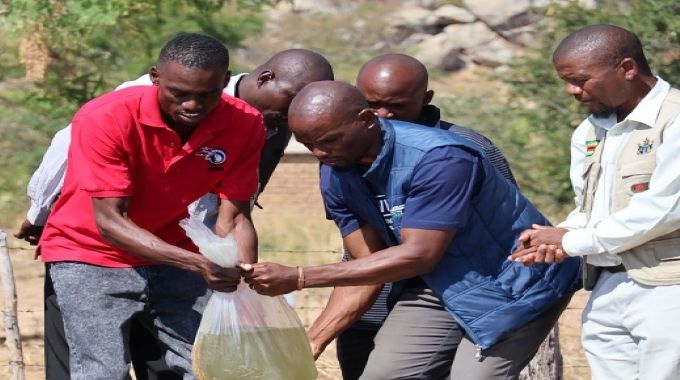
Theseus Shambare [email protected]
Mr Emmanuel Charehwa stands at the edge of a newly stocked fish pond, watching 2 000 fingerlings scatter into the depths like silver threads unravelling into a new kind of future.
The morning stillness is broken not by the sound of ploughs or cattle, but by water moving gently beneath the surface of the fish pond.
For years, his farming life followed the familiar rhythm of Zimbabwe’s smallholder agriculture — wait for rain, plant maize or small grains, pray for a good season, and hope the harvest would carry the family forward.
But that rhythm has been broken.
“I used to depend on rainfall and small grains,” he says quietly.
“But climate change has changed everything. We were taught how to use underground water for fish farming, and now I see farming differently.”
What is unfolding in Mudzi District where Mr Charehwa farms is no longer an isolated rural experiment.
It is part of a national shift — a redefinition of agriculture itself under Zimbabwe’s expanding Blue Economy agenda, where water, not rainfall, is becoming the new foundation of rural livelihoods.
Across Mudzi District, the numbers already tell a story of rapid adoption.
Under the Presidential Community Fisheries Scheme, 94 fish ponds have been established, 32 000 fingerlings stocked, and 3,6 tonnes of fish harvested since the beginning of the year.
Farmer participation has grown from 43 to 71 farmers, signalling a steady shift from subsistence dependency to aquaculture-based enterprise.
Director of Livestock and Fisheries Production in the Ministry of Agriculture, Mechanisation and Water Resources
Development, Mr Milton Makumbe said this is part of a deliberate national strategy to reposition fisheries as a pillar of rural transformation.
“Aquaculture is becoming a key component of Zimbabwe’s Blue Economy framework,” he said.
“We are building resilience, nutrition security and income generation through fish production.”
The programme provides free fingerlings, technical training, pond construction support, and where possible, borehole drilling — an essential intervention in drought-prone regions where surface water has become unreliable.
Beyond Mudzi, Government is now scaling the model nationwide — including Matabeleland North and South, where climate conditions are increasingly being seen not as a limitation, but an opportunity.
In Hwange District, Agriculture, Mechanisation and Water Resources Development Deputy Minister Davis Marapira recently urged farmers to embrace aquaculture as a survival strategy in the face of climate change and recurring El
Niño-induced droughts.
“Food security does not necessarily mean grain production only,” he said.
“It means having an uninterrupted source of income to buy food. Fish farming is ideal for dry regions where heat units support rapid fish growth.”
His remarks reflect a growing policy consensus: Zimbabwe’s driest regions may in fact be its most suitable zones for intensive tilapia production.
In these areas, boreholes drilled under Government programmes are becoming the backbone of a new agricultural model — one that decouples production from rainfall entirely.
The Science behind the shift
The policy shift is backed by scientific evidence.
Research on Nile tilapia (Oreochromis niloticus) shows that water temperatures between 26°C and 30°C significantly improve growth rates and feed conversion efficiency.
Studies by Nehemia and Azaza (2008) found that juveniles raised within this temperature range achieved higher final weights and faster daily growth compared to cooler environments.
In practical terms, Zimbabwe’s hotter, semi-arid regions — including Mudzi and Matabeleland — naturally provide conditions that reduce production costs and shorten growth cycles, allowing fish to reach market size in as little as six months.
For farmers, this is not just science.
It is profit.
The transformation is visible in Hwange District where Mr Michael Padiwa and his wife Constance have become early adopters of intensive aquaculture.
After drilling a 60-metre borehole, the couple established five fish ponds measuring 20 by 10 metres each.
With free fingerlings supplied under the scheme, their first harvest produced tilapia averaging 400 grammes per fish.
With market prices ranging between US$2,50 and US$4 per kilogramme, aquaculture is already proving to be a strong income generator in regions once considered agriculturally marginal.
Their story mirrors a wider regional trend — one where rural households are shifting from vulnerability to structured production systems supported by Government and development partners.
Zimbabwe’s aquaculture expansion is being strengthened by the PROFISHBLUE Programme (Programme for
Improving Fisheries Governance and Blue Economy Trade Corridors) — a US$10,1 million SADC and African
Development Bank-supported initiative.
The programme is transforming not just production, but the entire fisheries value chain.
Key interventions include cold-chain infrastructure, comprising refrigerated fish trucks handed over to producers to reduce post-harvest losses, Vessel Monitoring Systems (VMS) to combat illegal, unreported and unregulated fishing and development of a Lake Kariba Blue Economy Strategy and Investment Plan, in partnership with FAO, regional trade harmonisation, easing cross-border movement of fish products.
These interventions are ensuring that fish produced in places like Mudzi, Hwange and Chinhoyi can now reach urban and regional markets without spoilage.
A refrigerated truck recently delivered under the programme, alongside plans for ice-making machines, is already changing how smallholder producers access markets.
For many farmers, this is the missing link — production without preservation previously meant lost income.
The impact of aquaculture is not only economic.
It is also social and generational.
In Shinga Ward 4 back in Mudzi and other emerging aquaculture clusters, young people are returning to rural areas, reversing years of urban migration.
“I used to dream of Harare,” said 27-year-old Ernest Kirimi.
“Now I earn more here from fish and crops and I am building something sustainable.”
His story reflects a broader shift: rural areas are no longer being seen solely as zones of survival, but as spaces of opportunity.
Integrated systems — combining fish farming, horticulture, poultry, solar energy and organic fertilisers — are creating circular rural economies that reduce dependency on external inputs.
Meanwhile, Mr Charehwa’s pond has become more than infrastructure.
It is a learning site, a business unit and a symbol of transition.
Government technicians like Fisheries and Aquaculture expert Mr Thomas Bester continue to guide farmers through every stage — from pond siting to fingerling acclimatisation and feeding regimes.
“A fish pond is a long-term investment,” Mr Bester explained.
“Proper management determines survival and profitability.”
The message is consistent across districts: aquaculture is not a backup plan — it is a structured production system.
Development experts say Zimbabwe’s model is beginning to attract regional attention.
Dr Alexander Kefi, project manager for the PROFISHBLUE Programme describes it as a blueprint for Southern Africa.
“Communities that invest in climate-smart aquaculture are not just feeding themselves,” he said.
“They are contributing to regional food systems and trade corridors.”
From Lake Kariba’s investment planning framework to SADC-led cold-chain logistics reforms, the region is gradually aligning around a shared Blue Economy vision.
As the sun sets over Mudzi, fish ponds shimmer in fading light.
Children play near the water.
Goats graze nearby.
Farmers check feeding schedules instead of weather forecasts.
Where drought once dictated survival, adaptation now defines it.
And in both Mudzi and Hwange — in ponds carved into dry soil and boreholes drilled deep into the earth — a quiet transformation is underway.
Zimbabwe’s rural future is no longer waiting for rain.
It is growing in water.


