Chronicle Editor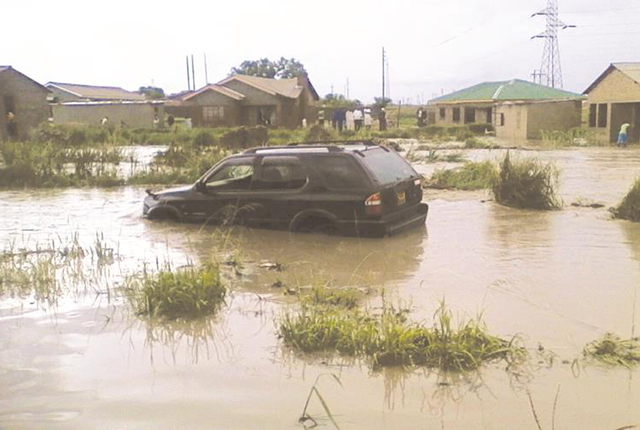
Sydney Kawadza Senior Features Writer—
There are times when consequences of stoicism and stubbornness become dire for human beings. A Mutare family lost a child recently when a house built on a wetland collapsed due to flooding.Authorities have battled for years to stop people from invading wetlands for residential purposes, with the pleas falling on deaf ears.
The results are there for people to see.
Besides bearing exorbitant costs of building on a wetland, many households in Harare and Chitungwiza face a continuous flood threat.
This could have been avoided.
Besides the Mutare mishap, there are residents who have sleepless nights when it rains.
While others are celebrating, these stubborn residents curse the heavy rains, as they face the consequence of their defiance.
Local government practitioner Mr Percy Toriro said people who have built on wetlands are risking the environment as well as their lives and properties.
He strongly condemned the practice of building houses on wetlands.
“Developments on wetlands are not only an ecological hazard, they are very costly to undertake.
“It is for these two important reasons that people would be discouraged from selling or buying stands on wetlands unless an Environmental Impact Assessment (EIA) has been completed with appropriate measures taken to manage the impact of the development, and are approved by relevant authorities.”
He said, technically, developing on a wetland means one needs a reinforced or special foundation.
“This foundation does not come cheap as it may include lots of steel and concrete as well as the need for a structural engineer to supervise the construction,” Mr Toriro said.
Home seekers who buy residential stands on wetlands need advice regarding how to sustainably develop therein.
“Where it is still possible, it may be cheaper and more sustainable to relocate such beneficiaries to more appropriate sites.”
Emerging architect Beshine Rondozai concurred saying building on wetlands increases construction costs.
“The moment one accepts a stand on a wetland they should know that they have exposed themselves to spending more on building the foundation using water resistant materials, which are usually costly.
“Building on wetlands affects the natural flow of water systems by blocking the water passages and the dependent ecosystems
“However, it seems as if in Zimbabwe special permission is granted to the development of residential flats on wetlands as the construction costs are more economical,” he said.
Rondozai noted the challenges faced when houses are built on wetlands.
“Wetlands reduce the risk of flooding and we have come across areas that can no longer sustain heavy rains.
“I would urge authorities to move those people before disaster strikes,” he said.
According to the US Environmental Protection Agency wetlands are transitional zones between uplands and deeper water, unique ecosystems characterised by their hydrology, soils and vegetation.
The wetlands function like natural tubs, storing flood waters that overflow riverbanks and surface water that collects in digressional areas.
The EPA furthers states that in this way, wetlands can help protect adjacent and downstream property from flood damage.
“The effectiveness of wetlands for flood abatement may vary, depending on the size of the area, type and condition of vegetation, slope, location of the wetland in the flood path and the saturation of wetland soils before flooding.
“A one-acre wetland can typically store about a metre of water, or one million gallons.
“Trees and other wetland vegetation help slow the speed of flood waters.
“This action, combined with water storage, can actually lower flood heights and reduce the water’s destructive potential.”
The Environmental Management Act describes wetlands as “areas of marsh, fern, peat-land or water, whether natural or artificial, permanent or temporary, with water that is static or flowing, fresh, brackish or salt, including riparian and adjacent to the wetland”.
The Environment Management Authority, the Act’s regulatory authority, notes that the loss of wetlands translates to loss of fundamental resources and functions they provided.
“Water retention of wetlands is usually affected by compaction and compression of wetland material due to the several human activities on them.”
In Zimbabwe, the progressive loss of wetland ecosystems, according to EMA, has caused detrimental effect to society including water scarcity, water pollution, increased run-off and flash flooding.
EMA spokesperson, Mr Steady Kangata said Zimbabwe has approximately 1 117 wetlands covering 793 348 hectares, which is about 1,5 percent of the country’s land area.
“Six percent of this area in communal and resettlement areas.”
He conceded that wetlands in Harare and Chitungwiza are under threat from infrastructural development such as malls, churches and houses.
In trying to craft good wetland management strategy, he said, EMA conducted a national survey to compile a resources inventory.
“This resulted in the agency coming up with a wetland map of Harare and Chitungwiza to guide the local authorities and developers on the status of the land to avoid ecological sensitive areas such as wetlands.
“Action was (also) taken against several perpetrators of wetlands degradation that included education as well as prosecution,” he said.
Mr Kangata said Chitungwiza and Harare municipalities have appeared before EMA to answer charges on the issuance of development permits on wetlands.
“In 2012, the two local authorities were found guilty on these charges. In 2016, Harare appeared before the EMA board and wetland issues were one of the charges but was set aside because it is still in the administrative courts,” he said.
In pursuit of promoting wise use of wetlands, Mr Kangata said, EMA initiated sustainable wetland management projects for rural communities living and utilising wetlands to accord the wetlands sustainable restoration.
He, however, expressed regret that the wheels of justice have been an albatross in EMA’s efforts to protect the wetlands.
“As EMA, we follow the legal procedure in addressing anomalies whereby we stop further damage, punish the offender for the malpractice and prescribe corrective measures allowing reasonable time that accords even the offenders natural justice for their side to be heard.
“Furthermore, EMA is there to enforce the provisions of an Act of Parliament.
“Some issues end being adjudicated by the courts of law and we abide by the legal procedures of the land.”
Mr Kangata said the fines, a maximum of US$5 000 were not, however, deterrent enough to local authorities and institutions.
“Amendments are at an advanced stage to the inclusion of the corporate veil in the laws so that heads of institutions are held accountable both in their institutional and personal capacities,” he said.
Harare City Council acting corporate communications manager Mr Michael Chideme said the local authority was working on removing structures built on wetlands.
“We recognise that wetlands were not ideal for construction projects and we have given enough notice for people to move off.
“The rains are upon us and we expect people who would have constructed houses on wetlands to have moved off the land or else council will assist in pulling down the structures,” he said.
Mr Chideme said council appreciated the importance of wetlands and their important role the purification of the water system.
Chitungwiza Mayor Mr Phillip Mutoti acknowledged flooding problems in the dormitory town.
He said floods where mainly experienced in Unit L, Zengeza 4 and St Mary’s suburbs.
“There are many places being affected by the floods especially the houses built on clandestinely distributed land.
“We are going to receive a comprehensive report from the engineer so that we can come up with a lasting resolution,” he said.
Mr Mutoti said people had already build houses on the wetlands and would be difficult to remove them.
“What we need is to come up with a comprehensive solution because the houses have also blocked drainage systems running through the wetlands,” he said.
Meanwhile, a group of environmentalists in Mabvuku have taken an initiative to protect the Donnybrook Catchment Area wetlands in their area.
Members of the group, Environment Action Group, have been overseeing the wetland since the early 2000’s and encouraging others to maintain the land in its pristine state
Environment Africa trained the group on best agricultural practices and protecting the wetland.
The organisation’s communications officer, Mrs Sandra Gobvu, said construction activities were not endangering the wetlands but putting residents at risk.
She appealed to authorities to stop construction projects on wetlands.
“Incidents of flooding have been increasing and the destruction of wetlands has contributed the problem,” she said.
The Donnybrook catchment area was once a thriving forest with wildlife and fruit.
“The wetland has provided a source of water for Mabvuku residents who for more than five years have lived with water shortages.
“They collect water from the many springs that are in the wetland.”
“As trees were cut down people began to farm in the area growing maize but being careful to maintain the land through practices such as conservation farming.”
The Environment Action Group has initiated a programme of planting trees in the affected area.
“Planting trees is a way of showing people involved in housing construction that they are destroying the wetland.
“By planting trees we are saying these are the rightful things that should be in wetlands, not cement and bricks,” she said.
The group planted vetiver grass to stabilise the soil and protect it against erosion.
Feedback: [email protected]



 Online Reporter