Online Reporter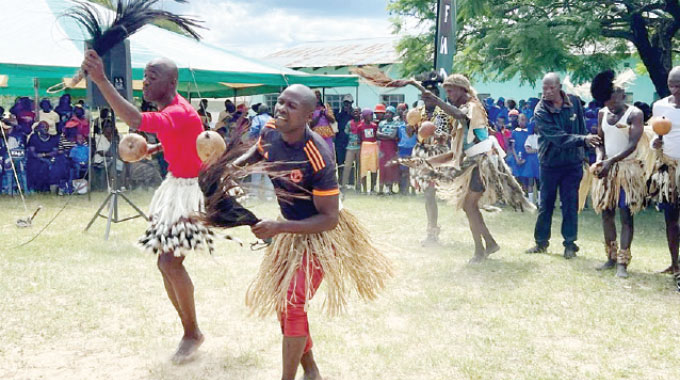
Sukulwenkosi Dube-Matutu, [email protected]
FAR from the reach of busy roads and impatient schedules, in the undulating hills of Silozwane in Matobo District, the air still quivers with a familiar, ancient rhythm. The steady beat of drums and the thunderous clap of stamping feet rise and fall against the landscape, telling a story that has travelled across generations. It is a story inscribed in memory and motion, one of belonging, unity and deep-rooted cultural pride. For the people of Silozwane, the celebrated Amabhiza dance is not something staged briefly and forgotten; it is a living expression of who they are.
Within this community, Amabhiza exists beyond the idea of performance. It breathes, evolves and endures, carefully entrusted to younger hands by elders who understand that culture survives only when it is practised. In a world changing at dizzying speed, the dance has become an anchor, holding the community steady and ensuring that heritage is neither diluted nor abandoned.
At 72, Mr Sofia Ndlovu carries this responsibility with quiet authority. From his homestead in Silozwane Village, his voice slips easily into recollection as he speaks of learning the dance in the 1970s, under the guidance of his father and uncles. They, too, had learnt it the same way — not from books or recordings, but through watching, listening and doing, over time, until the rhythm settled into muscle and memory.
“Now, it is our duty to teach our children and grandchildren. If we don’t pass it on, it disappears,” he said.
As a member of the Velabahleke Bazwedla Group, Mr Ndlovu describes Amabhiza as a force that gathers people together and reminds them of shared purpose. It is a cultural compass, guiding behaviour and reinforcing unity whenever the community comes together.
“This dance helps to bring order in the community, which is why it is also called umaqondisa. We use it to express joy during weddings and other important gatherings. When we dance, we jump high, like calves, showing strength and energy,” he said.
Every performance follows a clear, time-honoured structure. Women take their place behind the drums, their rhythmic precision setting the pulse of the dance, while men respond with powerful, energetic movements — galloping, springing and leaping in unison, bodies rising and falling as one. There is discipline within the exuberance, an unspoken understanding that binds the performers together.
For Ms Kesinathie Mnkandla (62), whose relationship with the drum began in 1972, the dance holds layers of meaning that go far deeper than visual appeal. Each beat speaks to history, belief and identity, reinforcing the link between the living and those who came before.
“This is not just entertainment. This dance is part of who we are. It is even used during rain-making ceremonies. When done properly, it is believed to help bring the rains,” she said.
A member of the Inqama Yophondo group, Ms Mnkandla explains that Amabhiza traces its origins back to the Kalanga people before finding a lasting home in Silozwane. With that history comes a firm commitment to authenticity, a refusal to let the dance be reduced to spectacle without substance.
She insists that preservation means more than memorising movements. It involves instilling values, discipline and respect — lessons woven into every practice and performance.
“We teach our children how to dress, how to behave and how to respect culture. There is a meaning when women beat the drums and men dance,” she said.
This sense of responsibility has pushed the group beyond village boundaries. Working with nearby schools, they introduce children to the dance while they are still young, ensuring that interest is sparked early and carried forward.
For 23-year-old Mr Mehluli Ndlovu, those lessons began long before formal training. As a child, he watched his father and grandfather perform, absorbing the rhythm and pride almost unconsciously.
“I grew up seeing this dance, and now I am proud to be part of it. It keeps us busy as young people and we can even earn an income when visitors come to watch us perform,” he said.
He notes that Amabhiza has increasingly become a cultural attraction for travellers passing through the area, creating opportunities while also strengthening the identity of the youth. More than anything, it has instilled a sense of self-worth firmly rooted in tradition.
“Through this dance, we have learnt to respect our traditions. It is something we will pass on to our children as well,” he said.
Defined by its high-energy, horse-like galloping movements, Amabhiza is a traditional Kalanga dance from Matabeleland South, originally performed during rain-making rituals, meant to appease ancestral spirits. Over time, its role expanded naturally, and today it features prominently at weddings, harvest celebrations and cultural festivals, its significance adapting without losing depth.
Dancers move in precise synchrony to the beat of drums such as the ingungu and the friction drum known as mandobo or mbarure, whose distinctive squeaking sound cuts sharply through the rhythm. Traditional attire — leather skirts, animal-skin hats and leg rattles — completes the spectacle, turning each performance into a vivid expression of history in motion.
Although it is often performed alongside dances like isitshikitsha or muchongoyo, Amabhiza retains a character that is unmistakably its own, defined by how intimately it is woven into daily community life rather than reserved for special stages.
In Silozwane, the dance continues to shift gently with the times while holding firmly to its core. It endures as a bridge between generations, linking past and present through rhythm, movement and a shared understanding that culture lives only when it is carried forward, step by deliberate step. — @DubeMatutu