Online Reporter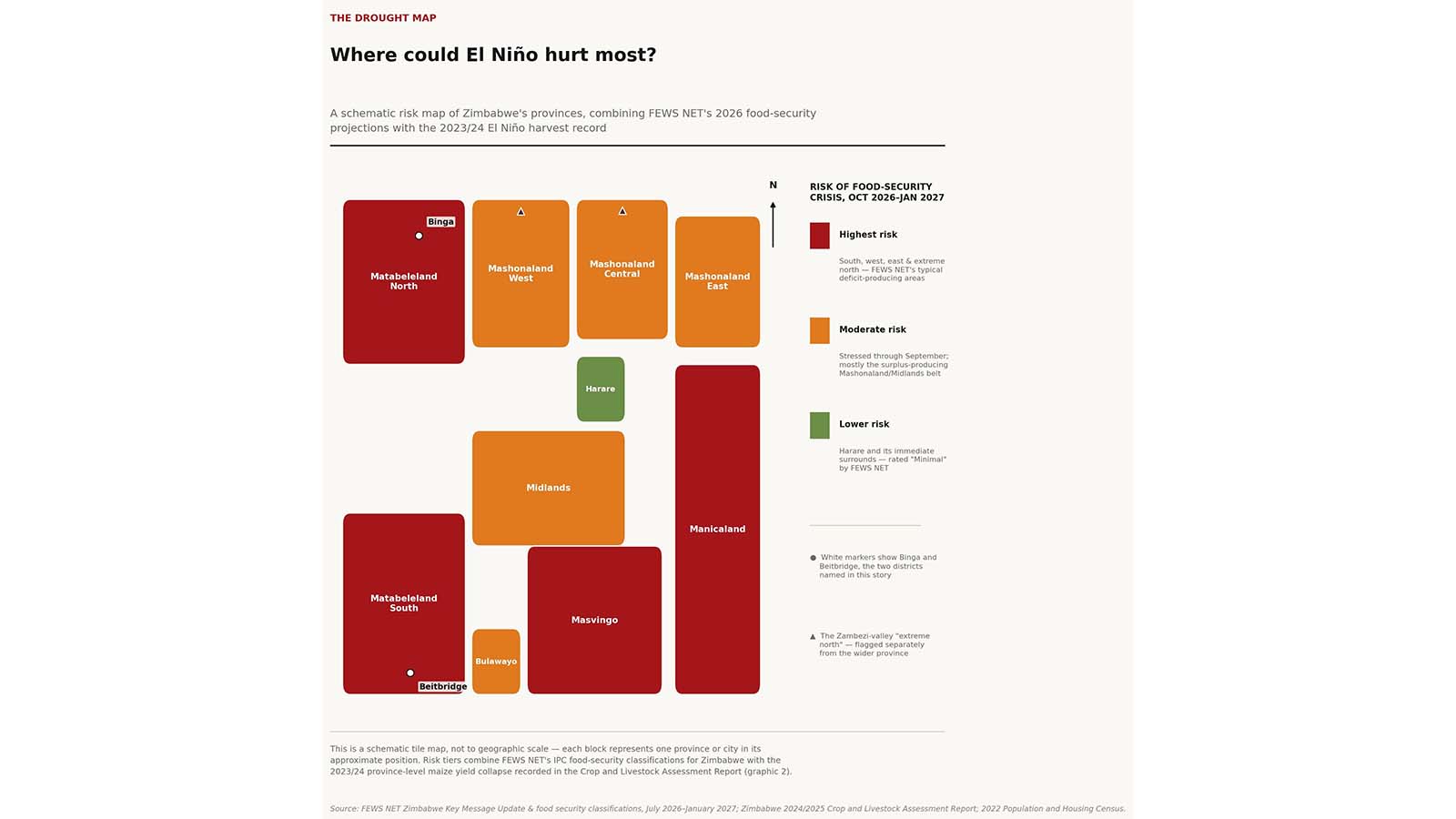
Tawanda Musarurwa
CHECKPOINT DESK
ON June 2, 2026, the World Meteorological Organisation (WMO) put a number on a fear that had been building for months: an 80 percent chance of a strong El Niño forming in the tropical Pacific by August – rising to 90 percent for the rest of the year.
Most forecasting models expect at least a moderate El Niño. Some expect a strong one.
“No two El Niño events are exactly alike,” WMO secretary-general Professor Celeste Saulo said when the update was announced. But for Zimbabwe, the pattern is familiar enough to cause worry.
The country’s farming calendar and food security depend almost entirely on one short rainy season, running from November to March, according to FEWS NET’s latest seasonal calendar for Zimbabwe.
That makes this forecast matter more here than in almost any other country on the continent.
El Niño has historically meant one thing for the country: below-average rain.
Zimbabwe will be affected; the question is how each region will be affected differently.
What the last El Niño did to Zimbabwe’s harvest
The country’s last El Niño season was 2023/24. The Zimbabwe 2024/2025 Crop and Livestock Assessment Report gives a precise, province-by-province account of the damage.
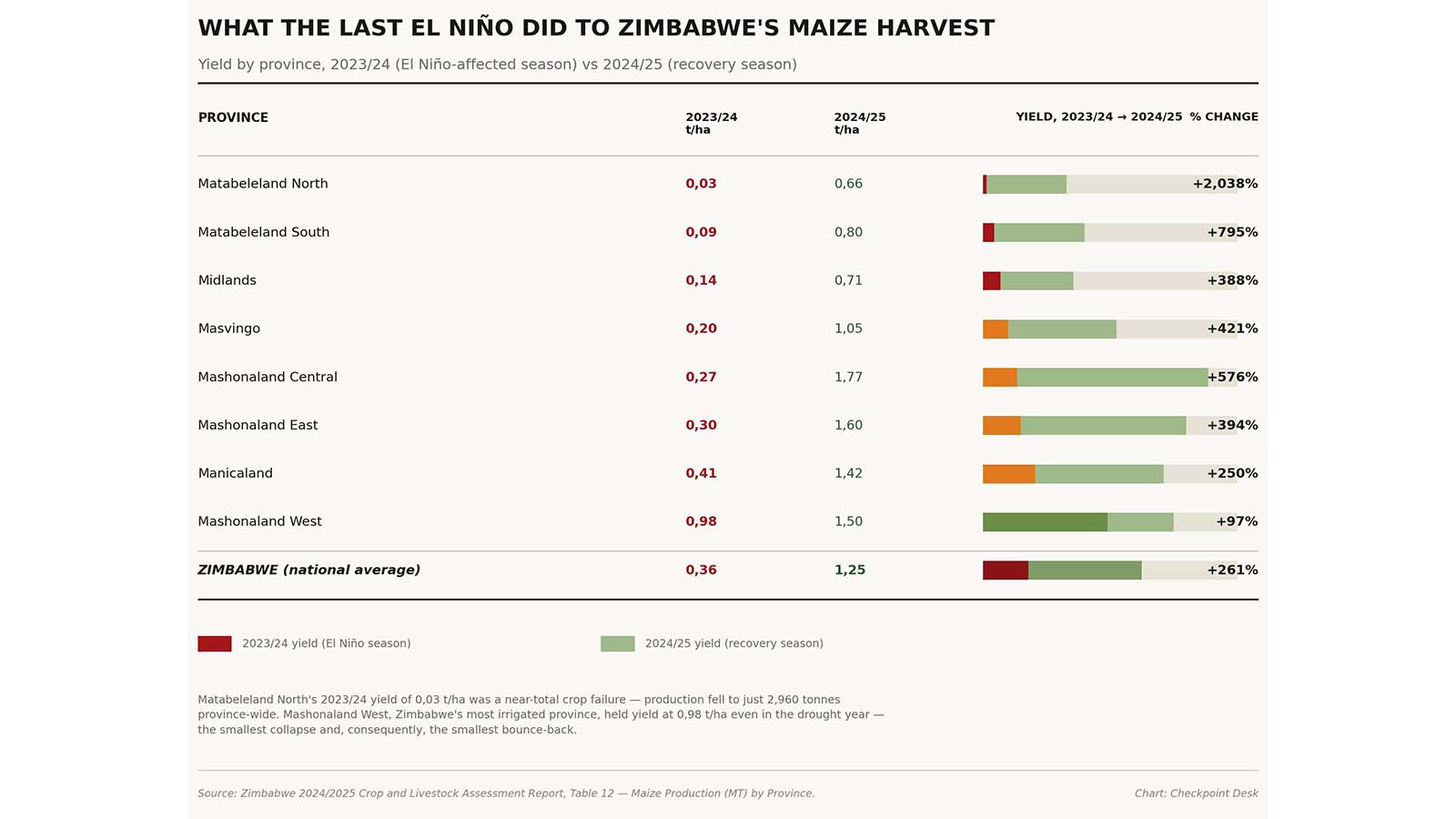
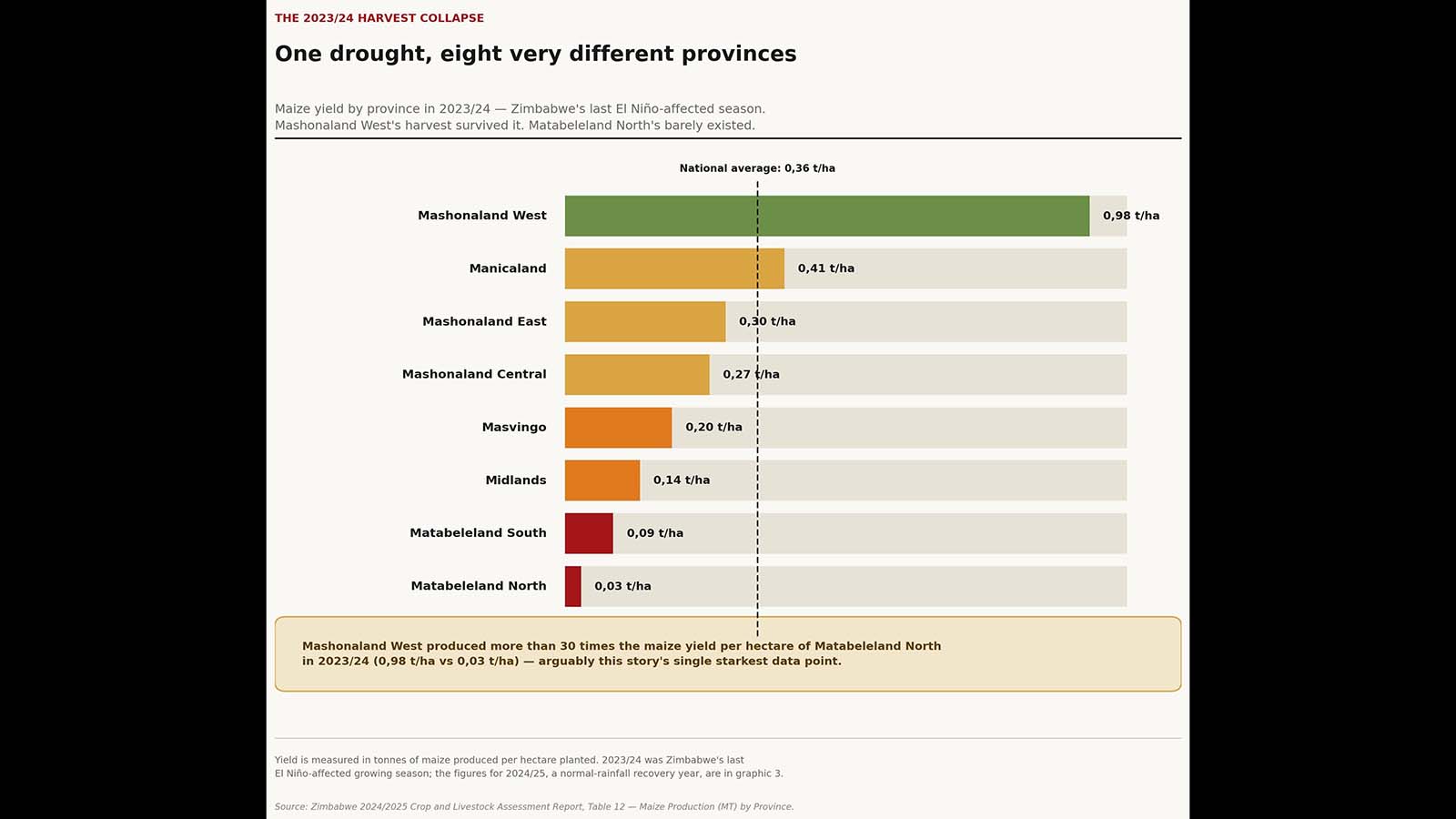
The national maize yield collapsed to just 0,36 tonnes per hectare that season, the report says.
But, that national figure hides a huge gap between provinces. Matabeleland North’s yield fell to 0,03 tonnes per hectare – close to a total crop failure.
Province-wide production collapsed to just 2 960 tonnes. Matabeleland South managed only 0,09 tonnes per hectare. Masvingo, Midlands and the Mashonaland provinces all fell below half a tonne per hectare too, but not as badly as the south and west.
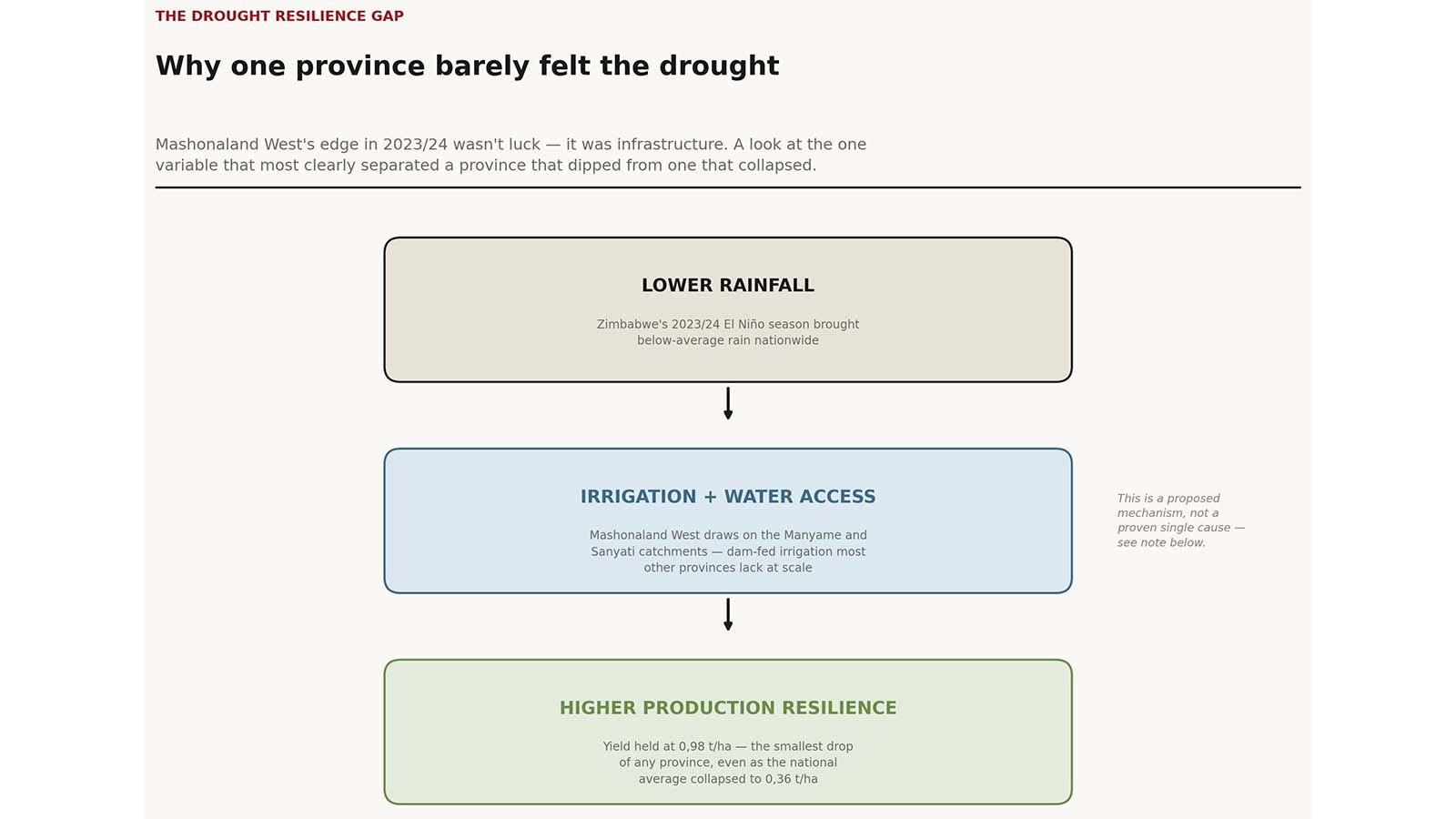
Mashonaland West was the exception. Its yield held at 0,98 tonnes per hectare even during the drought – the smallest drop of any province, and by far the best result in the country that year.
That gap is not random.
According to Zimbabwe National Water Authority (Zinwa) data, Mashonaland West carries much of the country’s irrigated commercial farming, drawing on the Manyame and Sanyati catchments this piece already tracks for current dam levels.
In effect, it is live proof that irrigation – not just rainfall – is what separates a province that dips from one that collapses.
The next season (2024/25) brought recovery. National yield rebounded to 1,25 tonnes per hectare as rains returned to normal, a 261 percent jump.
The provinces that had fallen furthest bounced back hardest. Matabeleland North rose 2 038 percent and Matabeleland South rose 795 percent.
However, that dramatic recovery only looks so large because both provinces had almost nothing to begin with.
Even after recovering, their yields – 0,66 and 0,80 tonnes per hectare – remained the lowest in the country, far behind Mashonaland Central’s 1,77 tonnes per hectare.
Vegetation health data backs up this pattern. The assessment report’s charts, which track a “vegetation health index” by province through the growing season, show 2023/24 running well below the long-term normal range for stretches of the season in the hardest-hit provinces.
In 2024/25, that same measure recovered to match or beat the long-term average – what the report itself calls “a significant improvement in crop health and biomass production.”
Where the next El Niño will hit hardest
The same geography is starting to reappear in current food security data.
FEWS NET projections show most of Zimbabwe in “Stressed” territory (IPC Phase 2) for July to September 2026.
Only Harare and parts of Mashonaland Central and West are rated “Minimal”. Move forward to October 2026 through January 2027 – the heart of the next rainy season – and “Crisis” level food insecurity (IPC Phase 3) is expected to emerge in what FEWS NET calls “typical deficit-producing areas in the south, east, west, and extreme north”.
In these areas, households will use up their own harvests early and become dependent on a market they increasingly cannot afford.
That geography now comes with district names and population figures, not just province-wide totals.
The country’s 2022 Population Census counted 159 982 people in Binga District, in Matabeleland North’s Zambezi valley – the province that lost nearly its whole harvest in 2023/24.
Beitbridge Rural District, in Matabeleland South, is home to 94 001 people, according to the census.
FEWS NET names it as the main crossing point for Zimbabweans returning from South Africa this year.
The district absorbing that wave of returning migrants is the same one that came closest to losing its harvest entirely last time El Niño struck.
The price of maize shows the same divide. In the deficit-producing areas, FEWS NET reports, maize grain is scarce enough that prices range from US$0,34 to US$0,57 per kilogramme.
In surplus-producing areas, the same grain averages US$0,22 per kilogramme – 30 percent cheaper than a year earlier and than the previous month, reflecting an above-average 2026 harvest in those zones.
That price gap maps out where the next El Niño will do the most damage. It will widen the existing divide, not close it.
Zimbabwe’s dams tell a similar story, even before any El Niño-driven dry spell has begun.
Zinwa’s catchment data for August 26, 2026, shows the Mazowe catchment at 60,5 percent capacity and falling – down 9,5 percent in a month.
Manyame, which supplies Harare and much of the irrigation behind Mashonaland West’s resilience, sits at 70,8 percent, down 10,5 percent in a month.
Gwayi, in the drought-prone west, has dropped 16,6 percent in a month to 80,2 percent – the steepest monthly decline of the seven catchments Zinwa tracks.
Every catchment Zinwa monitors is losing water month by month. That is normal for the dry season, but it is a reminder of how little buffer exists heading into a season forecasters expect to be drier than usual.
Two other pressures are adding to the climate risk. Remittances from Zimbabweans in South Africa – a lifeline for many households in the south – are expected to fall as xenophobic attacks push people to return home.
More than 115 000 people crossed back through the Beitbridge Border Post between the end of May and the end of July 2026 alone, FEWS NET reports.
Around a third of them received Government assistance.
Fuel costs are also elevated. As at August 28, 2026, petrol is about 25 percent and diesel about 28 percent above pre-February 2026 levels, following the escalation of tensions in the Middle East.
That has pushed public transport fares 50 to 100 percent above February levels in the same southern areas already facing the steepest food shortages.
How Zimbabwe is preparing
The country’s preparedness plan, set out in FEWS NET’s Key Message Update, rests on several measures: expanding the Strategic Grain Reserve, allowing early private and individual grain imports, promoting conservation farming methods (Pfumvudza/Intwasa) and drought-tolerant, early-maturing seed varieties, expanding irrigated land, stockpiling livestock feed and widening access to agricultural insurance.
The Mashonaland West evidence suggests irrigation, in particular, is the one measure that clearly worked last time.
One caveat is worth stating plainly. The most recent published seasonal rainfall outlook from the Meteorological Services Department actually covers October 2025 to March 2026 – a season it described as shaped by a neutral ENSO (El Niño Southern Oscillation) state, not El Niño.
According to the WMO, ENSO is a naturally occurring large-scale climatic phenomenon involving fluctuating ocean temperatures in the central and eastern equatorial Pacific, coupled with changes in the overlying atmosphere.
El Niño and La Niña are the oceanic components of ENSO.
That outlook is useful in that it shows the same north-south exposure pattern that keeps showing up across these datasets, with the north and west more vulnerable early in the season and the south and east more exposed as it goes on.
But, it is not a forecast for the El Niño season now developing.
The department’s updated outlook, due at the end of October, will be the one to watch.