Chronicle Editor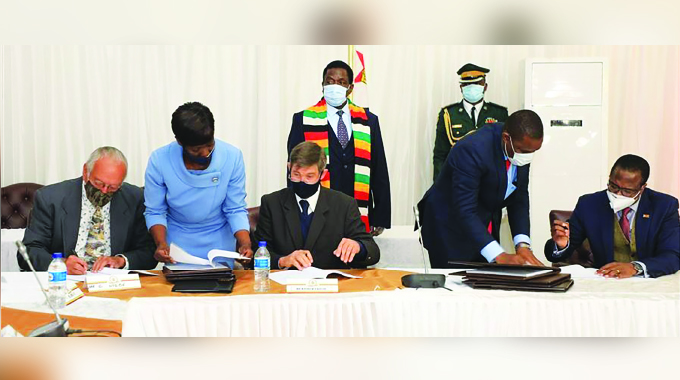
Richard Muponde, Zimpapers Politics Hub
THE Zimbabwean Government has taken steps to address the contentious issue of compensating white commercial farmers for developments on farms compulsorily acquired for the land reform exercise.
Under the stewardship of President Mnangagwa, the Second Republic struck an agreement with white farmers to compensate them under the Arrears Clearance, Debt Relief and Restructuring Strategy to facilitate the clearance of the country’s external payment and resolution of debt.
In a statement recently, Minister of Finance, Economic Development and Investment Promotion, Professor Mthuli Ncube, said the move to compensate the farmers is part of an agreement between the Government and its creditors to facilitate the clearance of the country’s external debt.
“The Government of Zimbabwe developed and adopted in 2021, the Arrears Clearance, Debt Relief and Restructuring Strategy to facilitate the process for the clearance of the country’s external payment and resolution of debt,” he said.
“Pursuant to this, the Government of Zimbabwe established in December 2022, a structured dialogue platform to institutionalise engagement with all its creditors and development partners towards arrears clearance and debt resolution, premised on reforms in economic, governance and land tenure areas.”
Prof Ncube said Government set aside US$20 million in the 2024 National Budget towards the compensation of white farmers.
“The Government made a provision of US$20 million in its 2024 National Fiscal Budget towards the financial compensation of farmers protected under BIPPAs,” he said.
“The allocation is targeted towards compensating farmers whose farms were acquired and who are nationals of countries that signed BIPPAs with Zimbabwe before the commencement of the Fast Track Land Reform Programme, that is BIPPAs that were ratified before the year 2000.”
The farmers were protected under the Bilateral Investment Protection and Promotion Agreements (BIPPAs) and were affected by the Fast Track Land Reform Programme in 2000.
Government has started the first phase of compensating them.
This marks a crucial step towards addressing what has been touted as historical injustices and fostering a more inclusive and equitable society in Zimbabwe.
The issue of compensating white commercial farmers has been a highly contentious and complex matter given the historical and political implications of the land reform programme.
However, recent efforts signal a willingness to confront this challenge and move towards a more sustainable and inclusive agricultural sector.
By addressing the compensation issue, the Government aims to promote national reconciliation and create a conducive environment for economic development.
This move reflects a commitment to addressing historical grievances and fostering a more harmonious society.
Zimbabwe Farmers’ Union president Mr Paul Zakariya, said they appreciate the Government’s efforts to fulfil the agreement as it would foster economic development.
“We are fully in agreement with what’s happening. We are only happy to see the performance of the agreement and how it is going to facilitate economic development,” said Mr Zachariya.
“It’s not just compensation but it’s how we treat each other in the future. We have to create a new normal. And those white farmers being compensated should play their part and show they are true citizens willing to contribute to the national good.”
He said the compensation was an agreed position which the Government was fulfilling.
“The debate is not whether it’s good or not. The Government is just following through on its commitment. Because of the agreed position, an obligation was created, it has to be fulfilled to its logical conclusion,” he said.
Government also invited qualifying farmers who chose the financial compensation option to submit applications for compensation.
The Government has been under pressure to compensate the former white farmers for the developments on land acquired during the Land Reform Programme in the early 2000s.
Under the deal, also known as the Global Compensation Deed, the farmers are to get half of the money within the first year, followed by four US$437,5 million annual instalments.
The agreement was signed by the Government and two unions representing farmers whose land was acquired — the Commercial Farmers’ Union (CFU) and the Southern African Commercial Farmers’ Alliance. According to the CFU, the GCD agreement had the support of 2 759 farmers out of 2 896 who voted before it was signed, amounting to 95 percent. There were 137 votes against the deal.
The Government’s debt clearance strategy is dependent on the compensation of white farmers, as this is a prerequisite for the country to receive international financial assistance. However, the Government’s limited capacity to pay the debt means that it may be many years before the debt is fully liquidated, but flexible modalities such as TBs could see it resolved quicker.
The country has been struggling to repay its debts for many years due to the negative impact of illegal Western sanctions, which weighed on the growth and performance of the economy, and the compensation of white farmers is just one of many financial obligations that the Government is facing.
At the signing ceremony, President Mnangagwa said “this step was legally necessary” in that it was bringing closure to the contentious issue while birthing a new beginning in the history of the land discourse in Zimbabwe.
The Government’s efforts to compensate white commercial farmers for the developments undertaken on the farms represent a significant step towards addressing the perceived historical injustices and promoting national reconciliation in Zimbabwe.
This development underscores the country’s commitment to fostering a more inclusive and equitable society, laying the groundwork for sustainable economic progress and social harmony.
These efforts are part of a broader strategy to address historical grievances and promote national reconciliation, signalling a positive shift towards a more inclusive and equitable society in Zimbabwe. — @muponderichard



 Online Reporter