Rodgers Irimayi
Cultural Perspectives
THE recent storm in Masvingo did not only damage roofs. It asked a very old question in a very new context.
In the Book of Luke, a lawyer asks Jesus: “Who is my neighbour?”
The answer comes, not as a definition, but as a story – the Good Samaritan who stops to assist the badly injured man.
Beyond the asbestos, tiles and timber, disasters test the invisible structures that hold us together.
We count a disaster in collapsed walls. We should also count genuine people who matter in assisting interrupted lives. True love is tested during and after a disaster.
That is the true measure of a storm.
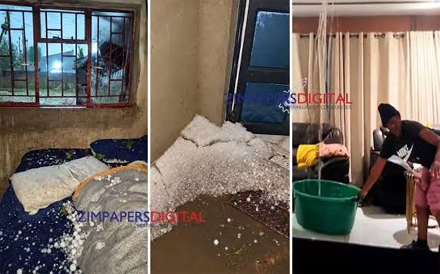
The recent hailstorm in Masvingo, with collateral damage reported in parts of Manicaland, did more than tear roofs. It tore routine. In a single afternoon, the ordinary questions of domestic life, where will we sleep tonight, what will we cook, will the children go to school tomorrow, became urgent and existential.
For decades, our disaster response has been built on the assumption that help flows downwards: from Central Government to province to district to ward to household. In reality, help now flows in multiple directions – horizontally between neighbours, diagonally from towns, and from above and beyond from the diaspora.
According to media reports, thousands of households in Masvingo were affected, with Government assessment teams deployed across the province. Homes, clinics, schools and market stalls were damaged, livelihoods interrupted at a time when many families were already navigating severe economic pressure.
To describe this only as infrastructural damage is to miss its sociology.
For a household whose roof is gone, loss is not abstract. Rain enters where shelter once was. Blankets soak, grain spoils, exercise books dissolve.
A mother must simultaneously secure a dry corner for her children, salvage what is left of her stock, and calculate how to pay for repairs she cannot afford.
When a school loses its roof, a whole catchment area loses learning days.
When a market loses its stalls, it is, not just traders who suffer, but the households who buy from them and the transporters who supply them.
Disaster radiates. It is in this radiation that the question of community becomes practical, not sentimental.
Talk to anyone who has queued for aid after losing their home, and you will hear two stories.
The first is gratitude — for the neighbour who offered a room, for the councillor who came early, for the organisation that brought roofing sheets. The second, often whispered later, is about shame.
About standing in a queue while your battered belongings are looked at. About being told what you will receive, rather than asked what you need most. About children watching their parents being counted, rather than consulted.
This is not an argument against assistance. It is an argument for assistance that understands what poverty researchers call the psychosocial cost of disaster.
A home is not only four walls. It is privacy. It is a place where a mother can breastfeed without being seen by strangers, where a father can discipline his children without an audience, where teenagers can study, where possessions that mark a family’s history, a grandmother’s plate, a child’s birth certificate, a Bible are kept safe.
When that space is destroyed, people lose more than corrugated sheets. They lose the boundaries that allow family life to be family life.
That is why dignity is not a luxury item to be added after food and shelter. It is part of shelter itself.
What helps in the first 72 hours is rarely grand. It is a neighbour offering a dry room for two nights. It is young men clearing fallen branches from a homestead. It is a blanket, a pot of sadza shared, checking on Mbuya next door whose radio has gone silent, passing on verified information about where assessments are being done.
No single act rebuilds a village. Cumulatively, they restore something more fragile than a roof: the sense that one has not been abandoned.
Anthropologists call this mutuality. Economists call it social capital.
In our villages, we have older, more precise names for it – humwe, nhimbe, zunde. Different words, same recognition, that survival is collective work.
The classic African ethic of Unhu/Ubuntu – munhu munhu nekuda kwevanhu, a person is a person through other people, was always more than locality. It was about moral membership.
The village was simply where that membership was most visible.
Every culture has institutionalised this instinct. The work party to re-thatch a home. The extended family absorbing children after a loss.
The granary reserve released after a failed season. These are not acts of charity; they are systems of insurance invented long before insurance companies existed.
They rest on a simple truth we tend to forget in ordinary times: hardship is never private for long. A family’s crisis becomes a community’s burden, but a community’s response can become a family’s pathway back. Storms also perform a cruel audit. They expose inequalities that are easy to ignore when the weather is fair.
A household with savings, with an urban relative who can send money, with a permanent structure, recovers faster. A household headed by an elderly person, a person with a disability, a family living in a pole-and-dagga house on the edge of a flood line, a family already spending more than 70 percent of its income on food, that household does not simply recover slower; it risks falling permanently.
This is why responsible relief cannot be first-come, first-served. Equity must mean deliberately reaching those most vulnerable and at risk, not simply those easiest to reach.
Generosity, to be useful, must also be disciplined.
Good intentions are not enough.
In Masvingo, as in Manicaland, needs must be verified before donations are mobilised.
One village may need roofing sheets; another may need food; another may need labour. Cash may be more dignified than goods in one place, while building materials may be more urgent in another.
Uncoordinated giving creates the familiar paradox of disaster economies: piles of clothes in one ward, nothing at all in the next.
Here local leadership matters, village heads, ward councillors, church leaders, women’s groups, school development committees, and trusted local organisations who know who slept where last night.
Their task is to connect willingness to need, and to ensure that dignity remains at the centre.
People who lost homes do not only need sympathy from a distance, they need a voice in what recovery looks like.
And recovery is long. The cameras leave after the assessment. The real work begins after the headline fades.
Re-roofing, re-stocking a stall, replacing lost documents, getting children back into uniform, this takes weeks and months. Listening becomes a form of aid too. Trauma does not end when the sky clears.
The Government reports from Masvingo speak of assessments by the Civil Protection Unit and emergency assistance.
These formal mechanisms work best when they are met from below by organised community information accurate, local, and honest.
If you cannot give money, you can give time. Transport. Carpentry skills. A phone call to someone who lives alone.
The mention of parts of Manicaland reminds us to look beyond the epicentre. Beyond Masvingo urban, areas in Gutu and Chivi were affected by the same hailstorm. Many communities suffer in the periphery of the main story.
Their needs should be confirmed through local authorities and trusted sources, but the principle remains the same, assess carefully, prioritise vulnerability, and stay engaged beyond the first wave of concern.
A storm cannot be undone. A neighbour’s shelter cannot replace a lost harvest. But these small, coordinated acts do something essential: they prevent a natural disaster from becoming a social abandonment.
When the hailstorm passes, what remains is not just damaged property. It is the question of whether we still belong to each other. We do. And that is the roof we must maintain together.
Rodgers Irimayi writes in his personal capacity and can be contacted on +263778246098 or [email protected]. He can also be followed on his YouTube channel, Culture Views with Judah Kalispokaz