Online Reporter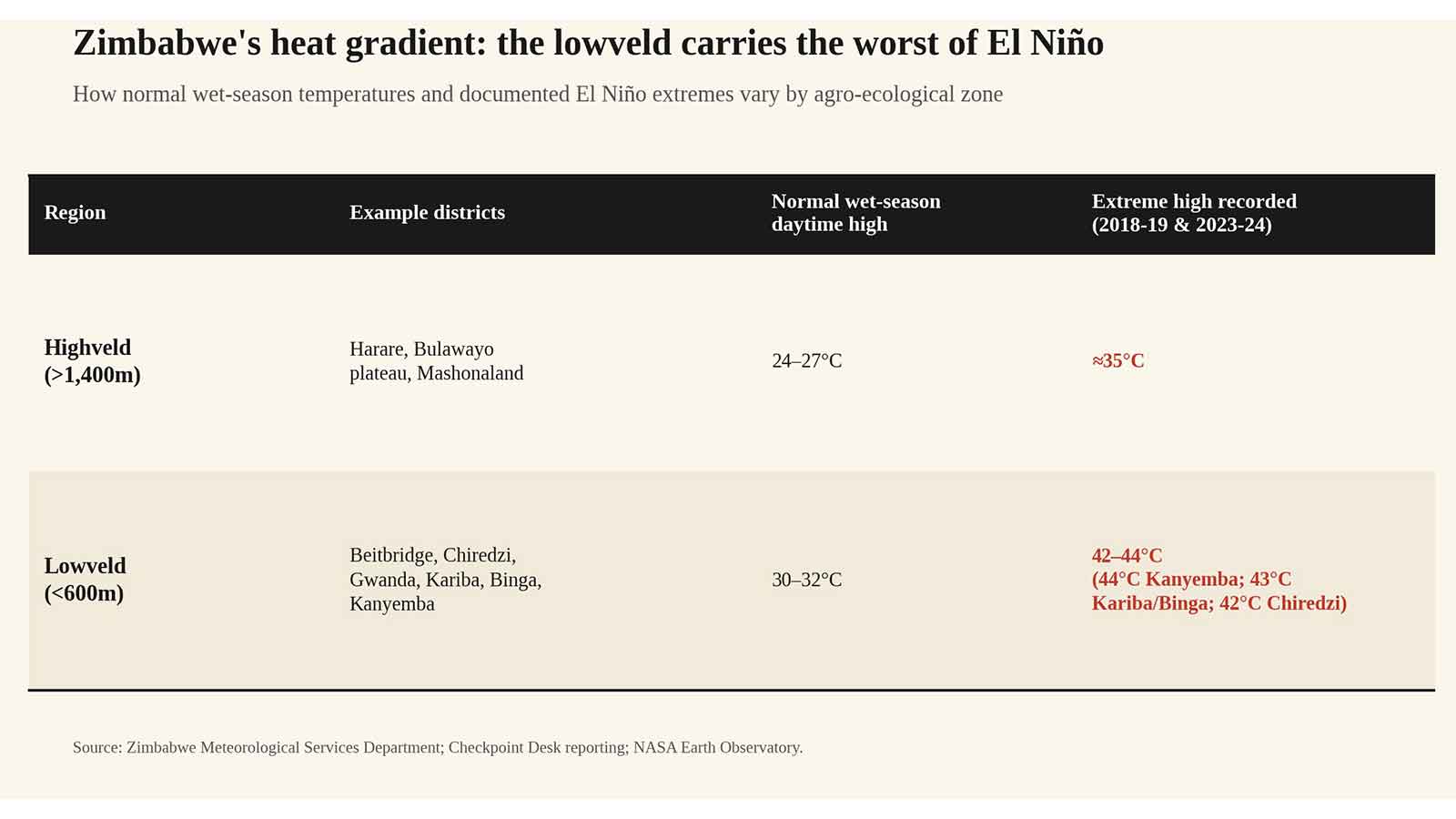
Tawanda Musarurwa
CHECKPOINT DESK
IN March 2019, Sazini Moyo watched her maize die on its feet. The crop on her farm outside Bulawayo had reached the tasselling stage in reasonable shape when a heatwave settled over Matabeleland South and refused to lift, wilting it past saving within days.
“I have lost significant money on seed and fertiliser with nothing to show for it,” she told the Thomson Reuters Foundation.
Her loss had a precise cause, not simply a shortage of rain. For five straight days, the province averaged 2 to 4°C above its normal March high, with Beitbridge touching 38.7°C, the Meteorological Services Department (MSD) said.
Agritex agronomist Kennedy Mabehla, assessing crops that season, linked the pattern to the warming trend the United Nations’ Intergovernmental Panel on Climate Change had flagged for southern Africa.
Local drought coverage tends to skip past that detail – a season filed as “below normal”, a district as having received “20 percent of expected rainfall”, the thermometer left as a footnote – understating the threat facing 2026/27.
Forecasters at the US Climate Prediction Centre and the International Research Institute for Climate and Society put the odds of a “very strong” El Niño – the Pacific warming pattern that shifts rainfall and temperature worldwide – peaking between November 2026 and January 2027 at roughly two in three.
The Niño 3.4 index they track is trending toward some of the highest readings since satellite records began.
Greenhouse gas expert Dr Walter Svinurai said temperatures this time will likely be significantly higher.
“During the forecasted 2026/2027 ‘Super El Niño’ event, Zimbabwe and the wider Southern African region are projected to experience seasonal temperatures 2°C to 4°C above historical averages,” he said.
“Because climate change has already elevated the global baseline temperature by roughly 1.4°C, this impending El Niño is essentially pouring fuel on the fire.
“This creates an environment for unprecedented, compounding heatwaves and severe drought conditions.”
Zimbabwe has no season-specific forecast yet – that awaits the Southern Africa Regional Climate Outlook Forum, usually held in late August – and forecasts this far out carry real uncertainty.
A more reliable guide is how the last two comparable events played out on the thermometer.
A pattern that keeps repeating, and worsening
Matabeleland South’s normal March high – when maize is filling grain – sits around 32°C, according to MSD figures.
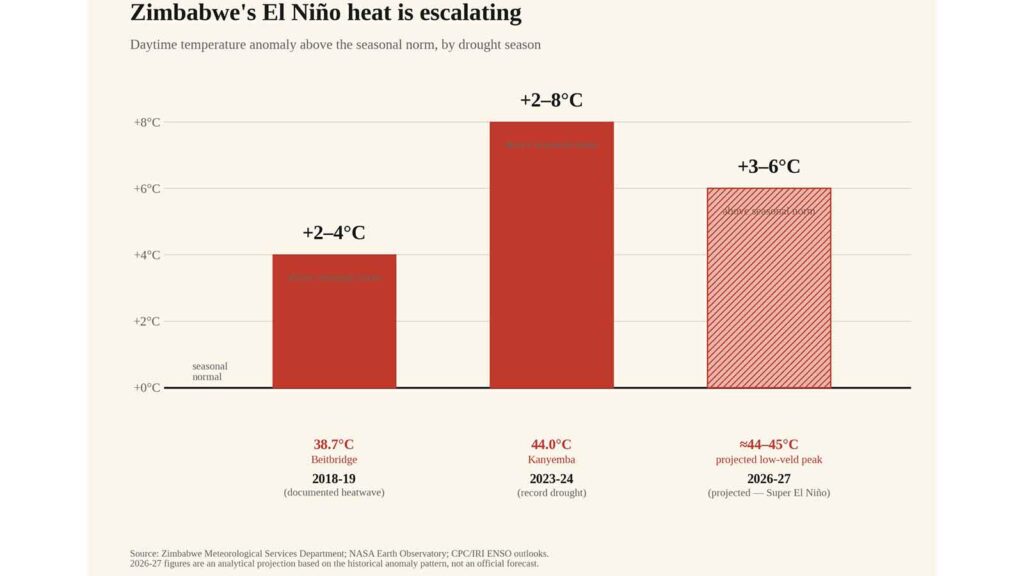
The 2018-19 heatwave breached that mark by 2 to 4°C; five years later, the breach was worse.
Going into the record 2023-24 drought, the MSD reported daytime temperatures running 2 to 8°C above the national average in November 2023: highs of 35 to 40°C were widespread, with hotspots reaching 44°C in Kanyemba, 43°C in Kariba and Binga, and 42°C in Chiredzi.
That heat compounded a rainfall failure – Climate Hazards Group InfraRed Precipitation with Stations (CHIRPS) satellite data confirmed it was the driest February in the region’s 40-year record – and caused damage of its own: The Famine Early Warning Systems Network (FEWS NET) reported in April 2024 that over 9 000 cattle had already died from drought and heat, with 1,4 million more at high risk.
None of this is happening against a stable baseline: Zimbabwe’s mean annual temperature has risen roughly 0.03°C a year since 1970, per the World Bank Group’s 2021 Climate Risk Country Profile — a slow trend that sits beneath every El Niño spike rather than resetting after one passes.
A full picture must also account for 1997-98, one of three “super” El Niños of the satellite era alongside 1982-83 and 2015-16.
Despite record Pacific sea-surface temperatures, it brought only minor drought impact to Zimbabwe. Historians instead point to 1991-92 – modest by Pacific standards – as the more severe domestic event, killing more than a million cattle.
Ocean-signal strength, then, has not always tracked local severity, cause for caution in reading 2026/27 off Niño 3.4 forecasts alone: a record-strength El Niño is more likely than not to produce a severe drought on the 2015-16/2023-24 pattern, but 1997-98 proves that is not guaranteed.
An uneven heat map
“Normal” is not one number across Zimbabwe. Harare, on the Highveld above 1 400 metres, has a wet-season daytime norm closer to 24-27°C.
The Lowveld (Beitbridge, Chiredzi, Gwanda, Kariba, Binga and Kanyemba) runs several degrees hotter even in an ordinary year, and these same drought-prone districts recorded the most extreme 2018-19 and 2023-24 readings: highs of 42-44°C, against Highveld extremes closer to 35°C, piling heat onto places already hottest and driest, where subsistence farming is most marginal.
This is where a measure called the Standardised Precipitation-Evapotranspiration Index (SPEI) becomes useful.
Unlike rainfall-only measures, it factors in temperature: heat above roughly 35°C speeds up evapotranspiration – drawing moisture from soil and plants faster than a rainfall shortage alone would predict – while damaging maize during tasselling and grain-filling.
That is the exact mechanism that destroyed Moyo’s crop in 2019, after the rains had looked adequate.
Response mechanisms
Seed-Co, the country’s largest seed company, keeps bringing early-maturing, heat- and drought-tolerant maize hybrids to the driest regions; some reach maturity in under 110 days, cutting a crop’s exposure to peak heat.
A CIMMYT/ICRISAT study – two international agricultural research bodies – on drought-tolerant maize adoption in south-eastern Zimbabwe found it added over nine months of extra food security per hectare for adopters.
The more direct hedge is water a farmer controls, not water the sky provides.
Zimbabwe’s irrigated area grew from 171 000 hectares in 2020 to 258 773 hectares by May 2026 – a 51 percent expansion Agriculture, Mechanisation and Water Resources Development Minister Dr Anxious Masuka called the fastest since independence, averaging 17 500ha a year.
A gap remains. Dr Masuka puts the shortfall at 237 227ha against a 2030 target of 496 000ha, requiring nearly tripling the pace to 47 500ha a year, though he maintains “this is achievable.”
Irrigated maize is far less exposed to heat-driven evapotranspiration, so this pace will decide how much of the 2026-27 anomaly reaches the harvest.
There is a financial hedge too, and it already exists. The country holds a parametric weather policy with the African Risk Capacity Group, which pays out automatically once agreed weather thresholds trigger it, rather than after a lengthy damage assessment; it paid out US$32 million in July 2024 under the 2023-24 policy. Finance, Economic Development and Investment Promotion Minister Professor Mthuli Ncube has said Harare intends to renew and expand that cover nationwide.
Set against a US$2 billion humanitarian appeal that season, US$32 million is a modest cushion – the gap is one of scale, not absence.
None of this changes the physical reality facing maize caught in a 40°C-plus heatwave during grain-filling, nor does it shield cattle herds and hydropower – both threatened more by a hot drought than a merely dry one.
Kariba, which supplies roughly half the country’s electricity, loses more water to evaporation in a hot drought, a factor behind the rolling blackouts of 2015-16 and 2023-24, with knock-on costs for the maize import bill and a currency with little room to absorb another shock.
A signal already visible beyond Zimbabwe
In July, Bloomberg reported that Ben Kirtman, dean of the University of Miami’s Rosenstiel School of Marine, Atmospheric, and Earth Science, put the odds of a single month in early 2027 exceeding 2°C of warming above pre-industrial levels at 35 to 40 percent – “a large probability”, in his words. He attributed much of that risk to the current El Niño, on track to be the strongest in modern history, alongside a possible broader acceleration in warming that scientists are still trying to explain.
That same El Niño was already producing record heat and destructive wildfires across Spain and France, forcing the evacuation of over 300 000 people, Bloomberg reported.
Climate scientist Kate Marvel, also cited in that reporting, suggested part of the acceleration may reflect faster-than-expected cuts to cooling aerosol pollution, chiefly from China, unmasking greenhouse warming previously offset – distinct from El Niño, but consistent with the steady warming already visible in Zimbabwe’s record.
No official Zimbabwean outlook exists yet, and the two most relevant precedents point in different directions on how closely Pacific Niño strength maps onto local heat.
Still, weighting 2015-16 and 2023-24 over the 1997-98 outlier, a season forecast to rival or exceed those two events is more likely than not to sit at or beyond the upper end of Zimbabwe’s experience: daytime anomalies of 3 to 6°C above the seasonal norm through the critical January-March window, extreme Lowveld highs testing or exceeding the 44°C mark set at Kanyemba in 2023, and a growing-season average measurably above the historical baseline once long-term warming layers on.
This is an extrapolation from two data points bracketed by one counter-example, not a model output; the season could fall below it as easily as above.
Why the monitoring matters more than the millimetres
For food security planners, the implication is straightforward, even if acting on it is not.
Early-warning systems built around rainfall alone – Standardised Precipitation Index (SPI), CHIRPS satellite maps – need reading alongside temperature and evapotranspiration signals such as SPEI and vegetation-stress indices like the Vegetation Health Index (VHI), since response timelines built around post-harvest rainfall assessments arrive too late for a heat-driven crop failure.
The tools to see a hot, dry season coming have never been better, and the African Risk Capacity payout shows financing is catching up too.
Whether that means pre-positioned grain, water and heat-tolerant seed before the tasselling window closes – rather than after, as happened to Moyo in 2019 – is the question 2026/27 will answer, whatever its final temperature turns out to be.