admin
admin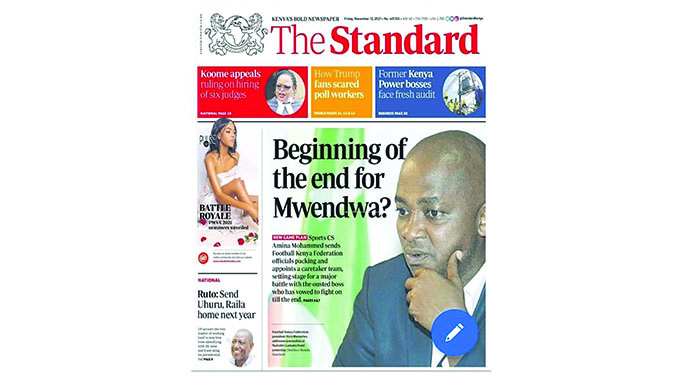
Robson Sharuko
Senior Sports Editor
FOURTEEN games, one win, 10 defeats, three draws — that is the sorry report card for the Warriors as they brace to close one of the darkest years in their history,tomorrow.
They host Ethiopia in a dead rubber 2022 World Cup qualifier.
Even fate appears to be closing this dreadful chapter for them as their home, the National Sports Stadium, will host its final international match tomorrow before its gates are closed by a CAF ban.
The continent’s football chiefs want the giant stadium to undergo another round of renovations, including the installation of bucket seats, before they can give it the green light to host matches under their authority.
In reality, it won’t affect the Warriors that much, with the team’s next round of home fixtures set for possibly March next year.
But, after a disastrous year in which their train veered off the rails, the future of both the team and the national game,is not as clear-cut as was the case this time,last year.
Pressure has been building up in the boardroom as the Warriors stumbled from one poor result to another in a horror year.
There is a feeling, among some key stakeholders, that Zimbabwean football has probably reached crisis level and, unless there is an intervention to arrest the slide, the national game will plunge into an abyss.
The Warriors poor campaign, throughout the year, hasn’t helped matters and just one victory, in 14 matches, ahead of their match against Ethiopia, represents a pathetic return.
Ironically, it was a loss to the East Africans which triggered the end of ZIFA’s ill-fated romance with Croatian coach, Zdravko Logarusic, amid relentless pressure from the domestic football family.
Whether another defeat, or failure to win against Ethiopia tomorrow might just be the result, which triggers wholesale changes in the national game, remains to be seen.
Two days after tomorrow’s match, the ZIFA board and the Sports Commission meet in Harare in what is likely to be an explosive indaba where the game’s challenges will be laid bare.
While that is obvious, what is not known are the cocktails of measures that are likely to be prescribed to breathe life into the national game.
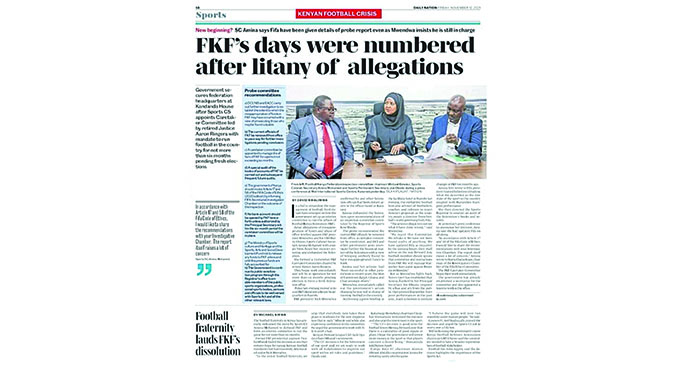
Will the Sports Commission choose the path that the authorities in Kenya adopted this week by disbanding their football federation and replacing it with a caretaker administration?
If that’s the direction they want to take, how will they factor in the possibility that this could probably mean sacrificing the country’s participation at the 2021 AFCON finals, in January next year?
Already, FIFA’s reaction, after the events in Kenya, has been quite predictable, with the world football governing body warning authorities in the East African country they should brace for a possible ban, from the international game.
However, the Zurich-based organisation also opened a window to meet the Kenyan authorities to discuss the challenges which they are confronting the game in that country.
The Harambee Stars, unlike the Warriors, are not set to take part at the next AFCON finals, and this has provided the Kenyan authorities with the flexibility to crack the whip without having to worry about sanctions affecting their national team.
But, what if the Sports Commission decide that banishment, from the next AFCON finals, is a sacrifice worth enduring given, if the team’s form this year is anything to go by, the Warriors will just be in Cameroon to make up numbers?
What if the local authorities are reading a page from their Kenyan counterparts who, on the day they received threats from FIFA, the caretaker leadership took an even bolder move to suspend the country’s top-flight league, for the next two weeks?
ZIFA can argue the SRC are compromised, when it comes to the country’s football controlling body, after the regulator wrote to FIFA, in August 2019, requesting them to use their powers to remove the entire ZIFA leadership, from office.
‘‘The SRC has, of today, this 15th August 2019, written to the secretary-general of FIFA requesting that FIFA invoke Article (8) (2) of the general provisions of the FIFA statutes to remove from office the entire Zimbabwe Football Association (ZIFA) board and to replace it with a normalisation committee,’’ SRC boss, Gerald Mlotshwa, revealed in a statement.
‘‘The SRC has reserved its right, in terms of the same correspondence, to act in terms of Section 30 of the SRC Act and suspend the entire board itself.’’
“Article (8) (2) of the general provisions of the FIFA statutes empower the world football governing body to act and remove national football controlling bodies and replace them with normalisation committees.’’
The drama which surrounded the Warriors’ camp during their ill-fated AFCON finals campaign in Egypt was also highlighted by the SRC as a symptom of the challenges that were rocking the administration of domestic football and the explosion of the issues in Cairo was just a culmination of events.
It was noted that a number of normalisation committees had been appointed in the Dominican Republic, Uruguay, Mali, Pakistan and Madagascar.
But, FIFA defended ZIFA and issued a stark warning that should the SRC intervene, back then, in a process which would lead to the removal of those in charge of domestic football, and their replacement with a caretaker committee, it would be deemed third-party interference, and there would be consequences.
Two years later, will the SRC, just like their Kenyan counterparts, now be compelled to intervene?
If it’s an exercise to try and save the Warriors, there will certainly be a number of the team’s fans, singing in the SRC corner given the way their favourite team have badly lost their way, in international football.
They didn’t even have a shot on target in their defeat to Bafana Bafana on Thursday as they succumbed to a fourth straight defeat in the 2022 World Cup qualifiers.
Their only goal, in the five matches has come from the penalty spot and, with one goal, at this stage of the campaign, it represents the worst World Cup campaign for the Warriors in history.



 Online Reporter