Online Reporter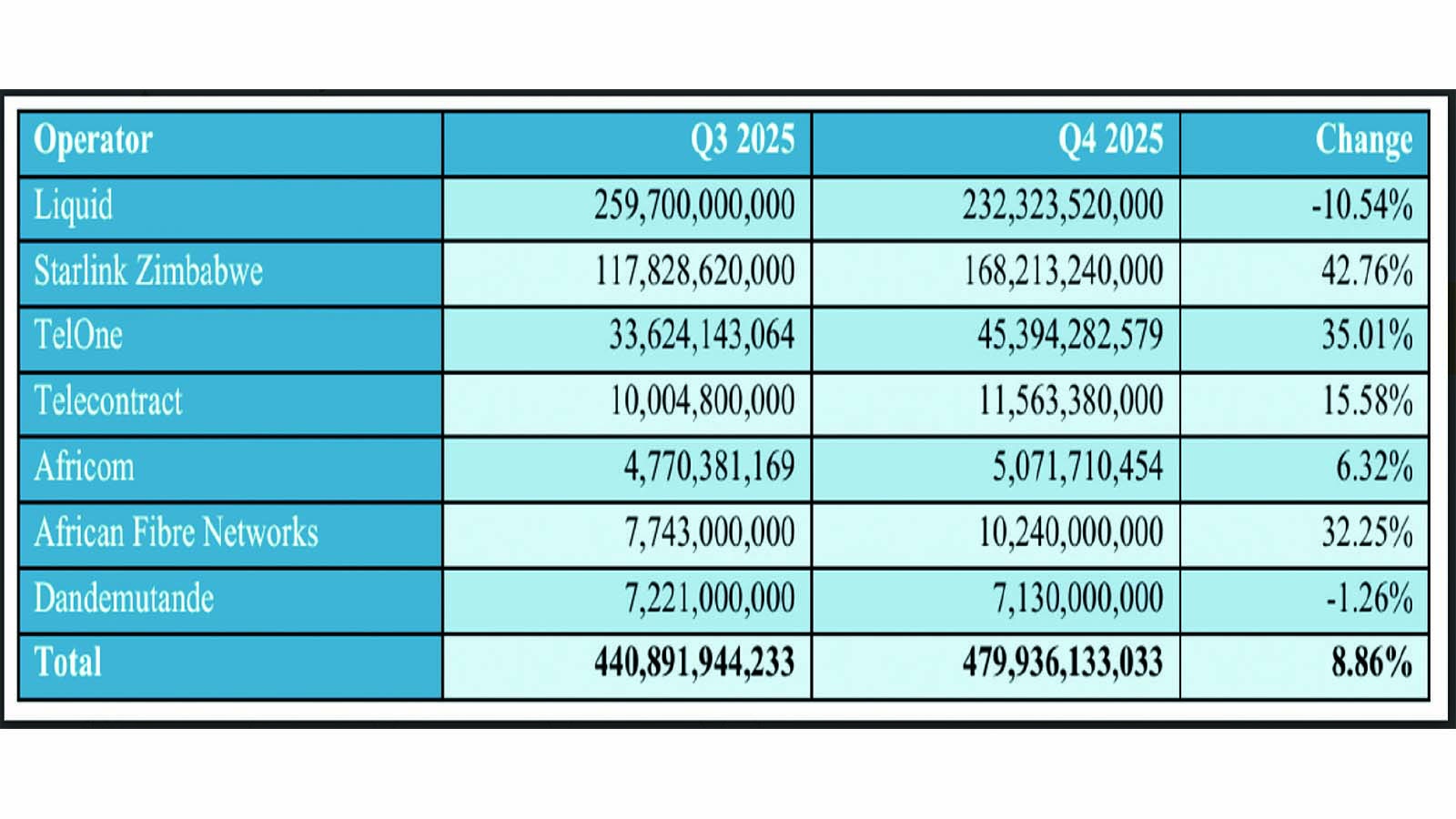
Business Reporter
ZIMBABWE’S fixed internet market continues to undergo significant structural shifts amidst the rapid expansion of Starlink, a low-earth orbit satellite internet service provider, the latest industry data shows.
According to the Postal and Telecommunications Regulatory Zimbabwe (POTRAZ) 2025 fourth quarter performance report, Starlink recorded a sharp 42,76 percent increase in internet data traffic, from 117.83 petabytes (PB) in the third quarter to 168.21 PB.
The strong growth has changed the competitive landscape, eroding market share for established operators, particularly Liquid Intelligent Technologies.
Liquid’s fixed internet traffic share declined by 10,49 percentage points over the same period, with overall traffic volumes also falling by 10,54 percent to 232,32 PB from 259,70 PB.
POTRAZ attributed the decline largely to Starlink’s rapid market share uptake, noting that the satellite internet service provider gained 8,32 percentage points in market share within a single quarter.
Starlink, which entered the Zimbabwean market in late 2024, is emerging as a formidable competitor in a sector historically dominated by fibre and mobile network operators.
Its satellite-based model has proven particularly attractive in underserved areas, where terrestrial fibre and LTE infrastructure remain limited.
“Starlink Zimbabwe recorded a staggering 42,76 percent increase in its Internet/data traffic from 117,83 Petabytes (PB) recorded in the third quarter.
“Liquid ceded fixed Internet/data traffic market share by 10,49 percentage points. This huge dip was mainly driven by an 8,32 percentage point increase in the market share of Starlink Zimbabwe,” POTRAZ said.
As of 2025, Liquid Intelligent held just over half of the fixed internet and data traffic market share in Zimbabwe.
Despite increased competition, Liquid remains the dominant provider, controlling over half of the market and providing over 75 percent of the country’s internet infrastructure.
In this age of digital technology, the entry of Starlink into Zimbabwe, which has increased competition, is benefiting users by driving down internet data costs, improving internet speeds and expanding coverage to previously underserved areas.
POTRAZ also indicated that subscriptions under the Very Small Aperture Terminal (VSAT) category, which includes Starlink, surged by 31,62 percent in the fourth quarter, increasing from 50 949 to 67 057 users, showing growing demand for alternative connectivity solutions.
Starlink’s competitive pricing model and simplified installation process are accelerating adoption while exposing long-standing infrastructure gaps.
It has effectively bypassed the traditional infrastructure bottleneck, enabling faster deployment of high-speed internet, particularly in previously underserved communities.
Despite the intensifying competition, Liquid remains the dominant player in terms of total fixed internet traffic, although its lead is narrowing.
Other operators, including TelOne and PowerTel, recorded notable traffic growth of 35,01 percent and 32,25 percent, respectively, indicating overall market expansion.
The developments reflect a broader transition towards a data-driven digital economy, with demand for high-capacity connectivity expected to rise further following the rollout of Zimbabwe’s Artificial Intelligence policy for 2026–2030.
With national internet penetration now standing at 84,55 percent and continuing to grow, the entry and rapid scaling of satellite-based providers is set to intensify competition, reshaping the structure and dynamics of Zimbabwe’s broadband market.