Chronicle Editor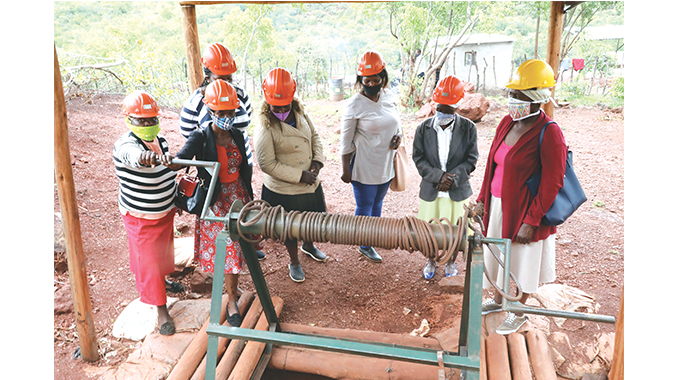
Judith Phiri, Features Reporter
TEARS rolling effortlessly down her dusty cheeks, 32-year-old Ms Lisa Dube* relates the harassment, torment and anguish she received from what she termed “mabhabhadzi or maShurugwi” as they demanded proceeds from her mining venture.
“They said to me if you do not want us to kill you, give us all the gold ore. One of them was holding a machete to my neck while the second one was pointing a gun to my head,” said Ms Dube taking a gasp as she pours out her heart on how she almost lost her life.
Standing at their hand-dug shaft which has reached about 10 metres deep, the woman miner’s conversation revolves around how she and her other four female colleagues lost a pile of gold-bearing excavated rocks.
Mining on a 0,4-hectare claim in Hope Fountain on the outskirts of Bulawayo, Lisa continues to cry as she gives a vivid picture of the incident on 21 August 2020.
Lisa’s colleague, Miss Stella Shumba explains how the gruesome ordeal affected their mining activities to date. She said after being attacked twice early this year, the third attack shattered their dreams of making it big in the mining industry.
“We have been mining for 10 years as a women miners syndicate and our journey has been bumpy. However, violence cases were rare before unlike the three attacks we witnessed this year. It was dark at night around 11pm when my colleagues and myself were taking a rest.
“The other three male counterparts who assist us with blasting had knocked off. To our surprise we were awoken by one of the guys we work with (Chester) but he was in the company of two other guys we did not know,” said Stella.
She narrated how the five women cried when the machete gang threatened to cut off their heads if they did not co-operate. Having being sold off by one of the men they were working with who had brought with him two robbers, the women had to give away their hard-earned ore.
“Unlike the other two encounters where we told the mabhabhadzi that we do not have ore, we had to let our ore be taken to from us, like a person taking away candy from a baby. Chester knew where we had placed it since we wanted to take it to the mill the next morning,” said Stella shaking her head as though in disbelief.
It has emerged, however, that the attack on women miners is not confined to one geographical location. The phenomenon is fast spreading across the country.
Another woman miner in Masvingo Province, Mrs Gloria Kachinda (39) said women-owned mines have been targeted for attacks more than those where men dominate. She contends that the mining sector remains a dangerous one for women.
In Africa, where most countries are endowed with rich mineral resources, women remain largely impoverished and their participation in the extractive sector is marginal.
Although there have been positive steps taken to integrate women into the industry, they continue to be under-represented, undermined and mining remains a man’s domain.
Various studies that have been carried out stated that the mining industry has the lowest number of women. Zimbabwe is one of the leading countries in terms of women venturing into the mining sector. However, these women face various challenges.
Accessing capital for mining ventures remains one the biggest obstacles for women. Mining equipment, such as compressors for milling ore and pumps to drain water from mine shafts, are generally unaffordable, and women miners have to resort to renting equipment at high costs, eroding their profit margins.
“Most of our miners are not properly constructed because we lack the necessary financial muscle to look for the necessary equipment. For one to sink a proper shaft and carry out proper mining they need metal detectors, digging tools, crushers, concentrators, excavators, hammer mills among others. Due to incapacitation we are forced to go down the shafts using a bucket and we fear what would happen if these shafts collapse,” said Ms Susan Sithole a small-scale woman miner.
The woman miner said removing water from their shaft was also a challenge as they did not have the required tools and traditional means were strenuous and time consuming, thereby negatively affecting their production capacity.
She added that they were also faced with other challenges of acquiring licenses from the Ministry of Mines and Mining Development and the Environmental Management Agency (Ema).
The women are appealing to the Government through the Ministry of Women Affairs, Community, Small and Medium Enterprise to intervene and assist them to get funding. They are also seeking the Ministry of Mines and Mining Development to review some of the fees which they say are too expensive for them.
Although mining has been associated with numerous challenges for women with the Covid-19 pandemic derailing their production capacity, they have also recorded success stories.
There are tangible gains for women who have joined the sector as small-scale miners, especially in gold and chrome, as they can afford household nutritional needs, pay school and medical fees, and even afford some modest luxuries.
Most women miners have become breadwinners in their families as Zimbabwe’s economic challenges, now more than a decade old, is seeing women take on work that has traditionally been deemed the domain of men.
Ms Sithole said: “As women we are forced to put food on the table, a role which we used to look up to men to fulfil. However, for single mothers like me and widows we have been pushed in these male-dominated sectors. When we talk of a breadwinner now men and women are both included.”
Other women miners also acknowledged and appreciated their family support and encouragement.
They said there was a growing trend where husbands appreciate women miners and treat them as businesspeople. This has resulted in women miners being able to balance being mothers and miners as men are also doing their part in raising the children and carrying out household chores.
According to a report from the Pact Institute, a Washington DC-based development non-profit, women make up 10 percent of Zimbabwe’s 535 000 artisanal and small-scale miners. This shows that a considerable of them are starting to work closely with men.
Meanwhile, the Minister of Women Affairs, Community, Small and Medium Enterprise, Dr Sithembiso Nyoni said her ministry was working tirelessly to ensure that women miners’ production was scaled up. Dr Nyoni noted that working with ILO over US$ 1 000 000 has been invested into two additional gold milling centres.
“As part of initiatives to also empower women miners two gold milling centres have been constructed each valued at US$500 000. The one in Gwanda has been completed and is up and running, while the one in Guruve has not been completed yet but much progress has been done. Women are encouraged to utilise these centres,” she said.
Dr Nyoni also said they have been working closely with the Ministry of Mines and Mining Development to capacitate women with requisite knowledge and skills for them to adapt to the male-dominated industry.
She said more trainings have been scheduled to adequately train women, and urged them to embrace mining as there were many success stories from other women who have made it in the sector.
The minister also noted that the commemoration of 16 Days of Activism against gender-based violence should be a wake up call to male miners especially the so called MaShurugwi to stop the violence towards women.
“Gender-based violence towards women should stop. We are calling upon the abusers especially these people called MaShurugwi to desist from killing and hurting people. People should adopt a culture of talking to each other, negotiating, finding solutions and coming up with an agreement. A lot of women are not violent, maybe verbally but physically men overpower them, so let us protect our women and children,” said Dr Nyoni.
Gender activist, Ms Lyrue Mazerenganwa said there was a need to overcome mine-based challenges faced by women.
“Women are abused and even sometimes raped at these mines. They, like everyone else, are looking for means of survival but they become victims to various gender-based violence perpetuated by men. As we commemorate 16 Days of Activism against gender-based violence we say stop the abuse to our women and protect them,” said Ms Mazerenganwa.
She added that equal opportunities for women should be created with better working conditions and an increase in the platforms where women can share their grievances, among others.
This year the 16 Days of Activism against GBV’s theme is “Orange the World: Fund, Respond, Prevent, Collect!” running from 25 November to 10 December 2020, the campaign aims at creating awareness on the crisis that has seen a spike in domestic violence reporting.
In Zimbabwe, about one in three women aged 15 to 49 have experienced physical violence and about one in four women have experienced sexual violence since the age of 15.
Across the world, women and girls face violence every single day. However, the Covid-19 pandemic made the year a little more difficult for some.


 Online Reporter