Alice Tagwira
Beyond Boundaries
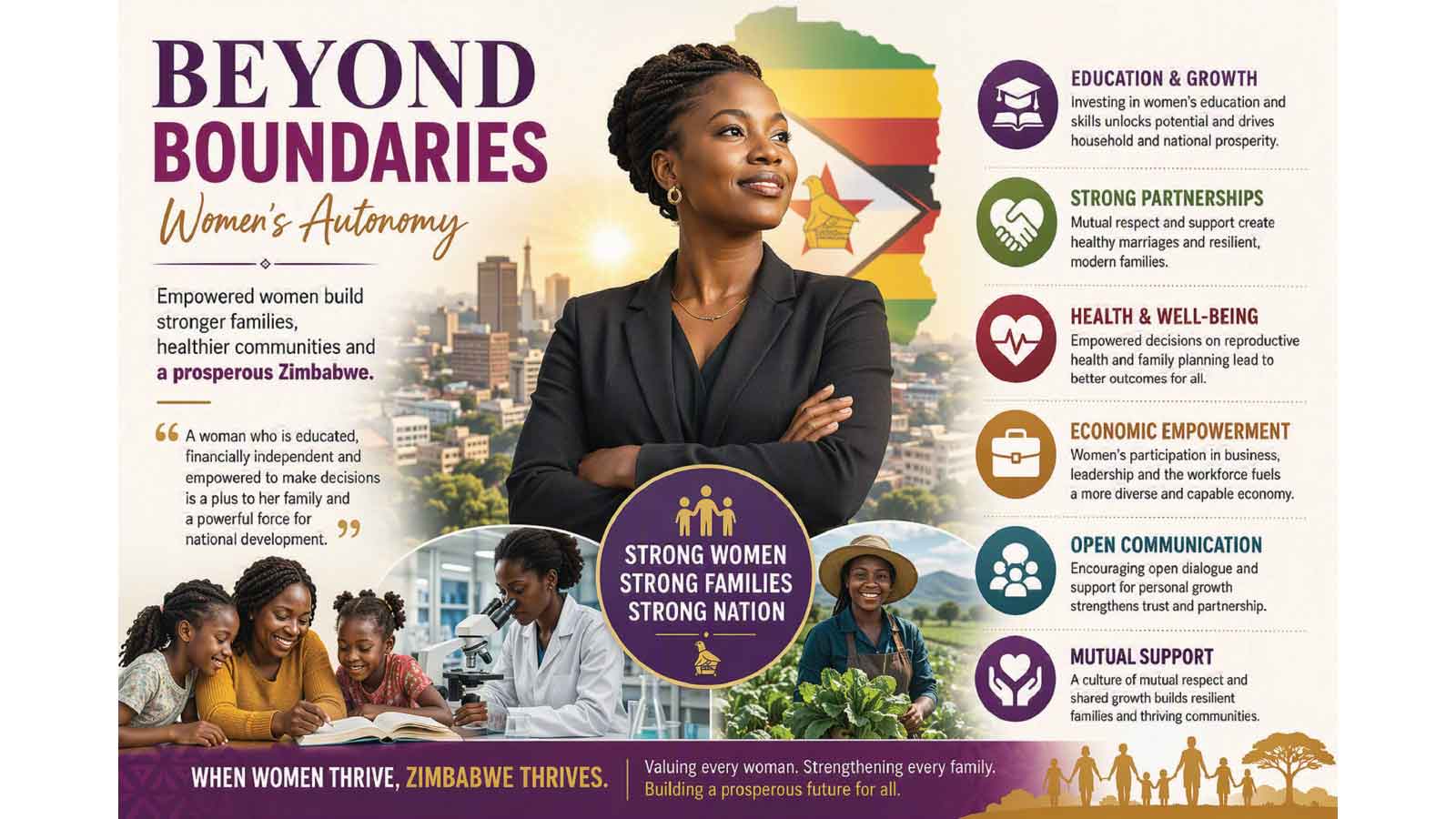
In the evolving landscape of Zimbabwean society, the conversation surrounding women’s empowerment has reached a critical juncture.
As we strive for national development, it is increasingly clear that the strength of our families and the prosperity of our nation depend on how we value the individual contributions of women.
At the heart of this progress is the concept of autonomy — not as a radical disruption of our cherished values, but as the foundational element of a healthy, productive and harmonious society. In the Zimbabwean context, marriage is widely regarded as a sacred union — a cornerstone of our social fabric. However, the true strength of this institution is found in the quality of the partnership.
A thriving marriage is built on mutual respect, where two whole individuals come together to form a greater sum.
When we encourage women to pursue education, maintain their professional passions and cultivate friendships outside the home, we are not undermining the family unit; we are fortifying it. A woman who is self-assured, financially savvy and intellectually engaged brings resilience to her household.
Rather than seeing a partner’s individual pursuits as a deviation from family duty, we should recognise them as essential components of a robust, modern Zimbabwean family.
When a partner is a “plus” to one’s life rather than the sole architect of one’s happiness, the relationship becomes more stable, reducing unnecessary pressure on both parties.
One of the most vital aspects of autonomy is the ability to make informed decisions regarding reproductive health. The 1995 Beijing Declaration, which Zimbabwe is a signatory to, highlights the importance of women’s health in achieving sustainable development.
Empowered decision-making within a marriage — where health risks are discussed openly and family planning is approached as a shared responsibility — leads to better outcomes for mothers and children alike. When families are planned in accordance with the resources available, they are better positioned to provide quality education and healthcare for the next generation.
As seen in various community-led health initiatives, when a woman is empowered to participate equally in these critical life decisions, the entire family’s socio-economic status tends to improve significantly.
It is not about defying traditions, but about ensuring that the health and long-term viability of the family unit remain the top priority.
Societal expectations often place women into specific, well-defined roles. While these roles — as mothers, daughters and wives — are undoubtedly noble, they should not eclipse the multifaceted identity of the woman herself.
Embracing one’s autonomy is simply the practice of recognising one’s worth as a citizen and a contributor to the economy. Whether it is through entrepreneurship, community leadership or professional excellence, a woman’s growth is a net gain for Zimbabwe.
We see this today in the increasing number of Zimbabwean women holding positions of influence in both the public and private sectors.
Their success serves as a testament to the fact that when women are encouraged to develop their talents, the nation reaps the rewards of a more diverse and capable workforce.
To achieve a more balanced society, we must foster environments where open communication is the norm. A good partnership thrives when both individuals are encouraged to grow.
This requires a shift in how we perceive time spent apart or independent activities. A secure partner understands that supporting one’s spouse in her external endeavours is not a sign of neglect, but a reflection of trust and a commitment to her holistic well-being.
As we look towards the future, the goal is to create a culture of mutual support.
By decentring the old paradigms of absolute dependence and instead fostering a model of partnership based on mutual respect and shared growth, we ensure that Zimbabwean families remain resilient.
Let us continue to advocate for a society where every woman is valued not only for the roles she fills but for the unique individual she is. By doing so, we strengthen our communities and uphold the dignity of all citizens, ensuring a prosperous path forward for everyone.