admin
admin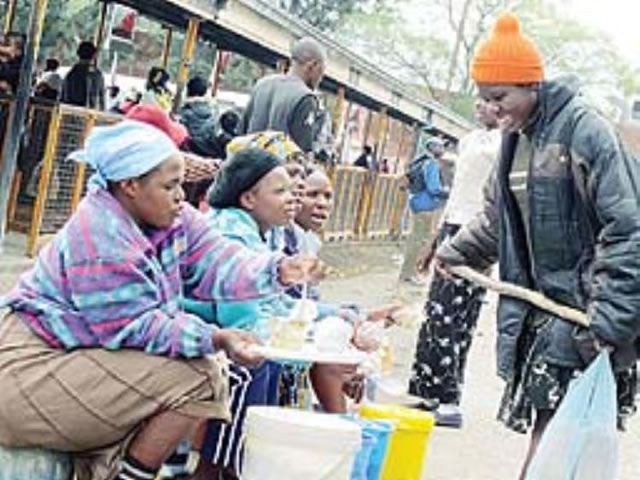

Vaidah Mashangwa
THERE is a strong belief in many African countries that women’s labour is not productive and does not create exchange value.
But the domestic economy is essential to the functioning of the economic system with women playing a critical role in the overall economic growth of most states.
Women’s contribution to socio-political and economic development is underestimated, one of the factors which lead to discrimination and the exclusion of women in major economic activities.
It is a fact that women provide most of the basic food stuffs for domestic consumption and they also ensure food security at household level. This places women high on the agenda in ensuring the successful implementation of the Zimbabwe Agenda for Sustainable Socio-Economic Transformation (Zim-Asset).
Women continue to engage in various agricultural activities such as poultry production, bee-keeping, piggery production and value-addition through trainings conducted by the Ministry of Women Affairs, Gender and Community Development countrywide.
Women dominate Zimbabwe’s farming sector, they frequently produce for the market, and they are processors of food, they are domestic workers and child rearers. In rural areas, women do most of the work as many men migrate into towns in search of employment.
If we are to consider accurately their role in the process of socialist transformation, we must also consider in greater detail the amount of labour that both rural and urban women provide.
In urban areas, a significant number of women are into fruit and vegetable vending and while it is a task that we take lightly, it is time consuming and involves a lot of determination. Most vegetable vendors are awake by 4AM and a normal day ends around 9PM.
Domestic work done by women extends itself into activities such as gathering firewood, picking and watering vegetables for daily meals, baking bread for family consumption in village ovens, fetching water, and at times herding domestic animals.
Sometimes, meals are prepared at home and taken to the fields for workers and family members.
After harvesting, the cereals are dried, packaged and processed for daily consumption. While the work done by women is not commoditised, it satisfies basic human needs and ought to be valued accordingly.
The daily reality of how much women contribute to labour is underestimated. As such, women are never afforded economic power and this consequently limits their political power.
Generally, men own more resources than women, giving them political mileage.
Also, because of the time they spend in subsistence production, women’s full participation in politics is limited causing their contribution in decision-making processes to dwindle. Women will remain unequal to men for as long as they continue engaging in unpaid work.
Countries such as Angola, Mozambique and of course Zimbabwe are making meaningful progress in ensuring the socio-political and economic emancipation of women.
Though men and women are equal partners in the socio-economic and political arena in practice, most socialist states have not achieved the equality of men and women.
At times, legal changes alone do not necessarily eliminate the oppression of women but it also implies change in the mind-set of men and the society as a whole in gender equity and equality issues.
Apart from challenges by women in agricultural production, if women were to increase their subsistence production for the market, they would need technical and material support.
While this might assist in increasing production, the sexual division of labour will remain unaltered as materialistic progress alone does not necessarily result in the liberation of women.
When organising co-operative production, women largely choose vegetable gardening, poultry rearing or sewing while men pursue bigger projects such as brick-moulding, carpentry and spare-parts shop selling.
In the end, traditional cultural values are strengthened.
Male dominance is a major feature of our society and as the dominant group; men can limit women’s access to the social, political and economic power that they enjoy thus sparing themselves from female competition.
Studies have shown that more women than men vote and that women are also likely as men to be active campaign workers but surprisingly, it is more men than women in political office.
However, depending on the calibre of man and mutual understanding between marriage partners, some families are witnessing changing roles of men and women.
Meanwhile, research has shown that traditional attitudes about gender roles are stronger in rural and non-individualised societies than in urban settings.
In general, women tend to have less traditional attitudes than men.
The participation of women in paid work has reportedly increased by 57 percent while on the other hand, men have started doing more chores formerly done by women such as shopping for groceries and taking care of children.
The writer is Vaidah Mashangwa, provincial development officer in the Ministry of Women Affairs, Gender and Community Development, Bulawayo. She can be contacted on 0772111592 or email: [email protected]



 Online Reporter