admin
adminthe 1990s to avoid rises in electricity tariffs, and then as these imports dried up the swinging financial sanctions meant it was impossible to borrow from development funds.
Now the World Bank reckons Zimbabwe needs to spend US$13 billion alone of resuscitating what we have and adding extra capacity.
To a large degree this incredible figure, about twice our gross domestic product, is underlain by a wish list rather than by what even our richest neighbours are doing in a practical way.
For a start no country in the world invests two or three times its annual GDP in energy infrastructure. Usually energy infrastructure and GDP are intimately linked in a virtuous spiral, investment rising as GDP rises and GDP rising as investment rises.
But we also have to remember that some investments produce rises in GDP well above the average, such as the infrastructure needed to supply a major mine or large factory complex, and some huge investments might produce very modest rises in GDP, such as electrifying a sparsely populated rural area.
Developing countries tend to first make the investments that produce the largest gains and only later go for the investments that produce just the modest gains. We need to remember that there are millions of people still alive in the US and Western Europe who can well remember when large swathes of farms were without electricity, but no one in those countries who was born before all larger towns were electrified.
So Zimbabwe does need to step up its investment rate in energy, but there is no way we are going to spend US$13 million all at once.
And there may well be options that will produce all that we need at well below the US$13 million thumb suck from the World Bank.
Most of the estimates for boosting power generation in Southern Africa tend to assume that we will build large numbers of coal-fuelled thermal stations, using the region’s huge reserves, with each country being at least almost self-sufficient. They also assume more expensive dams on the Middle Zambezi, schemes that may only add one gigawatt to the grid at huge cost.
South Africa, in addition, assumes that a second nuclear station could be added to its generation capacity.
Yet if Southern Africa is prepared to accept regional security, rather than national security, there has been on the table for some decades the largest power station in the world, Grand Inga between Kinshasa and the sea on the Congo River, which would provide around 40 000 megawatts for a cost of “just” US$80 billion, and there is no other scheme on this planet that can put out a gigawatt for an investment of just US$2 billion.
To put Grand Inga into perspective, it would almost double Sadc power generation. Another way of looking at it would be the advantage to Zimbabwe. Just half that US$13 billion the World Bank is talking about invested in Grand Inga would quintuple our present power output and more than quadruple what we will produce when Hwange Thermal is fully rehabilitated.
A preliminary study by South Africa’s Eskom in the 1970s reckoned that the costs of developing Grand Inga and transmitting the power all the way to South Africa would be less than half the costs of building the likely alternative, a chain of nuclear stations along the South African coast.
And that scheme would have negligible environmental costs, unlike the output of greenhouse gases from a dozen very large thermal stations, each about four times the size of Hwange, or the problem of waste disposal from nuclear stations.
So all that is required is a general Southern African pooled investment to develop the site; that development is a modest dam to divert the equivalent of the Congo River’s lowest flow during the year and a huge power station of 52 generators, each generator being roughly the same size as the whole of Kariba South, plus of course a transmission line.
Even that line can be laid with a pooled investment if it is sited correctly. Zimbabwean engineers in the 1980s noted that if the line is run through north-east Angola, western Zambia across the Caprivi, and then along the Zimbabwe-Botswana border to the Limpopo before terminating near Johannesburg, its biggest customer, it would rather conveniently feed the existing grids, directly, of the DRC, Angola, Namibia (via Caprivi), Zambia, Botswana, Zimbabwe and South Africa. Seven countries could meet their extra energy requirements for a decade or two from one power station and one transmission line.
The power station could even be developed in stages, new generators added as demand rose and investment capital became available.
All that is required is political will; the engineers have presented the proposal and can do the work and there is plenty of precedent in international commercial law to create very easily the transnational corporations that would be required for the station and the line, giving the DRC a fair royalty for supplying the site and the cheapest available power to 80 percent of the people of Southern Africa.
Zimbabwe’s share of, say, US$6 billion over 20 years suddenly becomes affordable, especially if the World Bank is prepared to do more than just talk and starts re-admitting Zimbabwe to its development lending programmes.


Online Reporter
- Chronicle
- July 28, 2026
- 13 views
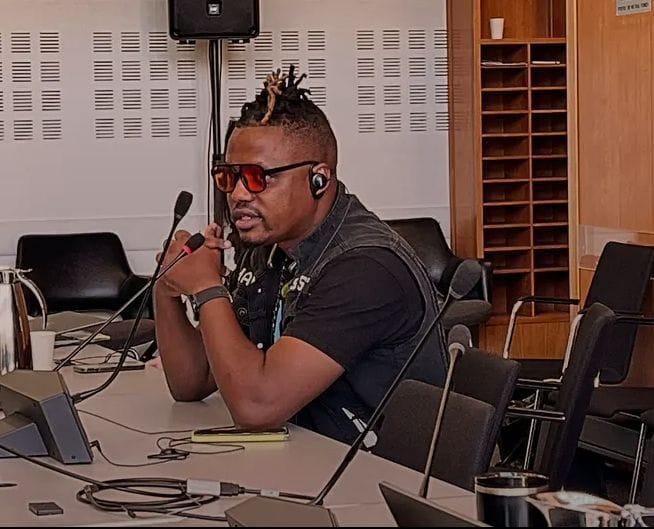
Dereck Mpofu takes Zimbabwean music to global health stage in Geneva
Nodumo Moyo, [email protected] Zimbabwean Afro-fusion musician and health advocate Dereck Mpofu has elevated his music onto the global stage after presenting the 2026 World Health Organisation (WHO) Hepatitis and Sexually…