

 admin
admin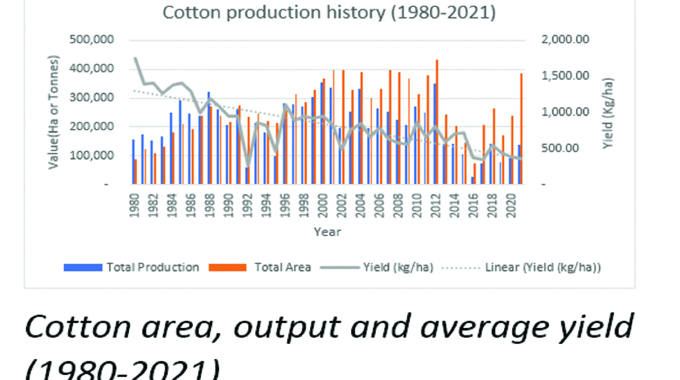
Edgar Vhera Agriculture Specialist Writer
ZIMBABWE will on Friday join the rest of the world in commemorating World Cotton Day.
An initiative of Benin, Burkina Faso, Chad and Mali, the celebrations that are held every seventh of October, were first launched on October 7, 2019.
In a statement, the Cotton Company of Zimbabwe (Cottco) yesterday said:
“The country will this year join the rest of the world in commemorating the World Cotton Day on Friday October 7, 2022 amid high hopes of increasing the economic contribution of the crop in the economy.”
This day was set aside to reflect on the importance of cotton as a global commodity and is meant to attract new investments from private and public sectors, development partners and cotton value chain players in the growth of the industry.
The event presents an opportunity to share knowledge and showcase cotton-related activities and products.
The day comes at a time cotton contractors are planning to contract over 600 000 growers to produce seed cotton under 480 000 hectares for the 2022/23 cropping season.
Cotton is a major source of livelihood for over 1 million people including farmers, farm workers and their families and secondary industrial workers. It is the second largest agricultural foreign currency earner after tobacco.
The Agricultural Marketing Authority (AMA) in 2011 revealed that cotton was a major source of raw materials for the oil expressing industry with over half of the cooking oil made in Zimbabwe coming from cotton seed.
The entire requirements of the domestic spinning and weaving industry, in terms of lint, are met through local production. Local ginners are mandated to destine 30 percent of their total lint output to domestic spinners and weavers before considering the export market.
Cotton productivity has been on a declining trend from an average yield of 1,75 tonnes per hectare in 1980 to around 0, 36 tonnes per hectare in 2021.
This year’s seed cotton output is expected to reach 55 million kg capable of producing 22,6 million tonnes of lint and 31, 9 million kg of cotton seed, further processing of which is projected to produce 6,38 million litres of cooking oil.
The cotton value chain starts with planting cotton seed bred at the Cotton Research Institute followed by mass production of planting seed by breeders and seed cotton by farmers.
Seed cotton is then ginned into cotton lint and cotton seed. Cotton lint is sold to local and foreign spinners who normally process it into yarn and textiles. Further processing of yarn produces household linen, sheets, towels, curtains, bedspreads, clothes, ropes, bags, lining for tyres, canvas tents and medical bandages and so on.
Cotton seed can be further processed into crude cotton seed oil which will be refined into edible cooking oil.
The residual meal is processed into stock feeds and the remaining hulls can also be used for stock feeds, fertiliser, bran or pulp. The short fibres or linters are processed into various by-products such as pulp, paper, viscose, yarns, felts for furniture and automobile upholstery, pads and cushion material. The cotton waste can also be processed into medical grades of absorbent cotton wool.
One tonne of cotton seed yields approximately 200kg of oil, 500kg of cotton seed meal and 300kg of hulls. Cotton seed oil is also used to make products such as soap, emulsifiers, cosmetics, pharmaceuticals, rubber, paint, water proofing agents and candles.
In Zimbabwe, current cotton production is not sufficient to meet the edible oil needs with the country resorting to imports.
The local spinning industry consumes less than 10 percent of lint production while the bulk of the lint is exported. The textile and clothing sub-sectors face very stiff competition from imports of finished second hand clothing.
The low-cost second-hand clothing is finding its way into Zimbabwe thus negatively impacting on domestic demand for locally manufactured fabrics.
Stakeholders have called upon Government to offer incentives to entrepreneurs for the resuscitation of the cotton to clothing value chain in order to create employment in excess of 50 000 as was the norm in the better years.
Zimbabwe Textile Workers Union (ZTWU) secretary general Mr Norman Makono had this to say: “The country’s formal textile sector at its peak used to employ 24 000 people but over a 15-year period by 2010, the figure had whittled down to 11 600, a reduction of about 12 400.
“Company numbers were also reduced over this same period due to closures and retrenchment. The number of employment within the textile industry has since withered to 3 500 currently.”
Recently the Zimbabwe Textiles Manufacturers Association chairman Mr Admire Masenda said: “The Government must seriously consider giving more incentives to exporters of finished high value goods. For example, now that the cotton farmers have been incentivised by receiving 75 percent of their money in hard currency, there was need for exporters of manufactured cotton finished products to retain more funds in their foreign currency account (FCA) rather than 60 percent.
“If incentives are given at each node of the value chain there will be ripple effects in the number of employments generated throughout chain.”



 Online Reporter