admin
admin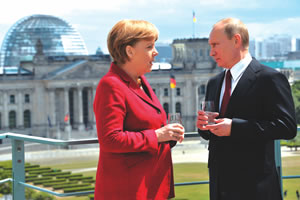
“extremely dangerous” but underlined his opposition to military intervention, after meeting German Chancellor Angela Merkel on the second leg of his first foreign tour since returning to the Kremlin.
Amid mounting pressure for Moscow to drop its resistance to tougher UN action on Syria, Putin, who was later due in Paris, warned at a joint press conference with Merkel: “You cannot do anything by force.”
“Today we are seeing emerging elements of civil war,” he said after arriving in Berlin from Belarus.
“It is extremely dangerous.”
Putin’s brief trips to Berlin and Paris come amid mounting outrage in the West against Syrian President Bashar al-Assad’s regime after a massacre of 108 people, including women and children, in the town of Houla last week. UN rights chief Navi Pillay said the massacre could be a crime against humanity.
“We both made clear that we are pushing for a political solution, that the Annan plan can be a starting point but that everything must be done in the United Nations Security Council to implement this plan,” Merkel said, referring to a peace plan brokered by UN-Arab League envoy Kofi Annan.
Her comments set a more conciliatory tone after the United States criticised Moscow over its stance on Syria and new French President Francois Hollande, who meets Putin later in Paris, refused to rule out foreign military intervention as long as it is carried out with UN backing.
Putin said Moscow was not taking sides in the deadly strife rocking Syria, where the Britain-based Syrian Observatory for Human Rights says 13 000 people have been killed since Assad’s regime launched a brutal crackdown on the opposition in March last year.
“To find a political solution of these problems. Can it be done or not? On the whole, I believe it is possible,” Putin told reporters.
“It requires certain professionalism and patience. You cannot do anything by force and expect an immediate effect,” he said.
But he added: “A lot of people are involved in the conflict with various interests.
“There is a need to find a convergence of these interests and have them sit down at a negotiating table. That’s the direction we are going to work in.”
Merkel earlier greeted Putin with military honours as demonstrators waving Syrian flags shouted and whistled outside.
Another protestor held a banner in the shape of a Russian flag with the Russian words “Putin is a thief” emblazoned across it.
“We were agreed that every country — I said this for the Federal Republic of Germany — must do everything to prevent a civil war and prevent more people suffering,” Merkel told reporters.
British Foreign Secretary William Hague also said Syria was on the verge of a civil war and risked collapsing into sectarian strife after meeting members of the Syrian opposition based in Istanbul.
Germany, France, Britain, the United States and other Western nations expelled Syrian diplomats in protest at the slaughter in Houla.
Syria allies China and Russia, which have both blocked previous attempts at the UN Security Council to condemn Damascus, joined other council members on Sunday in backing a statement condemning the Houla killings.
But US Secretary of State Hillary Clinton on Thursday warned that Russia’s policy of propping up the Assad regime could contribute to a civil war and even lead to a wider proxy war because of Iran’s support for Damascus.
The United States also condemned as “reprehensible” Russian arms deliveries to Syria, but Putin hit back Friday at suggestions Moscow was supplying weapons for use in Syria.
“As far as arms supplies are concerned, Russia does not supply the weapons that could be used in a civil conflict,” Putin told reporters.
German Foreign Minister Guido Westerwelle said in an interview with Die Welt newspaper yesterday that Russia should recognise that efforts to halt the violence in Syria were “not working against Russian strategic interests.”
“We must not give the impression in this difficult situation that military intervention is the road to a quick fix,” he said as his spokesman announced he would soon make a trip to the region.
Amnesty International demanded that Putin immediately stop Russian weapons deliveries to Syria, while Human Rights Watch called for Putin to make human rights a priority at home and abroad.
Meanwhile, China yesterday said that it is not acting as an “obstacle” for resolving the Syrian crisis, but is instead a “positive force” in promoting a political resolution to the issue.
Foreign Ministry spokesman Liu Weimin made the remarks at a press conference when asked to comment on recent statements by US Secretary of State Hillary Rodham Clinton regarding Russia and China’s involvement in the issue.
Clinton said on Thursday that Russia and China stand in the way of an international coalition against the government of Syrian President Bashar Assad.
Russia, along with China, have twice vetoed UN Security Council sanctions against Syria.
Liu said Syria has avoided a full-blown war thus far largely because of the efforts of the international community, including China.
He added that these efforts have brought forth, new opportunities for resolving the crisis politically.
Liu reiterated that China has no expediency on the Syrian issue.
China has been committed to safeguarding the purpose and principles of the UN Charter and the basic norms governing international relations, as well as maintaining peace and stability in the Middle East and standing up for the fundamental interests of the Syrian people, he added. — AFP/Xinhua.


 Online Reporter