admin
admin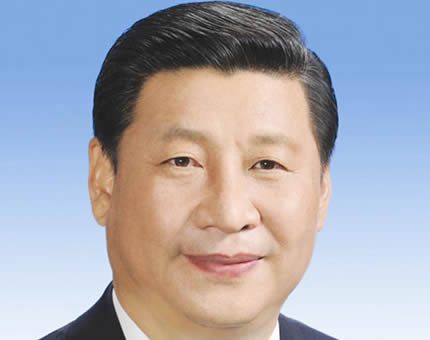
of the People’s Republic of China (PRC) and chairman of the PRC Central Military Commission (CMC) yesterday. He succeeds former president Hu Jintao.
Xi Jinping, who was born in June 1953, is an ethnic Han from Fuping, Shaanxi Province. He entered the workforce in January 1969 and joined the Communist Party of China (CPC) in January 1974. He graduated from the School of Humanities and Social Sciences at Tsinghua University with a major in Marxist theory and ideological and political education, has an in-service postgraduate education and holds the degree of Doctor of Laws.
About 3,000 delegates lined up to cast their votes in Beijing’s Great Hall of the People, dropping red papers into red ballot boxes in front of giant red flags, but the outcome was never in doubt.
Xi received 2,952 votes at the tightly choreographed ceremony, with one against and three abstentions, a 99.86 percent share.
“Now I announce comrade Xi Jinping is selected as president of the People’s Republic of China,” said Liu Yunshan, who chaired the session at the National People’s Congress, the country’s parliament.
To loud applause, Xi (59), stood up and bowed to the delegates, before shaking hands with other officials and walking off the stage.
Xi’s formal appointment as head of the world’s most populous nation is due to be followed by the naming of Li Keqiang as premier today, marking the final step in the nation’s once-in-a-decade power handover.
Xi’s new role was effectively guaranteed by his position as Communist party leader, the real source of his authority in China, but the title will increase his public and international standing.
Related Stories…
He takes office at a time when China is becoming more assertive on the global stage and is taking a harder line on territorial rows with its neighbours, and Xi has vowed to increase its military strength.
Domestically, since taking the top party post in November, Xi has pledged to preserve the ruling party’s grip on power by cracking down on corruption, improving people’s livelihoods and pushing forward economic reforms.
But despite the promises of action on multiple fronts, including pollution, observers say concrete reforms would be complex and will not be swiftly introduced.
“In recent memory there is no comparable figure who has such power in his hand (so quickly),” said Willy Lam, a politics expert at the Chinese University of Hong Kong.
As the son of one of China’s most famous generals, Xi has closer ties to the People’s Liberation Army and has strengthened the relationship in recent months with an unusually high number of visits to military bases.
He is seen as one of the architects of China’s recent more assertive stance on territorial disputes with neighbouring countries and a supporter of Beijing’s military expansion, telling troops recently that they should be “combat ready”.
“Comrade Xi Jinping pays a great deal of attention to military development, especially in raising the military’s level of battle preparedness,” said Yang Jianhua, a green-uniformed military delegate to the NPC.
Tokyo sent congratulations, and its chief cabinet secretary Yoshihide Suga said it had “always kept our door open for dialogue with China”, adding the relationship was “one of the most important international relationships for Japan”.
Officially Xi was elected for a five-year term, but tradition dictates that barring extraordinary events he will hold the position for a decade.
He is a Communist “princeling”, the name given to relations of the first generation of Communist leaders, who grew up immersed in the ruling party’s upper echelons.
Russian President Vladimir Putin yesterday congratulated President Xi Jinping on officially becoming China’s president, hailing the two sides’ “strategic partnership” and calling for even closer ties.
Putin told Xi, who is expected in Moscow later this month as part of his first foreign trip as president, that he also looked forward to meeting the Chinese leader, the Kremlin said.
In a telephone conversation, Putin “expressed satisfaction with the development of strategic partnership between Russia and China,” the Kremlin said in statement.
Putin also “underscored (Russia’s) interest in expanding cooperation in all areas, and also strengthening cooperation on the international arena”.
Russia and China jointly blocked three rounds of UN Security Council sanctions against Syrian President Bashar al-Assad in the past two years, vowing to continue to coordinate their foreign policies.
Xi is also expected to visit Africa on his first official trip abroad to attend the BRICS summit of top developing economies in Durban on March 26-27. – Xinhua/AFP.


 Online Reporter