

 Chronicle Editor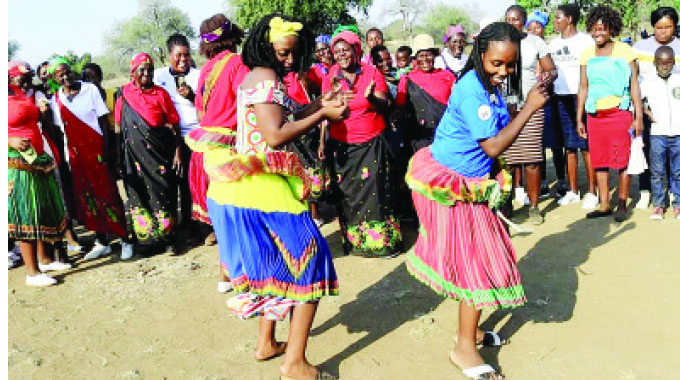
Thupeyo Muleya, Beitbridge Bureau
In Africa, music and dance play a very important role to preserve culture, relay history and maintain a certain identity.
Every African is proud of his or her cultural identity and is keen on preserving it at all costs.
Dance and music are often used during happy or sombre moments in most African setups including in Zimbabwe.
Zimbabwe has many different ethnic groups dotted in various places countrywide.
One such ethnic group is the Shangani located mostly in the southern parts of the country in places such as Chiredzi, Manicaland and Beitbridge.
Since time immemorial, the Shangani have been identified through the type of traditional clothes they wear for dance or other cultural activities.
Xibelani (Shibelani, Shibelana, Shibelane) is a popular dance and attire which distinguishes them from other ethnical groups.
The xibelani dance is an indigenous dance of the Tsonga or Shangaan women mostly.
In general terms, the name “xibelani” refers to the dance style while the skirt itself is referred to as tinguvu. However, the term “xibelani” is sometimes used to refer to both the dance and the skirt.
When one drives for 135km east of Beitbridge town, they come across the Shangani at Tshikwalakwala who have been working tirelessly to preserve their history, ethos and cultural values.
“This is a dance, where women move around in a circle, wriggling their waists. It shows our unity in maintaining our Shangani culture.
The term xibelani refers to the dance but it has become associated with clothes worn by the female dancers,” said Mrs Selina Maluleke, one of the senior women involved in preserving the Shangani culture at Tshikwalakwala.
“In fact, xibelani has become our eternal identity as the Shangani people; whether it’s those from Mozambique, Zimbabwe or South Africa. All the ethnical groups can easily identify the Shangani with the xibelani (skirt) especially when it’s properly worn.”
She said children start training from any age, but mostly around 12 years, and that this is done to ensure that they continue preserving their identity and culture.
According to Mrs Maluleke, the dance moves which involve wriggling one’s waist were taught at household level and initiation schools.
The dances differ with events which include weddings, cultural celebrations and sombre moments.
Other dances include mitshongolo, no-giya, kutshi-kitsha and magwaya.
“These are done depending on the occasion, however, xibelani is popular during celebrations and cultural events,” she said.
Mrs Maluleke added that although they were settled with many other ethnical groups around their area, they ensure that the dance and dressing is maintained at all their gatherings to preserve their identity.
She said the dance was attracting a lot of interest from many people and that they were working very hard in ensuring that all females in their area go through the dance and cultural trainings.
The xibelani dance has become one of the major attractions at the annual Mapowu Day that is held in September every year at Tshikwalakwala.
The event coordinator, Mr Melusi Hlongwane said:
“We use the day to celebrate the arrival of the first group of Shangani people at the confluence of the Bubi and Limpopo rivers.
“Our ancestors came from down south and settled in the fertile lands at a place called Mapowu. So, to preserve and promote our heritage, we hold this festival every year.”
On the day, he said, they bring together the Shangani people from Beitbridge and Chiredzi and adjacent villages in South Africa.
Mr Hlongwane said events like these help them stay true to their culture and pass on the knowledge from generation to generation.
“What we need to do is to build culture centres where people can visit throughout the year to learn more about the Shangani, Pfumbi or Venda people,” he said.
A Chiredzi based expert on Shangani culture, Mr Khesani Matatise, said xibelani dance is a VaTsonga type of dance that evolved from the celebrations connected to female rites of passage and etymologically.
He said it signifies the important role of women in procreation and economic productivity.
“It has been modified in time to fit contemporary tastes as culture evolved in time.
Nowadays it’s usually accompanied by the traditional genre of XiTsonga music. Xibelani dance is common among the VaTsonga people in Zimbabwe, South Africa, Mozambique and Swaziland but in slight variations,” said Mr Matatise.
He said other dances include xi(shi)nombela, Xigubhu, Makwaya and Marhula.
Unlike xibelani which is ceremonial, he said, these are usually done on occasions.
“However, they’re increasingly becoming ceremonial,” added Mr Matatise.
He said the xibelani skirt is specially made to give a specific heaviness and is usually decorated with beads.
The dancer, he said, also adorns themselves with waist, angle and wrist beads.
Mr Matatise added that xibelani also has a version modified for traditional fashion attire that is worn as a symbol of Vutsonga.
“Indeed, it has become the identity dress of the VaTsonga people in Southern Africa.”
Mrs Rossie Kwinika of Goda area in Beitbridge said previously, they used to buy the material to sew the Tinguvu (Xibelani) skirt from Musina, South Africa.
She said now they were buying the material from the Giyani area for resale in Beitbridge at varied prices depending on the stock process.
The skirts are sold for between R1 500 and R2 500 in South Africa.
A xibelani dancer from Mugwazhuli area of Beitbridge, Miss Tsameleni Nyagomo said she feels proud whenever she is on the dance floor.
“The dancing lifts my spirit, it makes me proud to show how the Shangani dance is unique from other ethnic groups. This is a dance we enjoy mostly in times of happiness.
This can be at weddings and any social gatherings,” said Miss Nyagomo. — @tupeyo


 Blessing Chizhande
 Online Reporter