

 Chronicle Editor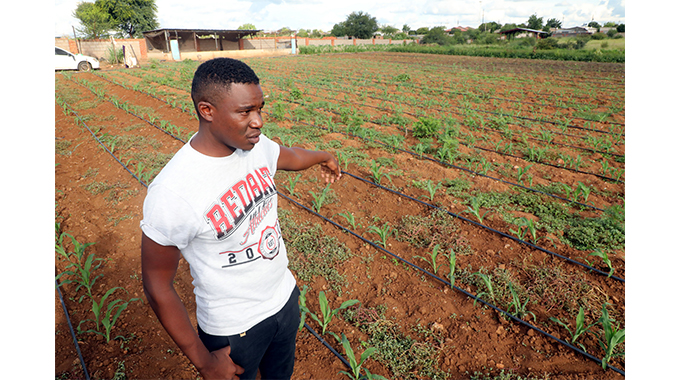
Flora Fadzai Sibanda, Chronicle Reporter
WHEN Mr Brian Mpofu (28) left his permanent job as a police officer in 2017 to venture into full-time farming, there was skepticism about his career choice among family members and former colleagues, but that did not deter him from pursuing his dreams.
After leaving the Zimbabwe Republic Police (ZRP), Mr Mpofu started farming on a one-and-a-half hectare piece of land in Nketa 9 in Bulawayo.
Today, he is running a thriving horticulture project, supplying Bulawayo markets with potatoes, butternut, tomatoes, carrots and chomolia. Since venturing into full-time farming, the youthful farmer has never looked back as his horticulture project is paying dividends.
He has also created employment for two youths who assist him in the project. Mr Mpofu, who is also running a poultry project, specialises in growing vegetables on his rented piece of land and recently harvested over 300 pockets of butternut and 60 pockets of potatoes, selling them at US$5 each.
Mr Mpofu’s story is one of hard work and risk-taking. He represents a crop of young farmers who are defining the success story of farming, thereby contributing significantly to food security for the nation.
Mr Mpofu is a product of the Opportunities of Youth Employment (OYE), a programme that is being implemented by the Netherlands Development Organisation (SNV) in partnership with Jairos Jiri, Bulawayo City Council (BCC) and other development agencies.
SNV funded the OYE programme to the tune of US$5 million in 11 districts in Zimbabwe.
SNV started the programme in 2019, which seeks to improve the livelihood and prospects of 10 000 out-of-school youths by creating “green” employment and enterprise opportunities in agriculture, energy and other emerging sectors.
It is supported by the Embassy of Sweden and the Swiss Agency for Development Cooperation.
Mr Mpofu joined OYE in 2016 and acquired skills in horticulture farming.
“In 2017, I took a big leap of faith to decide to quit my job and try something new by focusing on farming. My family frowned on my decision as they could not understand why I was leaving a stable job for something that I was yet to fully explore and understand,” he said.
As a hands-on farmer, Mr Mpofu toils on his piece of land, which he is leasing from BCC, and has managed to transform it into enviable farming project.
“Despite cynicism from my family and former colleagues, I didn’t look back and today I am running a flourishing horticulture project in Nketa 9 and supplying markets in Bulawayo with my fresh farm produce such as potatoes, butternut, tomatoes and carrots,” said Mr Mpofu.
While Mr Mpofu has a five-year lease with BCC, his ultimate long term plan is to acquire his own land and expand his business.
Mr Mpofu relies on a solar powered engine to pump water from the borehole to the fields.
“I actually installed a solar powered water pump and in 2020 and I erected a perimeter fence to protect the crops from being stolen. There was no meaningful development on this piece of land,” he said.
Since Mr Mpofu didn’t have enough money to buy irrigation equipment, in 2021, he decided to go to South Africa to look for a job where he raised funds to further develop the land.
“I bought the pipes, which I am now using for irrigation purposes. I introduced drip irrigation, which helps conserve water as well as improve the quality of my produce,” he said.
When the Chronicle crew visited the farming project, Mr Mpofu was busy sorting his butternuts as he prepared to take them to the market.
“I managed to harvest more than 300 pockets of butternut and 60 pockets of potatoes. I sell pockets for US$5 each and supply Bulawayo markets,” said Mr Mpofu.
The young farmer said through farming, he hopes to contribute significantly to the country’s economic growth.
Zimbabwe is an agrarian economy with most of the country’s sectors being directly and indirectly linked to the agricultural sub-sector.
Government is targeting transformation of rural and urban economies through enhancement of food, nutrition, markets, and jobs using value chains, including the horticulture sector, as a means of achieving a prosperous, inclusive, diverse, sustainable and competitive agriculture sector.
Zimbabwe envisages to be an upper middle-class economy by 2030 and agriculture is critical in the attainment of that vision, with the sector targeting to become an US$8,2 billion economy by 2025.
The Horticulture Recovery Plan, which was launched in 2020 by President Mnangagwa, is part of Government initiatives under Agriculture and Food Systems Transformation Strategy (2020-2025) to transform agriculture from a US$5,2 billion to a US$8,2 billion sector, contributing 20 percent of GDP by 2025 in line with the vision of making Zimbabwe an upper middle-income economy. @flora_sibanda



 Blessing Chizhande
 Online Reporter