Chronicle Editor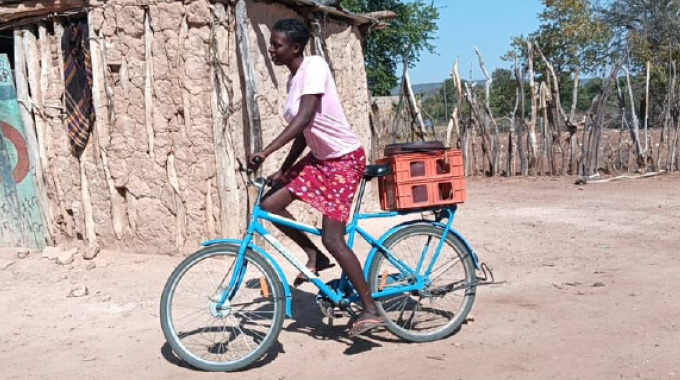
Leonard Ncube, [email protected]
THE faint light of dawn barely pierces the horizon as 24-year-old Exodus Munkuli sets out from her homestead in Siameja Village, Binga.
With a determined glint in her eyes, she loads a 20-litre container onto her bicycle, embarking on a 7km journey — a quest for water to sustain her dreams.
The scorching Binga sun and long queues at the village’s only water source pose a daily challenge, but Munkuli isn’t deterred. She wakes up before the first rooster crows, determined to beat the rush and secure precious water for her flourishing “keyhole” garden.
With a crate strapped to her bicycle carrier, she navigates the dusty path towards the community water tap. Eight 20-litre buckets — that’s her daily requirement to nurture the garden, a testament to her backbreaking effort. Watering the garden four times a week is just part of the equation; there’s her herd of sheep and goats, and of course, household chores.
In a community where teenage pregnancy and early marriage are prevalent, Munkuli’s path is an anomaly. The second-born in a family of three, she defies expectations. She rejects the notion of relying solely on handouts, driven by a burning desire for self-sufficiency.
Munkuli’s vision extends far beyond her homestead. Her dream is to become an agricultural teacher, empowering others to achieve food security. She aspires to inspire young people to be self-reliant even in the face of climate change, societal pressures and historical marginalisation.
In 2019, Munkuli graduated from Siansundu Secondary School with seven O-level subjects. She made the conscious choice to stay away from the pitfalls of early marriage and teenage pregnancy, paving the way for a brighter future.
Next year, Munkuli sets her sights on Hillside Teachers College. This is just the first step towards achieving her dream of becoming a beacon of hope for her community.
Munkuli’s story isn’t one of solitary struggle. She’s part of a mentorship programme by Binga-based Basilwizi Trust, focusing on Sexual Reproductive Health Rights (SRHR). The programme, in partnership with Action Aid Zimbabwe and other organisations, integrates SRHR with agricultural initiatives to create a foundation for food security.
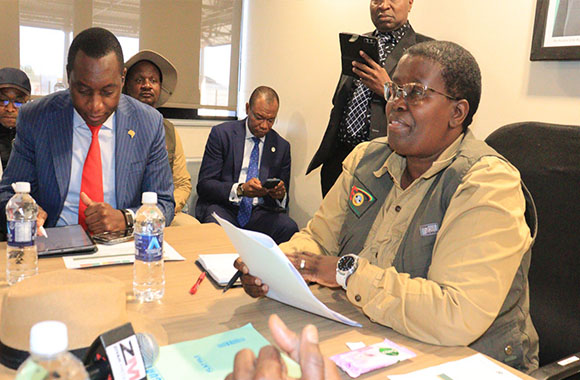
The unique programme operates across five Southern African countries. Recently, journalists were invited to witness first-hand the projects undertaken by the likes of Munkuli in Binga’s Tinde and Siansundu wards. The aim is to equip journalists with the skills for social accountability reporting, strengthening their role as watchdogs and fostering a more informed and empowered citizenry.
Munkuli’s keyhole garden stands as a symbol of her resilience. The innovative design — a raised bed with a central reservoir for water retention — is a demonstration of her resourcefulness in the face of climate challenges. But more importantly, it represents the seeds of hope she’s planting — for herself, her community and a future brimming with self-reliance.
“I started the rearing project in 2020. I was doing nothing after school when I started attending workshops and saved the allowances I received from there. As a young girl, I could have bought face powders and lotion using the money, but I saved it and bought two goats and two sheep which have multiplied.
“I also requested a piece of load from my father and started doing conservation farming last year with help from Agritex officers, although we were affected by the El Nino-induced drought. We had exchange visits with some colleagues from Mutoko and I learnt that they were earning a living through gardening, so with encouragement from traditional leaders who teach us about sustainable living, especially through farming, I started a keyhole garden model.
“We have a challenge of water and sometimes I use a bicycle to go and fetch water for the garden which I water four times a week. We fetch water about 7km away. This area is dry and the water table is so deep that no villagers have a borehole,” she said.
Munkuli’s flourishing keyhole garden boasts a mix of okra, paprika, and tomatoes. The innovative design, with its central reservoir for water retention, is particularly apt given Binga’s scorching climate.
The bicycle she uses is part of the Basilwizi Trust mentorship programme, a valuable tool for her work. Her father, a community health worker, also received a bicycle through the programme.
Munkuli is a true trailblazer. Not only is she the sole owner of a keyhole garden in the Saba area, but she’s also the only young woman in the community venturing into livestock farming. Her herd has grown to nine goats and nine sheep, despite the tragic loss of six sheep to hyenas — a stark reminder of the human-wildlife conflict in the region.
Undeterred, Munkuli takes her responsibility as a shepherd seriously. Every evening, she meticulously rounds up her herd from the surrounding hills and pens them for the night. This dedication comes with a risk, as venturing into the bush near the Zambezi River exposes her to potential attacks by predators.
Despite the challenges, Munkuli’s spirit remains unbroken. She is an inspiration to her community and urges young people to take charge of their destinies and embark on self-reliant projects. Water scarcity, she argues, shouldn’t be a deterrent to pursuing their dreams.
“If you don’t start projects you struggle in life. Young people need to join some networks and start this model of keyhole gardening which conserves water. They should attend community meetings to learn.
“I want my goats and sheep to multiply so I can earn a living out of them. I want to start a business with them and be able to also pay school fees. I know goat and sheep meat is a delicacy in the tourism industry so I want to enter that market. “I plan to go back to school to train as an agriculture teacher so that I can come and teach in the community,” said Munkuli. Munkuli’s success could pave the way for future leadership in the community, especially with a shortage of experienced farmers.
Across the district in Tinde ward, another inspiring story unfolds. Lithini Moyo, a 20-year-old mentee in the same programme, has joined forces with 10 others to establish a communal garden. However, water scarcity casts a shadow on their efforts.
Just like Munkuli, Moyo and her team rise at around 4am to queue for water at a well near the silted Tinde River. They must get water before the well is overrun by domestic animals later in the morning.
This shared garden serves a dual purpose for Moyo — it provides for her one-year-old daughter and even generates income to help pay school fees for some group members. Their collective effort exemplifies the power of community and resourcefulness in the face of adversity.
“We are a network of 25 young girls and boys and only 10 started the garden through the PSA programme. We are facing water challenges and we get it from a pool that accumulates under the bridge at night and dries up during the day. Soon it will dry up because of temperatures and we will be fetching water from a dip tank about 7km away. We wish we could get manpower from the community to scoop the mud so that the pool doesn’t dry quickly,” she said.
Moyo said the PSA programme has helped capacitate young people in SRHR issues thereby reducing teenage pregnancies, early child marriages and school dropouts. “We used to have high rates of school dropouts as a result of early marriages and teenage pregnancies, but now that young people have learnt to attend community meetings, the cases are going down,” she said.



 Online Reporter