Vusumuzi Dube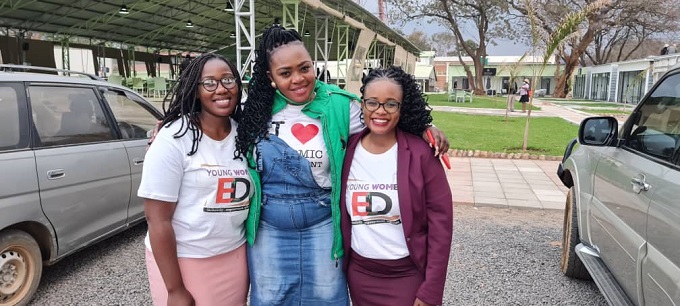
Mthabisi Tshuma, Sunday News Reporter
THE past couple of months have seen the birth of a new era where women are taking their development head on and in their hands.
This has seen the formation of an apolitical movement called Young Women for Economic Development (YWED).
Launched in August by First Lady Amai Auxillia Mnangagwa, YWED has had outreach programs in Gweru, Bulawayo and most recently in Matabeleland South province.
At the Matabeleland South outreach that was held in Figtree, a number of business women showcased their business initiatives which varied from beads making, detergents production, to clothing.
As the organisation has a mandate to incorporate not only urban based women but also rural women, Sunday News Reporter Mthabisi Tshuma (MT) caught up with YWED national programmes coordinator Ms Sithabile Gandi Ndlovu (SN) to get an understanding of the organisation’s operations.
Below are excerpts of the interview.
MT: As an organisation what strategies have you put in place to empower rural women?
SN: We are thriving for sustainable empowerment for young women in rural communities. The empowerment and development of women is a heavy but easy task that is if we all partake in actions with value and lifelong impact as individuals, development organisations, national and international government agencies, private and public companies.
This will lead to sustainable community impact and women development. As YWED rural transformation means new opportunities.
MT: Why rural transformation and what do you mean by rural transformation?
SN: Through rural transformation, young women in rural areas can drive economic growth, fight hunger and lift their own communities out of poverty. Young women that are in the business sector have a crucial role to play in achieving this. However due to the pre-existing challenges that young rural women face, rural transformation won’t just happen naturally but it is our collective effort to make it happen.
This can be done through firstly Education and Training Skilling, Resting and upskilling, changing of mindset towards education and training of young women in rural areas.
Rural women tend to have low literacy rate and this is due to a spectrum of reasons such as safety, costs and parental attitudes about educating the girl child. Meanwhile, even fewer girls continue to attend school during menstruation or after giving birth. We intend to partner with and lobby relevant stakeholders in increasing educational opportunities that yield significant improvements in the lives of women. We are looking at programs aimed at making secondary school more accessible and this can be done by reducing fees, strengthening counselling services or foregrounding discussion of gender.
In addition, improving vocational training by matching skills training to local market opportunities, or by tying financial literacy lessons into training on nutrition, entrepreneurship or farming are ways to promote learning for young rural women.
Especially with the help of woman mentors, young woman can gain the benefits of not only education, but also of increased confidence and broadened aspirations.
Secondly rural transformation focuses on strengthening voices and representation of rural young women. Young rural women need to be given more of a voice in the decision-making processes that affect them.
Traditional community norms may restrict the participation of women and youth, which means the specific needs of young rural women are rarely known or taken into account. As a result, the challenges that rural woman face often remain unaddressed. However, strengthening rural youth organisations, establishing a minimum level of representation at policy dialogues and providing training in public speaking and leadership are all ways to make sure the voices of young rural women have a better chance of being heard and that rural transformation can be truly inclusive.
Thirdly there is need to understand barriers for women’s empowerment and identifying opportunities for women in the specific context of the enterprise.
MT: The rural transformation aspect requires engagements. In which platforms or areas are you able to mingle with these rural women.
SN: People often treat or envision rural women as a homogenous group and that is not correct. There is a lot of diversity between rural women which is why there is a range of platforms which we take advantage of when we mingle with them.
These include outreach programmes, digital and social media, workshops and training sessions, radio and mass text messages.
We have structures cascaded down to the grass roots where we have representatives of our organisation that work in communities on a day to day basis to ensure all young women are included, empowered and influenced to be part of the economic trajectory in line with National Development Strategy 1 (NDS1) and Vision 2030
MT: The digital divide gap seen through communication challenges in rural areas are some of the gaps that have set rural women and urban women adrift. What synergies are bring put in place to address that.
SN: As is one of the objectives of NDS1 to mordenise the economy through use of ICT and digital, rural areas face the risk of a “double digital divide”. On the supply side, they are still lagging and behind in terms of the provision of next generation access (NGA) infrastructure – so creating synergies that target closing this gap has to be a continued investment priority for our organisation.
On the demand side, many rural areas lack the basic skills and knowledge of the potential of digital technology so that even if the ‘digital highways’ are in place, they may remain under-exploited in terms of service provision, business use, or customer take up.
We intend to ensure that women in rural areas have the relevant capacities to overcome this.
As next generation broadband services emerge, it is vitally important that young women in rural areas are not left behind. We need to work on both the supply and demand side of digitisation to ensure rural business prosperity, future livelihoods, public services and the community life of many of our young women in rural areas.
Closing in the digital divide is essential for equality, democracy, social mobility and economic growth.
MT: Youths and young women in rural areas have a challenge of securing loans due to the issue of collateral ligament. What methods have you identified for engaging with potential investors to address the above?
SN: On paper, things have never looked better for female entrepreneurs. However the reality these numbers only tell part of the story.
Women-owned businesses are still in the minority, and the hurdles faced by women who have embraced entrepreneurship are vast and often very different from those experienced by their male counterparts. Chief among these hurdles is issues around capital and financing.
We need more female investors to support one another and not only inspire but grow and support other female entrepreneurs through both funding and strategic educational workshops.
Female entrepreneurs can raise the necessary capital for their business by learning to ask for exactly what they need, even if that means requesting more than what they want.
Women are more conservative and don’t overstate projections and this is a key skill we want to impact to our members.
There is also need for financial growth, and financial literary capacitation workshops to enable banks to have more confidence when they give us loans.
MT: To sum up, are there any projects which are going to be implemented and be targeted to rural young women?
SN: Our goal is to accelerate progress towards economic rural empowerment with an intentional focus on food production and poverty eradication.
We intend to support the leadership and participation of rural young women in shaping laws, policies and programs on all issues that affect their lives, including improved food and nutrition security, and better rural livelihoods.
Young rural women need to be given more of a voice in the decision-making processes that affect them. Traditional community norms may restrict the participation of women and youth, which means the specific needs of young rural women are rarely known or taken into account.
As a result, the challenges that rural women face often remain unaddressed. However, strengthening rural youth organisations through partnership with YWED and relevant stakeholders will help in establishing a minimum level of representation at policy dialogues and providing training in public speaking and leadership will ensure young rural women have a better chance of being heard and that rural transformation can be truly inclusive.
We also intend to build and strengthen the capacity of all young women in the rural communities. We intend to roll our growth Master classes across all provinces.
MT: Thank you for your time Ms Gandi
SN: Thank you very much for having me


 Online Reporter