Online Reporter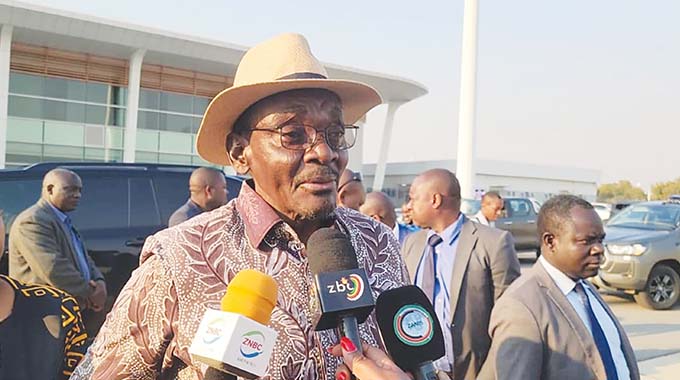
Africa Moyo in KABWE, Zambia
VICE PRESIDENT Kembo Mohadi has described his recent visit to Zambia to assess the state of liberation war shrines as a major success that revealed what needs to be done.
In an interview at Kenneth Kaunda International Airport as he left Zambia on Wednesday evening, VP Mohadi said he was happy with the outcome of the tour.
“What I can only say is that it was a very successful trip; we have been together, you must have realised that,” he said. “And the hospitality that we received was just wonderful in terms of transport. I say thank you very much for that. The sites, yes, they need a little bit of sprucing up. I think there should be more coordination between the National Heritage in Zambia and our National Museums and Monuments. They need to make more visits, they need to meet quite often, so that those shrines are kept up to date.”
At all the shrines, VP Mohadi recommended that trafficable roads be put in place, together with ablution facilities and solar-powered boreholes for the benefit of visitors. National Museums and Monuments of Zimbabwe director Mr Lovemore Mandima yesterday said the visit was an eye-opener. “Generally, I think the sites are in a fairly good state although I believe we can still do much better if we get the necessary resources. As you might be aware, we have entered into a Memorandum of Understanding with the National Heritage Commission of Zambia, and part of the deliverables within this MoU is for us to collectively identify, document, present, and preserve the liberation heritage of Zimbabwe, which is within Zambia.”
“What is key to that objective is to make sure that we are both adequately resourced to do so. I want to believe that this visit has also identified areas which need to be dealt with, the gaps, and we hope that with the necessary support from our principals, we shall be able to collectively, as an institution responsible for managing this heritage, improve on it,” said Mr Mandima.
Zambia’s National Heritage Conservation Commission acting executive director Mr Kagosi Mwamulowe said there is need for the two nations “to preserve these sites as they should continue speaking or reminding present and future generations” of what happened in the fight for independence.
“When we went to sites like Nampundwe, His Honour the Vice President was concerned about
the state of the site and he demanded that both, Zimbabwe and Zambia, in this case, the National Monuments and Museums of Zimbabwe and the National Heritage Conservation Commission, should implement their MoU so as to keep the site pleasant,” said Mr Mwamulowe.
On the first day on his trip to Zambia, VP Mohadi visited Chilenje House where the late Zambian founding President Dr Kenneth Kaunda lived, then to the house that the late former Zanu Chairman Herbert Wiltshire Chitepo lived also in Chilenje, then Nampundwe and finally Freedom Camp.
Day two saw VP Mohadi paying a courtesy call on Zambian President Hakainde Hichilema.
A lot came out of the meeting, principally that Zimbabwe has stood with Lusaka at this time when citizens are mourning former President Edgar Lungu.
It also came out that the rock-solid relations between the two countries should be maintained even by future leaders and that the both nations should collaborate and develop their economies for the benefit of citizens.
After the courtesy call, the delegation left for Kabwe, 138km north of Lusaka.
On the following day in Kabwe, the VP started his visits by travelling to Mkushi Girls Training Camp where over 1 000 Zipra forces were killed in air and ground attacks on October 19, 1978.
Also killed were Zambian police officers and the army.
VP Mohadi extended his tour at the shrine by going to places that had not been scheduled by protocol officials such as defensive positions, fox holes and the place that housed the clinic, as he wanted to check on their status.
On Thursday, which was the last day, he first stopped at St Mary’s Cemetery where 14 of the 15 Zambian policemen were buried.
He interacted with two of the surviving policemen and described them as heroes of Zimbabwe’s liberation war.
Afterwards, he went to Mulungushi Liberation War Site, located about 48km north east of Kabwe.
Mulungushi was attacked twice, on December 22, 1978 and on April 14, 1979, killing about 33 freedom fighters.
At all the shrines, VP Mohadi laid wreaths in honour of the departed freedom fighters.
A moment of silence was also observed.
The liberation war sites are recording a rise in the number of Zimbabweans wanting to know more about the struggle for independence.
Next month, a delegation from Teachers4ED is expected to visit the shrines.
After the courtesy call on President Hichilema, he asked the delegation to inform him of any assistance they might need, even after already providing two Zambian Air Force helicopters and a motorcade to ensure smooth movement.
VP Mohadi was accompanied by Deputy Chief Secretary to the President and Cabinet Reverend Paul Damasane, Zimbabwe’s Ambassador to Zambia Charity Charamba, Information, Publicity and Broadcasting Services Deputy Minister Dr Omphile Marupi, Home Affairs and Cultural Heritage Deputy Minister Chido Sanyatwe, Institute of African Knowledge chief executive officer Ambassador Kwame Muzawazi and other senior Government officials.