Online Reporter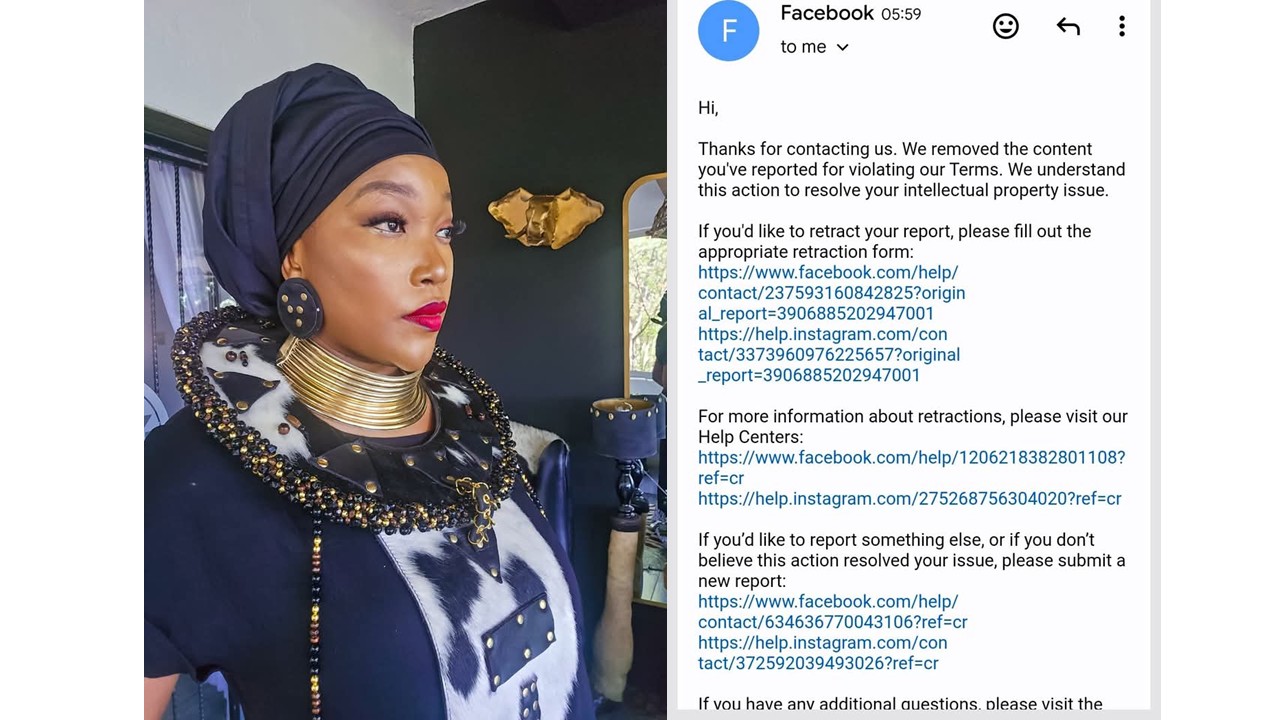
Mbulelo Mpofu, [email protected]
IN the digital age, the line between public accessibility and public property has become increasingly blurred.
For creatives, navigating this gray area is often an exhausting battle against plagiarism, online harassment, and systemic disrespect.
Local fashion designer and the force behind the prominent, “A Tribe called Zimbabwe” brand, Zana Kay, recently found herself back in the trenches of this war, sparking a critical conversation on Intellectual Property (IP) rights.
Following a successful copyright takedown notice on Meta platforms, the outspoken designer took to social media to give an update on her ongoing grievances, delivering a stern masterclass on the importance of creative consent and the legalities of ownership.
The catalyst for Kay’s latest legal victory was an unauthorised Facebook post utilising images of her Tribe clothing line.
According to the designer, the images were used “in a way that disenfranchised the brand.”
When Kay privately and publicly objected to the unauthorised use, the internet’s infamous “anonymous brigade” retaliated.
Rather than addressing the legal breach, detractors resorted to gaslighting, labelling her “difficult,” “dramatic,” and “chaotic” for defending her work.
“Music to my ears,” Kay fired back in a defiant public statement.
“Anyone who knows me well understands that I stand for what I believe in. I mean what I say. I don’t sugarcoat my convictions just to be liked. The page kept the post going regardless of my submission that I do not consent.”
Kay emphasised that her public pushback is not a cry for attention, but a calculated legal strategy.
“When I publicly object to the misuse of my work, I am not looking for applause or public sympathy. I am creating a public record that I do not consent to my intellectual property being used in that way. That is both my legal and moral right as its creator.”
Kay’s staunch stance on IP protection is born out of personal experience.
In a rare moment of vulnerability, she admitted that she was not always this legally literate.
Years ago, while running a personal blog, she pulled an image from Google to accompany a piece she wrote about the biblical Adam without seeking permission.
Months later, she woke up to digital DMCA notices threatening to pull her entire website down, accompanied by angry comments from the aggrieved creator – a Nigerian artist.
“My first reaction was, ‘Relax… it’s just a picture,’ but it wasn’t. To me, it was just an image. To her, it was years of skill, creativity, and labor. It was her livelihood. That experience changed how I think about creative work,” Zana Kay recalled.
This epiphany is what drives her current advocacy.
Kay noted that too many people still mistakenly believe that visibility equals permission, operating under the false assumption that if an image is on Google, Pinterest, Facebook, or Instagram, it belongs to everyone.
“Just because something is accessible does not make it public property,” she stressed, dismantling the common defense of “not knowing” who an item belongs to.
The fashion designer highlighted a toxic culture within the African creative industry where artists are bullied into compliance.
Many creators, she noted, remain silent when exploited because they fear being blacklisted or falling victim to cancel culture.
“I understand that fear. I just happen to be one of the people who speaks up. Not because I enjoy conflict, but because silence creates the impression of consent,” Zana Kay wrote.
Beyond the legalities of copyright law, Kay argued that the conversation must expand to brand autonomy.
She maintained that just as clients choose which designers to hire, creative businesses have an absolute right to select collaborations that align with their core values and business models.
Responding to local critics who have urged her to, “go with the flow” and accept the lax standards of the regional industry, Kay offered a firm rejection.
“I have chosen to stand firmly in who I am and in the standards I believe should govern creative work. If protecting my intellectual property makes me unpopular, then so be it,” she declared.
Kay insists that the local creative ecosystem will only become economically viable when stakeholders stop normalising disrespect and start normalizing proper industry standards, which include securing explicit consent before utilising content, executing licensing agreements to pay for the commercial use of creative assets, ensuring proper attribution by clearly crediting original creators, and fostering ethical collaboration through mutual, professional partnerships.
Zana Kay has promised to continue documenting infringements, enforcing boundaries, and escalating matters legally where necessary.
“If you want to exploit or misuse someone’s work, make sure that work is your own. Mine is protected,” she warned. – Follow on X @MbuleloMpofu



 Bongani Ndlovu