

 admin
admin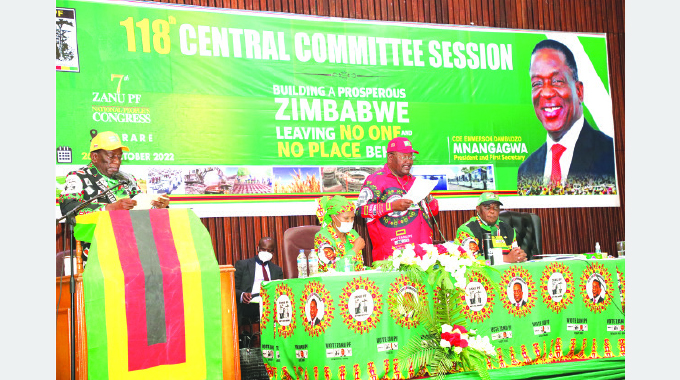
Dr Masimba Mavaza
On 27 October, as Zanu PF was holding its 7th National Congress, the United Kingdom Parliament led by the sworn enemy of Zimbabwe Load Oates was having a specific contribution to ask His Majesty’s Government as to what discussions they have had with the Government of Zimbabwe.
They were asking about the denial of bail to opposition Members of Parliament, Job Sikhala and Godfrey Sithole, and other opposition activists who are facing criminal charges at the courts, with their arrests being purely on criminal grounds and not political.
Contributors to the debate tried their best to show their particular ignorance about Zimbabwe’s judicial and political system.
The behaviour of the British House of Lords exposed the hypocrisy perpetrated by those with imbecilic proclivity.
“I marvel at the fecundity of human imagination when it comes to such adversarial relationship with the truth, blatant pathological lies. God forbid,” commented General Ezekiel Zabanyana, one of the illustrious sons of the soil.
Friends all over the world were tripping to congratulate Zanu PF for holding a constitutional mandate of having a Congress successfully, while the British House of Lords found the second to vilify and castigate Zimbabwe.
The world was shocked to hear Lord Johnny Oates, Liberal Democrats, in parliament and Baroness Katey Hoey stating that Zimbabwe is in a systematic attack on rule of law and human rights.
Lord Oates zeroed on the arrest of Job Sikhala, a serial offender, and his team of thugs who have been denied bail for inciting violence.
The debate was publicised wide and far. This made true what my General had said: “modern or future warfare is going to be won by the side that best exploit the electromagnetic spectrum.”
The British government and others in Europe’s accusation of Zimbabwe’s courts’ denial to grant Sikhala and Sithole bail exposed the hypocrisy manifested in the biased democracy fronted by the United Kingdom.
To dedicate a full hour to discuss about Zimbabwe showed that there is a bigger plot to disturb Zimbabwe’s harmonised elections in 2023.
Every time when it comes to the opposition, the European and American governments accuse Zimbabwe.
It is true that Sikhala and Sithole were denied bail following their court appearance on charges of incitement to commit public violence.
Lord Oates started by saying: “My Lords, the UK is concerned by the trend of lengthy pre-trial detention of government critics in Zimbabwe. We are monitoring the ongoing detention of the MPs Job Sikhala and Godfrey Sithole. As the ambassador publicly stated on 2 October, the UK is committed to the fundamental right to peaceful assembly and association, as enshrined in Zimbabwe’s constitution. The former Minister for Africa also raised the issue with the Foreign Minister of Zimbabwe on 30 June.
“My Lords, the Minister will be aware that opposition MPs Job Sikhala and Godfrey Sithole have now been detained without bail for 142 days in Chikurubi maximum security prison and paraded before court in leg irons; that only a week ago, the Bulawayo MP Jasmine Toffa was violently assaulted as part of an attack on CCC activists; and that across Zimbabwe political violence is raging in the lead-up to the 2023 general elections.
“Will he join me in calling on the Zimbabwe Government to end this political violence now? Will he join me also in making clear to Zanu PF officials and Ministers, members of the Zimbabwe Republic Police and Zimbabwe prison officers that the world is watching and holds them accountable for the safety and security of all Zimbabwe’s citizens?”
Zimbabweans have a very befitting statement to describe the hypocrisy perpetrated by the British Lords – “Crocodile Tears”
There is always a great interest in Zimbabwe when an event is about to happen. Now that we are nearing the election period all dust will be raised and all dirty will be thrown at Zanu PF and it’s government.
Lord Oats and many British parliamentarians as usual are trying very hard to expose their ignorance of Zimbabwean laws.
Without understanding the bail system in Zimbabwe, the confused Lord jumped to a conclusion and lambasted Zimbabwe on human rights.
The self-righteous Lord is the one who is inciting violence against Zanu PF and his utterances were unfortunate and misleading. These were the submissions of a Lord with an agenda.
It is a wonder how the honourable Lord fails to understand that Zimbabwe has its laws which must be enforced without fear or favour.
The utterances by Lord Oates are unfortunate and seriously embarrassing.
Considering that they have misfired and missed the target, their intentions against Zimbabwe are satanic diabolic and evil.
General elections are coming in few months, Lord Oates and his backers have realised that their preferred person is heading for a defeat so they start lambasting Zimbabwe in order to agitate the electorate.
Lord Oates must realise that Zimbabwe is no longer a colony of the United Kingdom.
In case Lord Oates did not know, Zimbabwe has a bail system which is clearly defined. Bail is never granted by Zanu PF, but by the courts.
Our courts are very independent. In a bail application, the judge or magistrate can receive evidence on oath or by affidavit, and hearsay evidence is admissible.
The prosecutor indicates his or her attitude to the granting or refusal of bail, and the judge or magistrate decides the question on the basis of what he/she has been told by the accused and the prosecutor.
Bail proceedings, in fact, follow the inquisitorial rather than the adversarial model of criminal procedure.
Both sides can be required to adduce evidence. If the accused gives evidence, however, the court must inform him/her that his/her evidence will be admissible and may be used against him/her at his trial.
An accused person “is compelled to inform the court” whether he/she has any previous convictions and whether he/she is facing other charges and, if he/she is, whether he/she has been granted bail on those charges.
It is not clear if this means that he/she must volunteer the information or need to disclose it only if asked.
If he/she willfully fails or refuses to give this information, or gives false information on these matters, he/she commits a crime.
If an application for bail is refused by a judge or magistrate, a further application cannot be made unless it is based on facts that were not placed before the judge or magistrate who first determined the application and which arose or were discovered after he made the decision.
If no new facts arise, the only recourse the accused has is to appeal.
It should be noted, however, that the passage of time can itself constitute a “new fact”: in other words, the fact that a long time has elapsed since an application for bail was made and accused can be placed before the court as a justification for a fresh application.
What those accusing Zimbabwe of victimising Sikhala do not understand is the fact that the refusal or granting of bail is a vitally important part of the criminal process.
Initial remand is an important step in a citizen’s loss of liberty.
After arrest without warrant, it is the first time that his/her case is presented to a neutral body for arbitration of the issue whether or not, on the basis of mere suspicion, the citizen must lose his/her freedom.
Bail is never granted on political grounds and the outbursts by the House of Lords is unfortunate.
The following principles govern were the principles used to deny or grant bail.
Section 50(1)(d) of the Constitution states that a person who has been arrested: “must be released unconditionally, or on reasonable conditions, pending a charge or trial, unless there are compelling reasons justifying their continued detention.”
According to section 117(1) of the Criminal Procedure and Evidence Act, every accused person has a right to bail, subject to the interests of justice: “[A] person who is in custody in respect of an offence shall be entitled to be released on bail at any time after he or she has appeared in court on a charge and before sentence is imposed, unless the court finds that it is in the interests of justice that he or she should be detained in custody.”
The constitutional provision protects liberty more stringently: an accused person must be released unless there are “compelling reasons” for keeping him in detention; the Criminal Procedure and Evidence Act on the other hand says that he may be detained if it is “in the interests of justice” to do so. Section 115C of the Act seeks to align the Act with the Constitution by saying, in effect, that the grounds listed in section 117 as justifying continued detention in the interests of justice must be regarded as “compelling reasons”. So, the Sikhala issue depends solely on principles.
It is impossible to define the term compelling circumstances comprehensively because what is compelling will vary according to the personal circumstances of each suspect and the facts of his or her case.
There are four reasons which normally justify continued detention: a) that the suspect is likely to abscond, b) that the suspect is likely to interfere with the evidence, e.g. by intimidating witnesses, c) that the suspect is likely to commit further crimes if released, d) And that the suspect is in breach of another bail condition.
Whether those reasons, individually or in combination, will be compelling depends on the facts and circumstances of each case, as already pointed out. The more likely the suspect is to do any of these things, the more compelling the reason for keeping him in custody.
In Sikhala’s case, giving him bail would have been an insult to our justice system.
Section 117 of the Criminal Procedure and Evidence Act seems to be based loosely on the equivalent provision of the South African Criminal Procedure Act, 1977, which in turn is based on section 35(1)(f) of that country’s constitution. Section 35(1)(f) states that everyone who is arrested has the right to be released from detention “if the interests of justice permit”.
Our Constitution is different, as already noted.
Arrested persons in Zimbabwe have a greater constitutional right to bail than is granted them in South Africa; so section 117 does not go far enough in guaranteeing to arrested persons their right to bail. To that extent, therefore, it is unconstitutional.
Merely saying, as section 115C does, that the reasons listed in section 117 amount to compelling reasons does not render section 117 constitutional.
Be that as it may, section 117 of the Criminal Procedure and Evidence Act elaborates on the reasons for continued detention listed above, and sets out in detail the considerations to be taken into account by a judge or magistrate when deciding whether to grant or refuse bail:
In the Sikhala case, it was in the interests of justice to refuse him bail. It was established that if he was s granted bail he was likely: to endanger public safety or the safety of an individual person; to “undermine or jeopardise the objectives or proper functioning of the criminal justice system, including the bail system”.
It was also in the interests of justice to refuse Sikhala bail as “in exceptional circumstances” it is likely that the release of the accused will disturb public order or undermine public peace or security.
The court in Sikhala’s case balance the interests of justice against the right of the accused to personal freedom.
Generally, the onus of showing that bail should not be granted rests with the prosecution, where bail is sought before the accused person has been found guilty. As Mathonsi J said in S v Munsaka 2016 (1) ZLR 427 (H), the onus of proving compelling reasons for not granting bail lies on the State.
The degree of proof required is a balance of probabilities. Under section 115C of the Criminal Procedure and Evidence Act
The presumption of innocence operates fully in bail applications made before the accused has been found guilty, and so the court is expected and required to lean in favour of the liberty of the accused.
In other words, if the State opposes bail it must prove that justice will be served by denying bail. So in Sikhala’s case the state proved that beyond any reasonable doubt.
Once, however, the prosecution has made credible allegations against the accused which would provide grounds for refusing bail, the onus shifts to the accused person, who must show on a balance of probabilities that his admission to bail would not prejudice the interests of justice.
When Sikhala was given the chance to offload the burden he boasted that he has been committing the same offence and got arrested for the same offence for over forty seven times.
This assisted the court to quickly without delay deny bail.
So it is a shame that CCC which is full of lawyers fail to see that Sikhala as a lawyer is indeed a liability to his liberty and to his own party.
His incarceration is not political but seriously criminal.
The interference in our justice system by the British parliament is unfortunate and evil. This evil has shaken democracies around the world.
The use of propaganda and misinformation to interfere in the internal affairs of other countries is not new, but events since last week have heightened awareness of how changes in social media platforms, political norms, and campaign financing rules have enabled foreign actors to influence elections on an unprecedented scale.
The House of Lords has started to make a case against Zimbabwe before elections. The reason for this is to create a fall back when their puppet loses elections.
The submissions by Lord Oates shows that our freedom is still under threat. Important analytical problems are in large measure obscured by the use of words which imply anthropomorphic or personalised explanations of social institutions.
Serious and research by Lord Oates should have vitiated by the ambiguity of some of key terms, which for lack of more precise ones we have constantly to use.
This would have put the paranoia mind of the Lord to rest. Zimbabwe does not weaponised the judicial system. We are civilised.
Zimbabwe has always been attacked by foreign electoral interventions. Foreign electoral interventions are attempts by governments, covertly or overtly, to influence elections in another country.
This is now alarming seeing that it is a parliamentary motion in the UK.
British law addresses an even more foundational question: why, exactly, does the country committed to free speech and robust public debate indulge in foreign participation in other country’s democratic discussion?
Even though there are laws prohibiting foreign influence in domestic elections are ubiquitous and increasing, but the underlying reasons for them are not always clear, especially when such laws target the distribution of information directly to the public.
Such laws are not readily explained by any of the common justifications used in interfering in other country’s democratic process.
In an increasingly globalized world, foreign political interference is a growing threat to democratic systems of government.
Lord Oates has shown his stubborn zeal to control the political land scape of Zimbabwe. Every election Zimbabwe holds, the United Kingdom will put its ugly dirty nose sniffing all over the electoral process of Zimbabwe.
The cruel fact of democracy is that those you do not want are the ones who attract the majority. Zanu PF attracts the majority and it has done this for over 42 years.
It is this time that the opposition with the help of Lord Oates will start to exaggerate on things in Zimbabwe so that they can get the sympathy of those oppressing us.
There will be a lot of stage-managed issues which will border on the side of abuse in order to convince their handlers that Zimbabwe is not in a good state to have sanctions lifted and to hold free and fair elections.
Despite a pervasive presence in politics, lying has played a role in formal models of elections, and the opposition have taken it a step further by lying to the international world in order to pile more sanctions on Zimbabwe.
The Western world has developed a model that allows opposition parties in the campaign stage to misrepresent their policy intentions if elected to office, and in which the willingness to lie varies across candidates.
You will find that the opposition is more willing to lie and is favoured by those who advocate for a regime change.
The Zimbabwean situation is simply the word of the opposition against that of the people of Zimbabwe. And, depending where you have read or heard about the accusations and counter-accusations flying between the opposition and the rest of Zimbabwe you will realise that the opposition is being a trifle “economical with the truth”.
The fact that most of what Western world see will have originated in either leaks from unnamed witnesses, or via the as yet unsubstantiated claims on CCC complaining machine will have only further muddied the waters.
But the biggest problem the West and their puppets in Zimbabwean opposition have is that a growing number of people, whether inside or outside the Western bubble, are finding it increasingly difficult to take either side at their word.
They have both long been devotees of what can be called “strategic lying”. This is a technique coined by the opposition in their campaign and played masterfully during many elections campaigns in which they tell a deliberate lie with the purpose of shifting the news agenda onto their preferred territory.
It doesn’t matter if their lie is easily rebutted. The ultimate goal of strategic lying is to have an impact on the salience of issues.
Calling for a guard rail against these lies to come from within the West quickly goes from curious to bewildering, along with the second embedded presumption that politics and compromise are a natural pairing rather than a contradiction in terms.
We must always remember that mud sticks visibly on clean clothes. This does not make mud part of the clean surface.
Striking quick and hard is one of the key components of the strategic lie playbook, as the sanctions advocates demonstrated and could also be seen during the 2018 general election.
Clearly, strategic lying raises a number of major ethical issues, but there is also an important practical one.
The quality of our democracy depends on the quality of the political debate within the public sphere. New campaigning techniques of sanction begging represent a real threat to both the debate and our democracy and something needs to be done urgently to address this problem.
Each time something is to take place in the international space the opposition starts lying with a straight face.
One wonders why it is easy for Tendai Biti to skip court towards the United Nations General Assembly. It was all strategy.
He was literally begging for a warrant of arrest so that they can tell the UN that they are being tormented for being the opposition.
This explains why the three MDC, now CCC, infamous ladies of J Mamombe, C Chimbiru and another absconded court few days before the UN Assembly. It was to portray Zimbabwe as an authoritarian nation.
The opposition is so fond of lying such that there is no difference between a liar and an opposition official. They naturally lie and have no shame for it.
If you continue looking at the space you will see a sharp increase in the cases of abuse of power.
The reason is simply that the CCC wants to have evidence to give to their handlers and have enough evidence to maintain sanctions.
For us to try and rebut the lies being peddled in the different forums it will look like we have something to hide.
It is evil that we have people who are in our country, but seriously digging a hole to mess the country.
These liars must remember that if you drill a hole in a boat it will sink with you in it. Calling for sanctions does not give votes. It simply makes you an enemy of the people.
Zimbabwe has nothing to hide and looks forward for pathetic representative of the Zimbabwean opposition in the British House of Lords to come to Zimbabwe.
We pray they will be able to see the fiction from reality.
Zimbabwe is the only country we can call ours in the whole world.
[email protected]



 Online Reporter