Chronicle Editor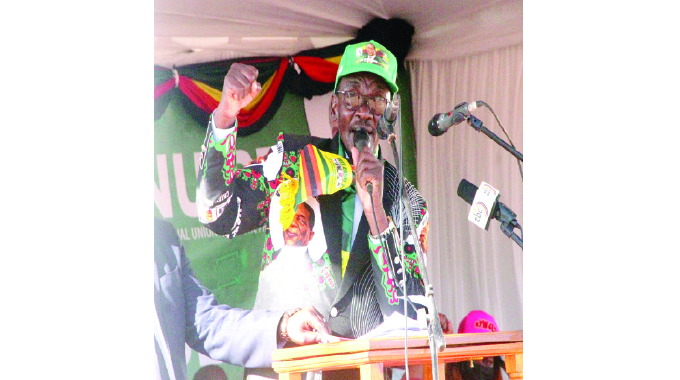
Oliver Kazunga, Senior Reporter
ZIMBABWEANS should shun opposition political parties and vote for Zanu-PF in the upcoming by-elections to address the “rot” in opposition-led urban councils across the country.
Zanu-PF Vice President Cde Kembo Mohadi said this yesterday at a star rally held in Nkulumane, Bulawayo ahead of by-elections slated for March 26.
Two parliamentary seats, Nkulumane and Pumula, are up for grabs in the city and Cdes David Ndlovu and Pumulani Nsingo are Zanu-PF candidates in the respective constituencies.
Addressing thousands of supporters in Nkulumane 12, Cde Mohadi said the ruling party had given the opposition-led urban councils across the country enough time to prove their capacity in championing development, but they had failed.
Cde Mohadi said time has come to bid farewell to the opposition as the revolutionary party was implementing a number of mega projects with a huge bearing on people’s lives.
Such projects include the Lake Gwayi-Shangani investment in Matabeleland North province, oil and gas project in the Cabora Bassa basin along the Zambezi River in Muzarabani, Mashonaland Central province, Batoka Gorge Hydro Electric Project, and the iron and steel project in Manize area in the Midlands province.
“Come March 26, which is next month, I urge you as Bulawayo people to vote our candidates into office, vote our two candidates into Parliament.
“But don’t stop there, make sure all the local council vacant posts are equally filled by Zanu-PF candidates because we want to turn around the rot that has taken place within our local authorities,” he said.
“We want to do away with garbage, we want to do away with sewer that is flowing from everywhere, we want to do away with potholes, we want to do away with everything that is negative. We can only do so, if you are Zanu-PF, because Zanu-PF will be able to communicate with local government …we have given the opposition chance, 20 years is not a joke of running the cities and they have done disasters in our cities.”
Cde Mohadi said failure by the opposition to deliver improved service delivery at local authority levels bears testimony that they cannot lead and develop the country at large.
“If they failed to run a city, how therefore do you think that they can run a country? How do you then run a country when you failed to run a city of less than a million people…after all we (revolutionary party) we liberated this country and we are to liberate it economically and what we tell you is what we and we are still going to do,” he said.
“Time has come for you to make us bid farewell to the opposition both in Parliament and in local authority.”
Cde Mohadi said he had been sent by President Mnangagwa to preside over the rally with a special plea to the people in Bulawayo that they need to vote for Zanu-PF, which is a party with a vision for people’s development.
Under the Second Republic, which came into power in November 2017, significant effort has been made towards economic recovery and promoting development across the country.
This has been through macro-economic policies such as the two-year Transitional Stabilisation Programme (TSP) that ran between October 2018 to December 2020 with a view to stabilise the macro-economic environment.
Now that the macro-economic environment has stabilised, Zimbabwe through the five-year economic blue-print, the National Development Strategy 1 (NDS1), has moved towards stimulating production across all economic sectors.
This is in sync with the Second Republic’s vision of attaining an upper middle-income economy by 2030.
“For the first time our development is guided by Vision 2030 which captures the aspirations of our people for development. It is hoped that by the end of that period, Zimbabwe would have achieved an upper middle-income economy.
“The NDS1 sets out specific steps to be taken in our journey towards our vision.
“The vision is not only for Zanu-PF, but for every Zimbabwean. Such a vision makes His Excellency a national leader and no prisoner to partisan politics,” said Cde Mohadi.
“Our development is internal driven. Although with support from friendly countries, we are largely using local resources to develop our country. Nyika inovakwa nevene vayo, Ilizwe lakhiwa ngabanini balo. I wish I could explain to the people that most of our money is dedicated to the numerous capital projects we embarked on since we came into being as Second Republic.”
Under the new political dispensation, Cde Mohadi said, according to the World Bank, Zimbabwe is one of the fastest growing economies in Africa.
The country has also seen a remarkable growth in foreign currency receipts to close to US$10 billion from about US$4 billion in 2017.
Capacity utilisation in the manufacturing sector has also been rising remarkably with the Confederation of Zimbabwe Industries, which represents the manufacturing sector expecting results for the yet-to-be released 2021 manufacturing survey to be at 61 percent. – @KazungaOliver



 Online Reporter