

 Online Reporter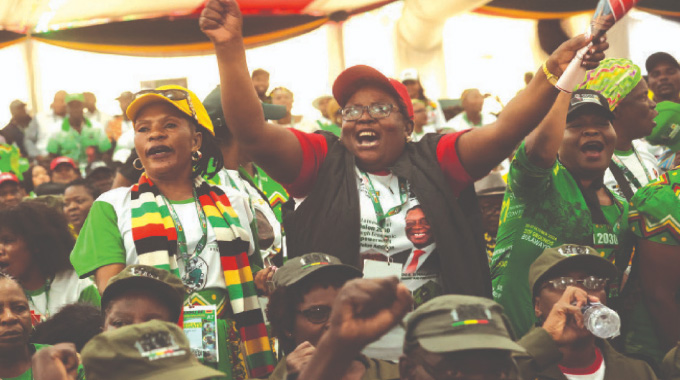
Joseph Madzimure, Zimpapers Politics Hub
THE ruling party, Zanu-PF, has successfully maintained its position as the central and most influential political organisation in Zimbabwe throughout the year, reinforcing its dominance through a combination of historical significance, structural resilience, and a sustained focus on a national development agenda.
The party’s enduring strength can be attributed to its liberation legacy, which deeply anchors it in the identity of many Zimbabweans, particularly in rural areas where the memories of the struggle remain potent.
This historical foundation gives Zanu-PF a level of legitimacy and loyalty that opposition political formations often struggle to match.
The revolutionary party is also well structured, maintaining a strong, co-ordinated grassroots organisation from cell level up to the national leadership.
This extensive network keeps Zanu-PF visible and active throughout the year, in contrast to some opposition groups that operate more like pressure movements without solid, community-based structures.
The party’s mobilisation strategy, coupled with its decades of electoral experience, provides it with unmatched political skill and continuity.
Zanu-PF has secured numerous victories in recent by-elections, often with large margins and some uncontested seats, which the party views as a sign of growing grassroots strength and public trust.
The party’s work is centred on unity, peace, and national development, guided by economic blueprints such as the National Development Strategy 1 and 2 (NDS2).
Simultaneously, opposition parties, notably the Citizens Coalition for Change (CCC), have faced significant internal divisions, recalls of elected officials, and persistent organisational challenges, contributing to a state of crisis for the opposition.
This instability, marked by repeated fragmentation and the absence of a unified ideology, has further solidified Zanu-PF’s position and eroded public confidence in the opposition.
Regionally, Zanu-PF leverages its shared history as a liberation movement with other dominant Southern African Development Community (SADC) parties, such as the African National Congress (ANC) of South Africa, Frelimo of Mozambique, Swapo of Namibia, Chama Cha Mapinduzi (CCM) of Tanzania, and the Popular Movement for the Liberation of Angola (MPLA). These historical ties maintain strong political solidarity within the region.
While opposition parties frequently split, rebrand, or suffer leadership disputes, Zanu-PF maintains stability and institutional memory. Its national presence is another major advantage, remaining active in all provinces and addressing the priorities of a broad electorate through policies tied to land reform, revolving funds as part of empowerment and rural development.
The ruling party has demonstrated an ability to adapt, refresh its leadership, and renew its mobilisation strategies, especially targeting the youth.
President Mnangagwa’s development-focused agenda is resonating deeply with Zanu-PF structures across the nation, bolstering party morale in support of the economic blueprint, NDS2. The growing confidence in the President’s vision was the central theme at recent inter-district meetings held across the country.
The party is intensifying efforts to empower communities across Zimbabwe to set up their own businesses by providing essential tools and inputs such as incubators, sewing machines, clothing materials, revolving funds and land for agricultural purposes.
For the ruling party, young people are not just a voting bloc; they are seen as the nation’s most valuable asset and the “vanguard” of the party. Their role is to uphold the party’s core values and safeguard its revolutionary legacy.
President Mnangagwa has consistently stated that both Zanu-PF and the Government are committed to empowering the youth because the country’s future rests in their hands.
Acknowledging this, Zanu-PF has made concerted efforts to engage young people, ensuring their active and beneficial participation in political, social, and economic affairs aligns with the party’s goals.
The party is at present focusing on first-time voters under the “Fishers of Men” strategy, a large-scale mobilisation drive to recruit new members, including those at tertiary institutions and returnees from the opposition.
Every party member has been tasked with recruiting at least one new member each year.
At present, the party is engaging in inter-district meetings to update the structures on the outcomes of the party’s 22nd Annual People’s Conference, which was held in Mutare, ensuring structural coherence and policy alignment.
Zanu-PF’s status as Zimbabwe’s dominant party is the result of historical legitimacy, strong organisation, national reach, and opposition disunity, remaining the most deeply rooted and structurally resilient political force in the country.


Where are Cdes Nelson Chamisa, Fadzai Mahere and Ostalos Siziba? Rumour is Chamisa is returning to ZANU-PF. He is one of the thousands that will be introduced as returnees soon.