Online Reporter
Theseus Mauruki Shambare, Features Writer
Across the sprawling grounds of the Zimbabwe International Trade Fair, the language of progress spoke in steel.
Engines hummed. Conveyors gleamed.
Heavy machinery towered above visitors as delegates moved between exhibition halls discussing markets, production lines, logistics and trade corridors.
This was the 66th edition of ZITF, staged under the theme Connected Economies, Competitive Industries — a call for regional integration, industrial efficiency and the unlocking of Africa’s productive power.
Yet inside one pavilion, among armoured carriers and military displays, another truth about development stood quietly on a wall.
It did not move. It did not roar. It did not flash.
But it stopped people in their tracks.
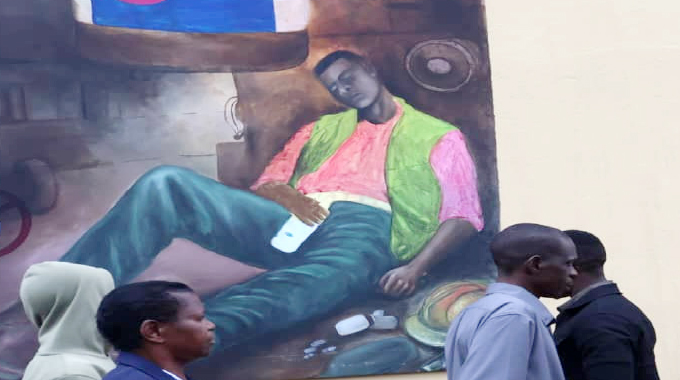
The painting showed a man broken by drug and substance abuse, collapsed beneath intoxication.
Behind him, factories crumbled into ruin, their structures fractured like abandoned dreams.
Children, who had come to climb military vehicles paused. Adults lowered their phones.
Young people leaned closer.
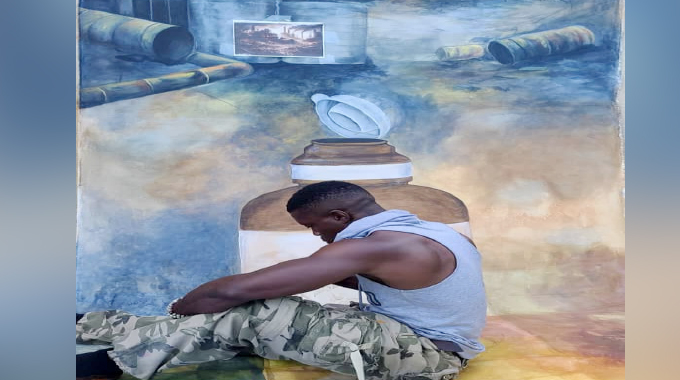
The mural belonged to the Zimbabwe Defence Forces stand.
Its artist is a soldier.
Corporal Malvern Mafunga, dressed in civilian clothes but still unmistakably carrying the bearing of a soldier, stood near the canvas as curious visitors gathered.
In a trade fair built to showcase the future of industry, he had painted a warning about what could destroy it.
“As a Zimbabwean soldier, I have realised that in this time and age we are not only fighting battles on the battlefield using guns, as many believe,” he said.
“We are also fighting this war machine called drug abuse. That is why I created this painting, focusing on substances such as Broncleer cough syrup, known in the streets as brongo, while also speaking against many others. We continue to say no to drug and substance abuse.”
His message carried beyond the exhibition hall.
Because in Zimbabwe — and increasingly across the Southern African region — drug and substance abuse has become more than a public health concern. It is now an economic issue, a labour issue, a youth issue and a development issue.
In Zimbabwe, Afrobarometer surveys show that 79 percent of citizens say drug and substance abuse is widespread in their communities, rising to 97 percent in Harare and over 93 percent in other urban areas, reflecting its deep penetration among working-age populations.
Academic research by Maraire and Chethiyar (2020) further estimates that as many as 57 percent of Zimbabwean youths may be affected by drug and substance abuse, highlighting the scale of the crisis across urban settings.
Regionally, the UNODC World Drug Report (2023) records a 23 percent global increase in drug use between 2011 and 2023, with Africa emerging as one of the fastest-growing consumer markets for illicit substances.
The UNODC Southern Africa Programme also notes rising synthetic drug markets and increasing pressure on public health systems across SADC countries.
Together, these trends point to a structural challenge: substance abuse is no longer only a social issue, but a direct threat to productivity, industrial competitiveness and regional development.
No connected economy can thrive on broken human capital.
No competitive industry can be sustained by a generation trapped in addiction.
And in Bulawayo, one soldier chose to say so without speeches or slogans.
He used paint.
The workforce behind the theme
Trade fairs celebrate visible progress: machines, factories, technologies and exports.
But every economy depends first on less visible foundations — disciplined workers, healthy communities, stable families and functioning minds.
That was the deeper logic behind Mafunga’s mural.
The fallen figure represented more than individual collapse.
He symbolised lost productivity, interrupted education and talent that never reaches the workplace.
The collapsing industrial skyline behind him suggested a wider consequence: when drug abuse spreads, it does not remain personal.
It reaches workshops, farms, classrooms, warehouses and entire value chains.
Lieutenant OB Nyoni, speaking beside the artwork, said the symbolism was intentional.
“This anti-drug mural shows a man, who is highly intoxicated by drug and substance abuse, lying there in a collapsing industry,” he said.
“It shows that drug and substance abuse drastically destroys our human resource base and human capital. This is a call for awareness by the Zimbabwe Defence Forces to encourage responsible behaviour, especially among the younger generation, in support of Vision 2030.”
In that sense, the mural offered one of the clearest interpretations of this year’s ZITF theme.
Connected economies are not built by infrastructure alone.
They are built by capable people.
Competitive industries are not powered only by machinery.
They are powered by sober, skilled and motivated workers.
A regional challenge wearing
many faces
Across Southern Africa, Governments are increasingly confronting the rise of drug consumption among young populations facing unemployment, urban stress and social fragmentation.
What was once treated mainly as a policing issue is now understood as a broader development risk — affecting productivity, public health and long-term economic growth.
In Zimbabwe, communities report growing concern over substances ranging from cannabis and illicit alcohol to misuse of cough syrups and synthetic drugs.
Rehabilitation centres, schools, families and employers are all bearing the consequences.
President Mnangagwa, speaking at the Pre-Independence Day Children’s Party at Mahetshe Primary School in Maphisa, Matobo District, warned against the growing scourge of drug abuse, bullying and violence among children, urging discipline, patriotism and responsible citizenship.
“My Government will not tolerate criminal delinquency, such as bullying, abuse and violence of whatever nature. Stay away from drugs and substance abuse,” he said.
That warning echoed quietly through the fairgrounds in Bulawayo.
At the ZDF stand, the response to that call was not a speech.
It was a painting.
Visitors stepped into armoured personnel carriers, inspected equipment and posed for photographs.
But many left speaking about the mural.
The APCs drew excitement. The painting drew reflection.
The artist behind the uniform
Corporal Mafunga’s journey began far from military displays.
Born on May 26, 2000 in Bindura, he spent much of his childhood at his grandparents’ farm in Mhangura, where exposure to nature shaped his imagination.
By Grade Two, he was already sketching animals and landscapes.
At school, he often remained in the art studio long after lessons, developing a talent later refined at the National Gallery of Zimbabwe.
Today, he carries two identities with ease: soldier and artist.
That combination reflects a changing reality within modern institutions, which are increasingly expected to engage society beyond their traditional roles — through communication, education and community awareness.
The ZDF presence at ZITF reflected that evolution: not only displaying force, but also offering social messaging and civic engagement.
And Mafunga became its most compelling voice.
The cost of losing youth
For countries pursuing industrialisation, youth are the decisive factor.
They are the workforce of factories, the minds behind innovation and the backbone of trade.
When young people fall into addiction, nations lose more than individuals.
They lose momentum.
Factories can be built. Machines can be imported.
Infrastructure can be financed. But rebuilding lost human potential is slow and costly.
That is why the fight against drug abuse extends beyond law enforcement.
It belongs to educators, employers, planners, families and communities.
It also belongs, as Mafunga’s work shows, to artists who can translate complex crises into immediate human understanding.
One image of collapse can say what volumes of reports cannot.
Where guns rest, brushes speak
There was quiet symbolism in the scene at ZITF.
A soldier stood not behind a weapon, but beside a canvas.
The public often associates armed forces with external threats.
Yet nations are also weakened from within — by addiction, lost talent and eroding social discipline.
By addressing this publicly, the Zimbabwe Defence Forces projected a broader form of security: protecting the future workforce.
As crowds moved through the exhibition halls discussing trade deals and industrial prospects, the mural remained fixed on its wall — still, silent and unyielding.
It reminded all who passed that industrial ambition begins with human readiness.
That before factories rise, futures must be saved.
That before economies connect, communities must heal.
That before industries compete, young minds must be protected.
And amid the machinery, commerce and ambition of Zimbabwe’s premier trade showcase, it was a soldier’s paintbrush that delivered one of the most powerful development messages of all.