Taking Stock
Kudzanai Sharara
For too long, our capital markets have been a room with a door half closed.
The Zimbabwe Stock Exchange (ZSE) has served large companies well, but it has not welcomed the businesses that actually run this economy.
That is why the launch of Zimbabwe Entrepreneurship Exchange (ZEEX) matters. And that is why the Mwana Group initial public offering (IPO), which opened ahead of an expected listing this year, deserves more attention than its US$1 million size suggests.
A market that had forgotten how to start small
Small and medium enterprises account for roughly 60 percent of Zimbabwe’s Gross Domestic Product (GDP), 70 percent of employment and 90 percent of businesses in Zimbabwe.
Yet the capital market has been out of reach for most of them.
A main board listing demands scale, history and compliance costs that a small startup cannot carry.
Finance Minister Prof Mthuli Ncube said deepening capital markets is central to Vision 2030.
What ZEEX actually is
Launched in July 2026, housed within ZSE Holdings and licensed by the Securities and Exchange Commission of Zimbabwe, ZEEX is a regulated digital platform for small and medium enterprises (SMEs) and high growth entrepreneurs.
It has four parts.
ZEEX Public Markets allows a business to raise capital, list and trade publicly. ZEEX Private Markets allows a business to raise capital privately with no public listing.
InvoiceX turns unpaid invoices into immediate working capital. ZSE DebtBridge holds collateral for debt.
ZEEX will also use tokenisation for instant settlement, beyond the traditional T plus 2 cycle.
Why the money is waiting
The most surprising assertion from ZSE chief executive Mr Justin Bgoni is about supply of capital.
“Our challenge as Zimbabwe at the moment is not the money,” he told the CZI forum.
“Our challenge is getting the money that we have committed to the platform into the hands of entrepreneurs.”
He was talking about InvoiceX.
Major backers have pledged up to US$200 million towards the feature. Effectively, the financier is financing the big company that owes the invoice.
CBZ chief executive, Mr Lawrence Nyazema, made the same point.
As of August 2026, banks held US$7,1 billion in deposits against US$3,79 billion in loans.
ZEEX has set a first target of at least US$10 million in invoice financing by year-end. More than 30 companies are in the pipeline, with roughly 70 percent seeking a public listing.
Zimbabwe’s foreign investment rose from US$596,7 million in 2024 to US$964,9 million in 2025.
Mwana Group: small, real and exactly the point
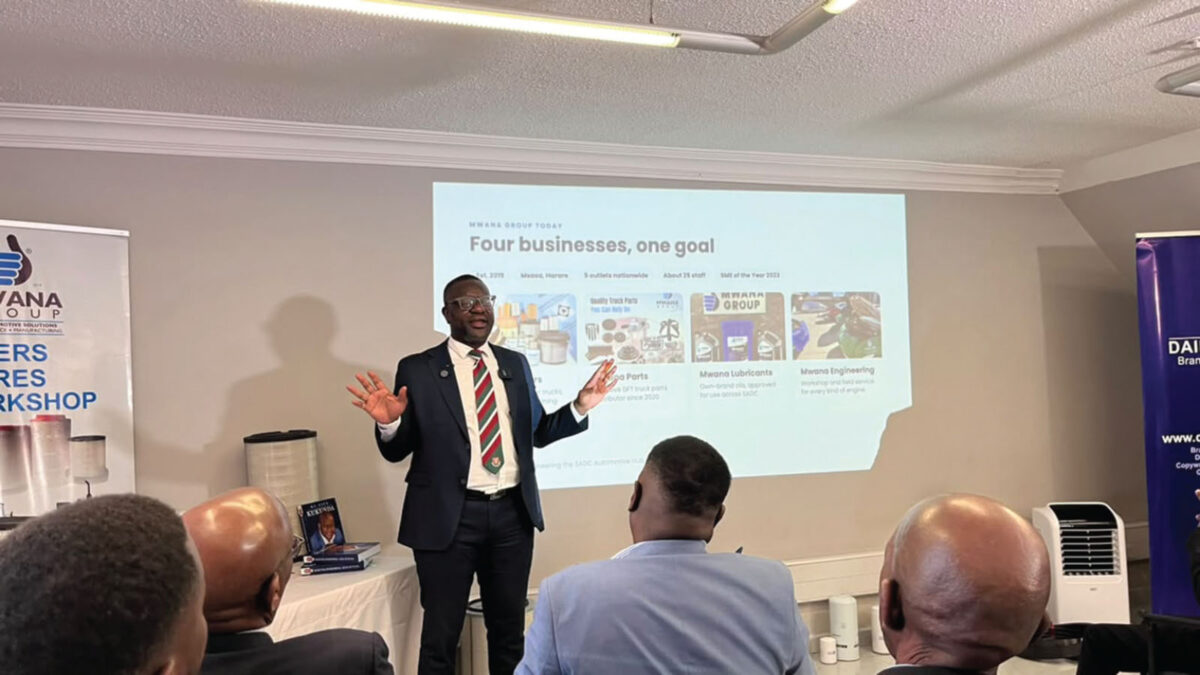
Mwana Group is not a mining house or a bank. It is a Zimbabwean automotive business that began operating in 2019 and has grown into the country’s only locally owned manufacturer of filters under its own brand.
Its offer was for 20 million shares at US$0,05 each to raise US$1 million.
Before the offer, it had 163 844 961 shares in issue. After the offer, it will have 183 844 961 shares, meaning the public will hold 10,88 percent.
The minimum subscription was US$100 for individuals and US$1 000 for corporates.
The board intends to use the money mainly for equipment, raw materials and inventory, to grow from 5 outlets to at least 15 sites and lift filter production from 20 units per day to at least 1 000 units per day. US$100 000 is allocated to Tractor CKD kits.
The numbers investors must read twice
Mwana’s audited financials are small. Revenue was US$222 329 in FY2023, US$348,765 in FY2024, and US$371,862 in FY2025.
In FY2025, it recorded an operating loss of US$170,546, largely because of a US$231,596 abnormal loss from writing down obsolete inventory.
The valuation is built on a very steep forecast.
Management projects revenue of just US$442 518 in 2026, then US$11 895 422 in 2027, rising to US$15 832 807 by 2030.
Using a Discounted Future Earnings method at a 15 percent discount rate, management arrives at a present value of US$8 657 028.
At US$0,05 on 183 844 961 shares after the offer, the implied market capitalisation is about US$9,19 million, a modest premium to that valuation.
In other words, you are being asked to pay for growth that has not yet happened.
Founding shareholders have undertaken not to sell their shares for five years from listing. Mwana is not a safe blue chip.
It is a classic ZEEX company.
Taking Stock: The market in the period under review
For October 1 to November 5, 2026, the ZSE All Share Index fell 1,03 percent, from 482.33 points to 477.37 points. The Top 10 fell 1,37 percent, from 472.88 to 466.42.
The VFEX All Share fell 0,32 percent, from 268.91 to 268.04. Keep that in perspective.
As at 5 November, the All Share was still up 67.86 percent year to date, and the VFEX was up 51,33 percent.
The market did not collapse. It paused after a very strong run. The Medium Cap Index was the only major ZSE index to rise, up 0.27 percent.
The standout was Padenga Holdings. Its price rose 6.93 percent over the period, from 149,59 cents to 159,95 cents, taking its year-to-date gain to 168,82 percent.
Padenga also carried a liquidity warning. On October 1 457 033 shares changed hands in 32 trades.
On November 5, only 3 650 shares changed hands in 18 trades.
What has to happen next
InvoiceX must now get real invoices from real large buyers, funded at scale. Commitments are not disbursements. Sponsors must keep standards high while keeping costs proportionate.
Companies like Mwana must deliver, or at least report transparently when they do not.
ZEEX must become a genuine feeder, a staging post to larger capital and eventual graduation, not a place where small companies go to be forgotten.
If those things happen, ZEEX will have given the businesses that employ most Zimbabweans a way to turn ambition into capital.
That is breathing new life into our capital markets.
Not with a grand announcement, but with a filter manufacturer in Msasa asking ordinary investors for US$100, and a platform built to let hundreds more follow.
The breath is real for Zimbabwe. Now we need a heartbeat that lasts today.