Online Reporter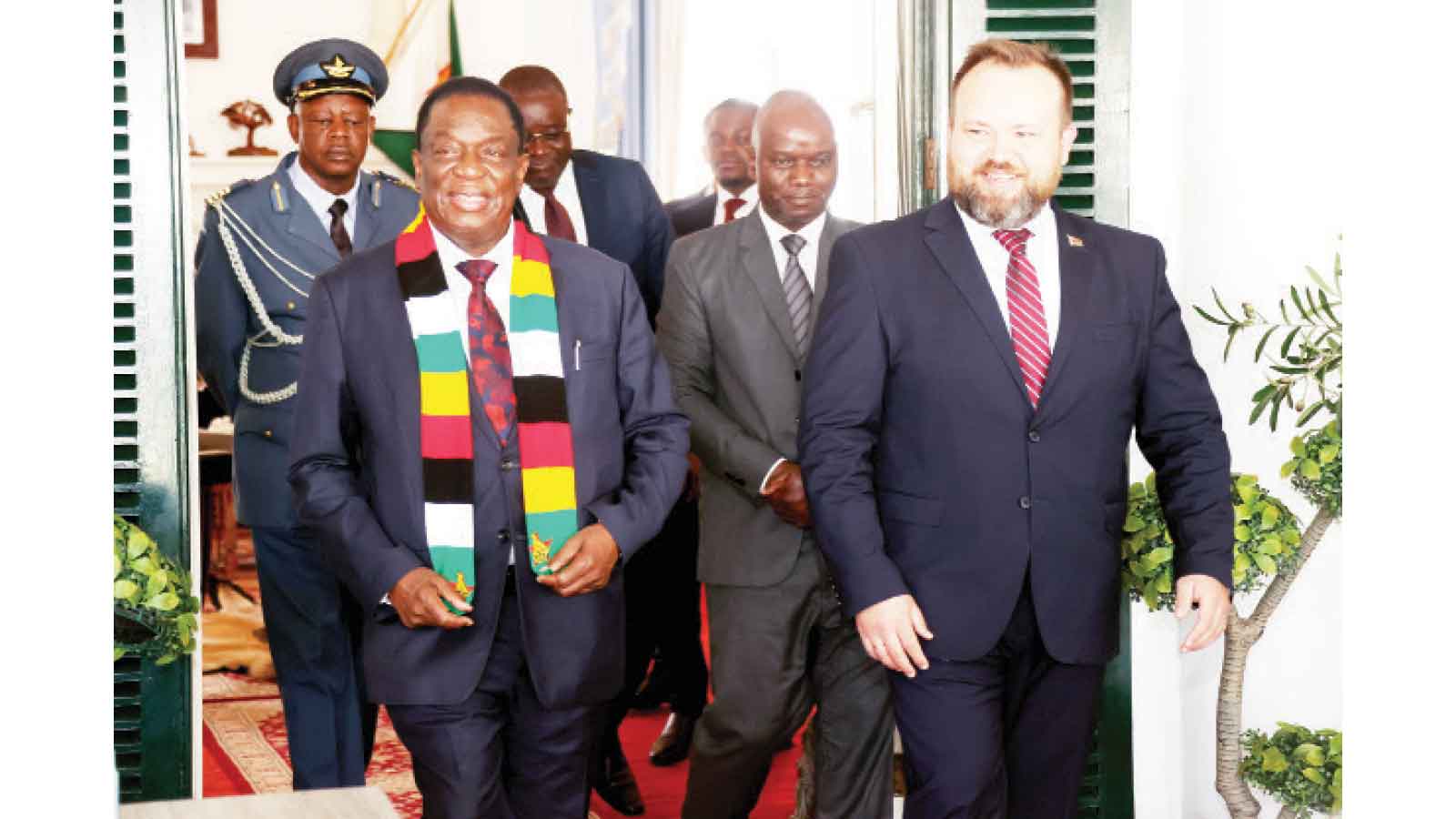
President Mnangagwa was yesterday interviewed by a Belarusian national television channel at State House in Harare and outlined Zimbabwe’s development priorities, his close relationship with Belarusian President Aleksandr Lukashenko, the country’s economic transformation and prospects for deeper Zimbabwe-Belarus cooperation. The interview comes as Harare and Minsk continue to deepen cooperation in areas of mutual interest, with Belarus increasingly supporting the country’s agricultural mechanisation and industrial development. Below is the full interview .
Q: Your Excellency, we are meeting in the capital of a country whose residents are considered lucky in many parts of the world, first of all because Zimbabwe is peaceful. Secondly, your country is making steady progress in many areas and is focusing on a strategic development programme, Vision 2030. Please tell us how this national strategy is being implemented and what results are expected from this programme?
A: Well, what is critically important is that, as a nation, as a people, we deal with that which faces us, which needs to be addressed. Most importantly, we must make sure that we listen to the needs of our people, the ordinary person in the countryside, the people in the urban areas; what are their needs.
The youth demography must be attended to; their interests, their aspirations continue to differ from year to year.
So, as a Government and as a leadership, we give them an ear so that we make sure we address and we adapt to the needs of the times. Well, I don’t think that what has happened in the entire journey of my career in my party, or the struggle of our country, I one day said I was determined to do what I had to do. Circumstances make you do the things that you do.
At each time in history, challenges come and on the basis of the challenges that you face, you do your best to surmount those challenges. So I don’t think that anything that we have achieved can be attributed to an individual. I always believe in the collective effort through my party, ZANU PF, and of course the entire population of our country.
We always make sure we listen; we hear the desires and the needs and the expectations of our people. That’s what we do and do our utmost to achieve and accomplish. I know that we cannot satisfy every individual, but collectively as a group and as a leadership, we do our best to serve the needs of our people.
Q: Your Excellency, you and the President of Belarus, Alexander Lukashenko, have very sincere and warm relations, both politically and personally. Mr President, do you think that such informal, genuinely human contacts contribute to the successful development of our bilateral relations? And in what areas of cooperation do you consider your relations most effective for both countries?
A: Well, let me put this at two levels. This first level is that there is a personal relationship between me and President Lukashenko. We are personal friends at the personal level. We are brother and brother, family and family. That’s at that level.
But then, besides that, as the Republic of Zimbabwe and the Republic of Belarus. We are again very friendly countries. And Belarus is more advanced than us and we look to benefit from the development they have achieved. And also, we have our people, our young people, going to your country, to Belarus, to receive education and training in various fields and this benefits us in terms of acquiring these skills to develop our own country.
We are developing a third world country and we are lucky that we have a country like Belarus that facilitates and helps us develop in various areas, especially in the economic subsector of our endeavour.
Q: Our countries have in common not only effective economic cooperation, but also a bilateral economic partnership. Zimbabwe has managed to move towards economic stability despite significant restrictions. Please tell us about the tactics that allowed Zimbabwe to avoid falling on its knees before the US and European union countries.
A: We have been on these stupid sanctions imposed by some Western countries for decades now. But we have realised that as a country, as the sun rises, our people need to be fed. And we don’t need to go to other countries to ask them to feed our people. We make sure we say to ourselves, our people, family by family, village by village, district by district, province by province, that the burden to feed ourselves is upon ourselves. The burden to develop our country is upon ourselves. Other people can only come and assist. But the primary task and burden rest on our own shoulders. A country can only be developed by its own people, not by foreign people. They can only assist. That’s the philosophy of the world. That way, we become independent and we can develop and be proud of what we achieve. And everything that we do becomes a Zimbabwean.
Q: Mr President, nowadays, in the reality of global geopolitical turmoil, the centre of global politics and economics is shifting to the Global East and South, where new opportunities are opening up and the role of the African continent is growing exponentially. It is obvious that Zimbabwe now plays a leading role in SADC and the African Union, as well as other important international organisations. Is the world of big global power and politics ready for such a power shift? And what benefits will this strengthening of African countries bring to the whole world?
A: Let me assure you that when I wake up, I’m not thinking about global politics or global dynamics. I think about my country. What should we do to develop Zimbabwe? What should we do to make sure the younger generation is engaged? They have that will to save their country.
They must be patriotic about their country. They must realise that they must develop their country on the basis of the endowments that the country has. And to do so, we must capacitate them through education and many other skills which we are able to do so.
Beyond that, we get assistance from friendly countries. We give our skills. We send our students to learn new skills and acquire more education.
That we accept. But basically, at the end of the day, we must develop on the basis of the facilities which we have in the country. We have very good education. We believe that in our region, in SADC, we have very sound education. And I believe that Zimbabwe is among the top elite nations in the region.
Q: Could you please share your personal impressions after your latest visit to Belarus? We know a lot about the contracts, official conversations and efficiency of our cooperation. But the most interesting is what is behind the scenes of these official talks. What impressed you particularly? What is the first thing that comes to your mind when you hear the word Belarus?
A: Well, at the personal level, you mentioned Belarus. The first image that comes into me is my brother. We have such personal relationship between me and the President Lukashenko. Belarus is advanced. It’s one of the first world countries.
And we’re a third world country. And we are having this relationship with a first world country and a third world country. So who is benefiting? It is us, a third world country.
Benefiting from a country willing to assist us. We have many of our students learning now in Belarus, acquiring skills to come back and develop our country. So I cherish this relationship both at the personal level as well as country-to-country relations, which we are now enjoying. And I’m very grateful to this facility, which President Lukashenko continues to extend to Zimbabwe.
Q: Our President has several times spoken about our future cooperation and future relations between Belarus and other African countries. He has said, with great importance and respect, that Zimbabwe is our honourable gateway to other countries in the African region. It seems to me that, speaking about our union, it is a real union — Belarus and Zimbabwe. Why not? We can discuss the prospects of relations with other African countries. How do you think Belarus and Zimbabwe, together with other countries, can shape the future of relations in the African region?
A: Well, I may not venture into what will happen in the future, but for the past and the present, we are very happy.
The relationship that is developed between Belarus and Zimbabwe, but especially between the two Presidents, myself and my brother, is very comfortable. We share a lot, but at the end of the day, Zimbabwe benefits because Belarus is more developed than us. So it is us who benefit from what Belarus has developed and is sharing with us.
We have so many students now who are in Belarus studying, and this is what it ought to be. I believe that as we go on, Belarus will feel also proud that they have contributed to the development of the sister republic like Zimbabwe. We have very good relations, both people to people, president to president, and economically also, we are benefiting from our relations with Belarus.
Q: Mr President, a personal question. You are, I’m sorry, in great physical form. You look wonderful and speak wonderfully. What’s your secret? What do you do to stay in such good shape?
A: The secret is that I follow what my mother told me. It is to eat breakfast, lunch and dinner. That’s the secret.
Q: What else?
A: I have my breakfast, lunch, dinner.
And I am married. I have a good family; children, boys and girls, all good education. We’re comfortable. So, I think, okay, besides, I’m from an agricultural family. We are a farming family, so we also are producing. We have a farm in the Midlands, and every Saturday and Sunday I’m back at the farm. And I produce, I contribute to the nation of food security, so I’m very happy.
Q: Do you have a Belarus tractor?
A: Yeah, Belarus tractors, yes, I have.
Yes, yes, I think I have two. That’s great. I have two.
Q: What is your dream as a President and as a Zimbabwean man?
A: My dream is that the trajectory that ZANU PF has brought to the country in terms of development should continue.
I’m so satisfied that the younger generation, which we have in ZANU PF, the younger leadership, which is ZANU PF, is so committed to our philosophy as ZANU PF. I believe that even today, if the current leadership goes away, those who are behind us, the younger generation in the youth, both in the women and youth leadership, the country will continue to grow and prosper.
I’m so, I’m so confident ZANU PF will rule and rule, rule and rule. I see no challenges, I see no challenges facing the party for the future, for ZANU PF future. Because we have a system of grooming our young people, we have the Youth League, the Women’s League, and then they come to the men’s league to leadership.
And they also go through ideological colleges, which they train about the philosophy, which we brought about as a revolutionary party ZANU PF. We continue to make sure we stick to that revolution theories, which made us liberate ourselves from the British and continue to have the country intact, united and progressive.
Q: I understand and respect that you don’t want to look too far into the future, but I cannot avoid asking you this. How do you think unions such as the one between Belarus and Zimbabwe — two countries that are more than 12 000km apart and very different in terms of their people and circumstances — could become a real foundation for future politics in the world? Could such relations, where both countries help and understand each other, be part of a new world?
A: With regard to Belarus, I want to mention that first and foremost, the relationship between me and my brother Lukashenko. He’s my brother, well he’s my young brother of course, he’s younger than me. And at the end of the day, we benefit more because Belarus is a more developed state than ourselves. We’re happy that we have our students going to Belarus, studying, getting skills, coming back to Zimbabwe and benefiting from the skills they’ve achieved or gained in that country.
And I believe that this relationship will continue to grow from strength to strength. I’m so happy that I have President Lukashenko on my side.
Q: US$100 million of bilateral trade is our plan to 2030. Is it a realistic figure, in your view? Can trade reach US$100 million?
A: Well, the question of trade, one would want it to be bigger. But again, you don’t force trade, you facilitate trade. Because you, Belarus is an independent and free country, Zimbabwe is an independent and free country.
We don’t force our people to trade in one way or the other. Business people go where they get the best advantage, on both sides. So, we would want to make sure, as governments, to facilitate business between our two communities, so that we both benefit.
We’re a fast-developing country in Southern Africa, and it is critically important that we have some country or countries that we relate to and look to, and have assistance in our journey for industrialisation.
Q: Your Excellency, we know that you are a unique leader in today’s great politics, who communicates with ordinary people and knows what is happening on the ground. Is the name Belarus — tractors made in Belarus — really known among ordinary people, or is it just a signature in contracts?
A: In all our provinces, wherever you go, you find Belarus tractors. If you go to my farm, from the combine harvester to tractors, most of them are Belarus machinery, and they are very popular in this country. It is because they’ve given us very lucrative terms in purchasing them. So, we are very happy, and I’m very thankful to my brother, President Lukashenko.
Q: And do people know anything about Belarus in Zimbabwe?
A: I don’t think there’s any part of Zimbabwe which doesn’t know about Belarus, because you find Belarus tractors everywhere, and they are rich in Belarus. So, you don’t need to go into any library to find out whether we know about Belarus. We know about Belarus in every street, every village.
If they have tractors, we have them. Of course, we have other tractors from other countries, but Belarus is quite dominant.
Q: Is an official visit to our country planned?
A: No, no, no. I don’t have immediate plans, no. But any moment I feel like going to Belarus, I’ll go. For any moment my brother wants to come, he’ll come. We have no problem at all. We’re almost family now, Belarus and Zimbabwe. We’re just family.
Q: Mr President, the last question, very short. What are the three main words, or three main milestones, for you in your life and political career?
A: Three main important things; I don’t know what we have in mind. Every phase has its own challenges and its own achievements. I don’t think I should believe that what we have achieved should be isolated as an individual achievement. Whatever we have achieved is a collective achievement.
In this country, we have political parties, but the predominant one is ZANU PF. We had our first President, the late President Robert Mugabe. We were in the Youth League. We grew up in the party, young in the Youth League. I grew up and also then joined the main wing. I grew up in the structures, in various positions, secretary general of the party, Vice President of the party, and I’m President of the party. I’m just a product of the party. I don’t know of another situation. I’m just ZANU PF in and out.
My blood is ZANU PF. Everything is ZANU PF. So I believe that I’ve inherited the philosophies, teachings, and the dreams of my predecessors, President Mugabe, the Muzendas, the Msikas, and so on. I think I carry their dreams. I’m very grateful for this meeting. It will be very interesting and very important and to the history of our relations also.