

 admin
admin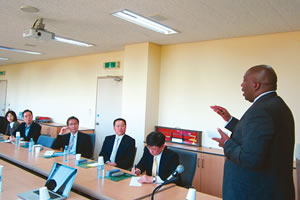
during which the country has emerged as one of the most industrialised countries in the world.
The unmistakable commitment to work appears to be the driving force of the Koreans and this is evident as one strolls on the streets of Seoul where the massive infrastructural developments that dominate the skyline cannot be missed.
Clearly, circumstances are different and much as we may say that we have abundant resources in our country – unlike Korea which has to depend on importing them – it is the utilisation of those resources and a culture of work that separates the two nations.
The task at hand is to draw lessons across the economic, political and social frameworks of the Korean experience and apply it to Zimbabwean.
To this end, a business delegation led by Youth Development, Indigenisation and Empowerment Minister Saviour Kasukuwere spent five days in Seoul, learning what they have done.
Other members of the delegation included State Enterprises and Parastatals Deputy Minister Walter Chidhakwa, National Indigenisation and Economic Empowerment board chairman Mr David Chapfika and his chief executive Mr Wilson Gwatiringa.
Agricultural economist Professor Mandivamba Rukuni and a team of local economists and businessmen were also part of the delegation.
To address the gap in the Zimbabwe manufacturing sector, Prof Rukuni said there was need to grow small-medium businesses into major industries able to manufacture, not only for the local market, but also for export.
He added there was need to integrate fiscal and monetary policies for broad-based development of the economy.
“We need to look at the key competencies required of public servants and the State and how the localisation and indigenisation policies and strategies were shaped at various stages of development,” said Prof Rukunu.
“Once we get an understanding of how this was done we can look at how best this can be applied locally,” Prof Rukuni said.
He said development should be viewed as a way of “modernising and not Westernising Africa”. This approach had strong cultural, societal values that created sustainable development, he said.
Minister Kasukuwere stressed that his mission was not geared to look for aid from the Koreans, but to learn about their development experience and adapt it to Zimbabwean.
“We are not here to beg, no. As we unlock the value in our resources back home, we will be able to come back here and seek ways on how we can buy or even manufacture some of those machines you are making here,” said Miniser Kasukuwere.
“We have communities that have been empowered and now have a significant stake in the mining sector, for instance, and they would want to buy machinery to expand. What stops them from coming here to buy that machinery?”
He said the Korean localisation model was similar to the Zimbabwe indigenisation policy that has seen the
Government set up community trusts that have been given a stake in mining companies around the country.
The policy will also cascade to
the manufacturing sector, resulting in locals owning 51 percent of all
foreign-owned firms in a broad-based economic empowerment programme.
On the Korean highways, the dominance of the country’s local motor industry is unmistakable with Hyundai, Kia and Daewoo vehicles forming the majority of the cars on the road. .
Deputy Minister Chidhakwa observed that historically Zimbabwe and other countries in Africa had never entered the mainstream economies of the world as they were restricted to producing goods for export where they were processed in support of the industrialisation of Europe.
He said the delegation’s visit
to small and medium enterprises in Korea was a revelation as they are involved in the making of machines that manufacture consumer goods, a rare phenomenon back home.
Mr Chidhakwa advocated for a shift in the prevailing scenario where the locals continued to be in the periphery and never viewed themselves at the centre of the production process.
Minister Kasukuwere described the Korean trip as a success. What remains to be done is to find a way in which an experience can be adapted into an empowerment programme that can achieve sustainable economic growth in Zimbabwe.
He said it was “key” for Zimbabweans to change their mindset and start believing that they were indeed masters of their destiny and believe in their own competencies.



 Online Reporter