admin
admin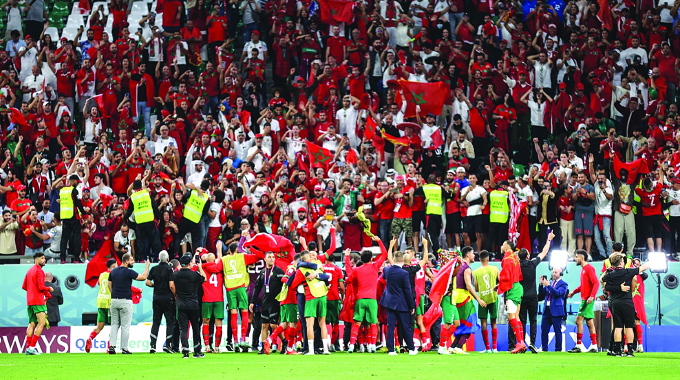
CONGRATULATIONS to Morocco for making it to the semi-final of the 2022 FIFA World Cup. They made history as they became the first African nation to reach the semi-final of a FIFA World Cup following a 1-0 win over Portugal in the quarter-finals in Qatar.
Unfortunately they got knocked out by France in the semi-finals.
Morocco made Africa proud. They have made Africa believe that indeed the World Cup can be won by an African team if enough efforts are put into football by respective football associations in Africa. Africa can now dream. The continent is awash with talent, some of which end up being ”stolen” by European countries because of the chaos and disorganisation of football in Africa.
I am glad Patrice Motsepe ,the CAF President, is trying his best to elevate African football and drive the message that African FAs need to be really serious and organised about football and its development.
Morocco’s historic feat has been subject of many commentaries and comments across the world, with some having the opinion that the Moroccans are lucky to have been in the last four of the FIFA World Cup. Nooooooo. Their historic semi-final place is not a product of luck but a result of years of goal driven development by their football association.
The Moroccan Football Federation (FRMF), in conjunction with the government and monarch, have been passionately focused on the development of football In the North African country. From the state of sporting facilities to the talent discovery and development formula, Morocco has been sowing the right seeds which has grown into what is playing out in Qatar.
Fouzi Lekjaa, the Morocco Football Federation president, aptly captured the federation’s vision in this comment: “The development of football in Morocco is founded on a triangular approach that should form the basis of the development of any system: facilities, talent and qualified personnel. Along with my colleagues at the FRMF, I am convinced that those three fundamentals have to be in place for the process to develop as it should.”
The Morocco Football Federation unveiled their new sports complex dubbed “The King Mohammed VI Football Complex” a few years ago.
The project was started with FIFA Goal Project funds but King Mohammed VI chipped in with millions and transformed the whole project into an awesome world class sporting facility.
Mohammed VI complex facility is an old football centre previously known as National Maamoura. It enjoyed a massive facelift and renamed in honour of the King for his massive “gift” to football. The complex has six residences (hotels) for national teams, 66 rooms and four suites, four stadiums, special training box drills and sports medicine centre.
The King Mohammed VI sports complex is designated to develop a high level football practice that reflects the Monarch’s constant solicitude towards sports and youths; and his desire to secure professional football players all the conditions for improving their performance.
The facility features dining and relaxation areas, a 221-seater auditorium that can host various events as well as an administrative building. The sports complex facility is opened to foreign teams who wish to make it a tourism development tool.
The FRMF has been delivering on its promises, focusing first of all on facilities both nationally and locally. A high point in its development plans came with the 2019 opening of the Mohammed VI Football Academy which covers 30 hectares and boasts the latest facilities and equipment — all of it compliant with FIFA standards.
The jewel in the crown of Moroccan football, it is one of the biggest and highest-achieving sports academies in the world.
In the meantime, the Moroccan authorities have also been developing local facilities, with a team overseeing development across the country’s 12 regions, starting with talent detection with young players attending club academies.
They made such a big effort to make sure clubs have their own academies and compliant with the FIFA licensing requirements
Their regional academies are the same as the national academy, but just smaller. The best players from the regions go to the centre of excellence, which has coaching and medical staff who work with young players spotted in grassroots football and taken up to the next level.
That’s the way their development cycle is designed. It starts with talent detection at grassroots level, with that talent then channelling into the clubs, the regional academy and on to the national centre of excellence.
In conjunction with the development of facilities and as part of the talent detection process, the FRMF is also in schools, closing the net as tight as it can and making sure that no potentially gifted individuals slip through it. They have embarked on a sports studies programme with the Ministry of National Education to create school structures across the country that can accommodate boys and girls who play football all the time, offering them a timetable adapted to every level of schooling.
They take raw talent at the age of 10 and allow them to express it and raise their game. The idea is to prepare them for life as professional players and for them to kick on and join clubs academies at an early age.
The talent is there everywhere. All that is needed are qualified people to ensure that potential is harnessed to the full. As a result of all this, Morocco is leading the way with the Talent Development Scheme, setting an example for others like Zimbabwe, to follow.
With six FIFA World Cup appearances, a thriving domestic scene, a clutch of clubs regarded as continental heavyweights, and a solid reputation for producing dependable defenders, creative midfielders and stylish forwards, it is no exaggeration to say that Morocco has been a hotbed of football talent.
But as I look closely, any country in Africa has the talent. It is how you develop the talent that makes the difference.
It was in Morocco that, a few years ago, FIFA held a workshop devoted to the Talent Development Scheme (TDS), which was launched by Arsene Wenger, FIFA Chief of Global Development. More than 50 development specialists and regional technical advisers attended the Mohammed VI Football Academy to discuss talent development strategies, share best practice, and prepare the ground for the rest of FIFA’s member associations to support the scheme.
The Moroccan Football Federation (FRMF) is said to have been devoting all its energy to these goals. That is why their youth teams are doing well in international junior tournaments. Two notable products to emerge from the Mohamed VI Academy are Yousef En Nesri (he scored the goal which knocked Portugal out) and the lanky midfielder Azzedine Ounahi, who dominated the midfield proceedings during the match that the phones at his club Angers in France have not stopped ringing.
His performance on Saturday warrant this attention. Morocco indeed has a football development strategy and the two frontal approach (home and abroad) is paying rich dividends. Morocco have so developed their football and are presently Africa’s best in CAF Club Competitions. This year, RSB Berkane defeated Orlando Pirates to be crowned champions of the CAF Confederation Cup while Wydad Casablanca followed up by dethroning Al Ahly of Egypt to win the CAF Champions League title.
The focus has not been on men’s football alone. Morocco women’s national team finished second at the last Women’s Africa Cup of Nations tournament to book a first ever FIFA Women’s World Cup qualification ticket. There was success off the pitch too, with record attendances confirming the country’s strong interest in women’s football.
Even the Women’s CAF Champions League title is on Moroccan soil. ASFAR FC Ladies dethroned Mamelodi Sundowns to the title in November 2022.
Morocco is very much serious with the development of Moroccan women’s football.
They have been paying plenty of attention to the women’s game. The Covid-19 relief plan under the FIFA Forward Programme made grants of US$500 000 available to each member association in order to assist women’s football and the federation directed all the funds to where money was supposed to go.
The Morocco national Futsal team is ranked first in the Arab world and Africa in the latest Futsal world ranking published on September 4. With total points of 1 441, Morocco are placed 8th worldwide, ahead of Italy, Ukraine and Columbia
On the diaspora front, it is important to note that 14 of the players in the current squad were born abroad. These include star players Achrif Hakim of PSG, Hakim Ziyech of Chelsea and Nousarri Mazroui of Bayern Munich, very good players who could have played for their host nations but chose Morocco.
What is Morocco’s secret? The secret lies in a strong scouting network for diaspora talent. Achrif Hakim, for example, was invited to train in Morocco 10 years ago. He is now 24. The relationship with the Football Association therefore starts at a very young age. When they become fully fledged professionals, they are not conflicted about their international allegiance.
This is a good lesson for Zimbabwe and other African nations. Some wait until the player realises that he cannot make it in the host nations like Netherlands, Belgium or France, then they invite them to play for them.
The player might be good but might not be the best. He will come because he just want to play international football. This can be problematic in terms of talent, commitment and patriotism. The case of Prince Boateng is a good example.
Off the field, Morocco’s massive investment in sporting facilities sets them apart from the rest of Africa. That is why, hosting of nearly all CAF football tournaments in the last four years, will always have a mention of Morocco.
To remain compact and solid like this Moroccan national team players have been takes a lot of hardwork, dedication and commitment. It is obvious they want to fight for their country.
Who will look at the energy and positivity around the country’s football circles and not want to play a part to bring more success? Head Coach Walid Regragui was snapped to the team after guiding Wydad Casablanca to CAF Champions League victory and the 47-year-old has always hailed his nation as playing a huge part in his development.
Discouraging the linking of LUCK to Morocco’s historic World Cup semi-final qualification is important to allow other African countries to learn from the Morocco example.
It is time football administrators in Africa, particularly Zimbabwe, adopt this tested and successful formula and we will be proud of the growth and successes it will attract.
The Government, the private sector and football association should join hands and play their big part. Invest in facilities, invest in talent discovery and development. Remove politics from football administration and get the leagues, reserve leagues, provincial select leagues, provincial junior leagues etc running effectively. All national teams, men and women, from the Under-12s to the senior team, should compete in all international tournaments.
The Beach and Futsal leagues should also run effectively and form a big part of the development of football in the country.
Many great players in top footballing countries have had their star players taking part in Futsal and beach football where they developed their great skills.
Morocco have shown the example and we are enjoying the benefits. It’s not luck, they have planned and worked for this to happen. Morocco, indeed, has a football development strategy and the two frontal approach (home and abroad ) is paying rich dividends.
This is a template Zimbabwe can easily adopt. With the amount of local talent and the vast diaspora community, Zimbabwe can have a long and short-term strategy that can be highly successful. This can be achieved provided we have visionary football leadership in place.



 Online Reporter