admin
admin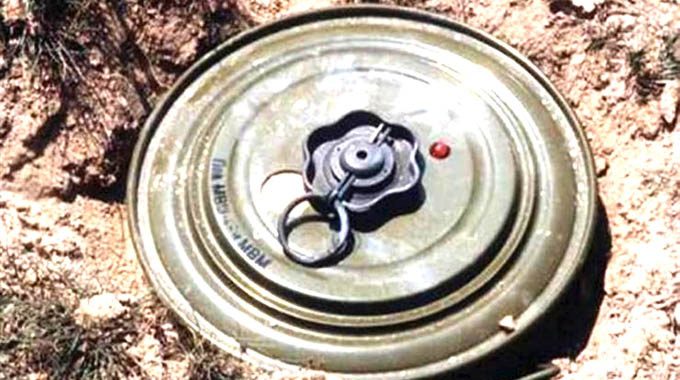
Columbus Mabika Herald Reporter
Zimbabwe has destroyed over 209 430 landmines since 1982 which were planted by Rhodesian forces at the peak of the liberation struggle between 1976 and 1979.
This was said by director Zimbabwe Mine Action Centre Colonel Bhika Mkhululi Ncube in a presentation on the landmine situation in Zimbabwe to AU and UN delegations last week.
“The initial contamination was 310,65 square kilometres, non-technical surveys, technical surveys and clearance cancelled and reduced vast areas to remain with 49,35 square kilometres as at 31 May, 2019. To this end, over 209 430 anti-personnel mines have been recovered and destroyed,” he said.
Col Ncube said since independence, Government has been concerned with the landmine menace which continues to hamper development and restricting movement in border lying areas.
In 2012, Government was concerned with the landmine issue and signed a memorandum of understanding with three international organisations; the International Committee of the Red Cross (ICRC), HALO Trust and Norwegian People’s Aid to complement the Zimbabwe National Army engineers who have been carrying out demining operations since 1982.
Col Ncube added that in 2016, Government accredited two more international organisations namely Mine Advisory Group (MAG) and APOPO to speed up the rate of clearance.
He said the rate of clearance has now come down due to lack of mine laying records which could facilitate ease of clearance.
Minefields have been hindering free movement, killing innocent victims who include humans, domestic and wild animals. People living close to landmine-infested areas are also restricted from socialising with relatives across mined areas for fear of losing life and limb.
Col Ncube said minefields have also impacted on the economic activities of people living close to them.
“Limitations in land use and loss of livestock are some of the challenges. Cattle represent the only real wealth, savings and insurance for a peasant farmer. Thus, loss of cattle and other livestock is a very serious concern to a peasant farmer.
“The Sango Border Post to Crooks Corner minefield runs adjacent to the Gonarezhou National Park, which is part of the Great Limpopo Transfrontier Park, a tripartite tourism project by Zimbabwe, South Africa and Mozambique. Tourism has remained subdued on the part of Zimbabwe due to presence of landmines,” he said.
Rhodesian forces laid minefields along the northern and eastern borders of the country with the aim of preventing the infiltration of freedom fighters into the country from Mozambique and Zambia.
Technical surveys carried out reveal that the initial landmine infested areas covered an area of 310,65 square kilometres which translate to a linear distance of around 850km with approximately three million mines laid.
The mines laid were below and above surface.



 Online Reporter