

 admin
admin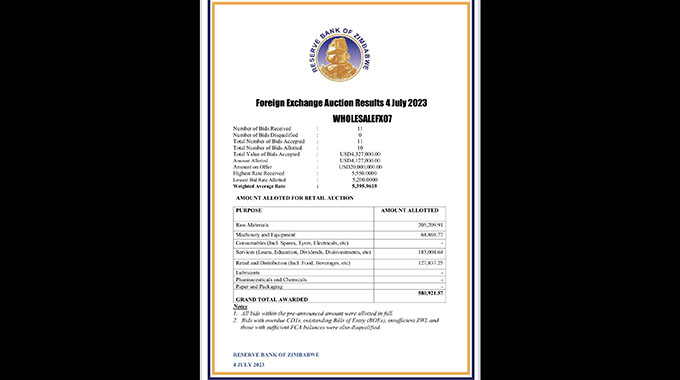
Herald Reporter
THE Zimbabwe dollar firmed again yesterday, another 7 percent on the wholesale auction for banks stocking up on foreign currency, and the much smaller auction for large direct importers, with the weighted average now $5 395,9619 to US$1.
This has brought the total gain in the value of the Zimbabwe dollar to 22 percent since the local currency bottomed out in value.
As with the two wholesale auctions last week, the 19 commercial banks did not have enough uncommitted local currency to buy all the US dollars the Ministry of Finance and Economic Development had made available for the auctions run by the Reserve Bank of Zimbabwe.
In fact they did not have enough to even come close.
It is this surplus of foreign currency over local currency which is driving down the price of US dollars, as there are now far more US dollars for sale to banks than banks can find the Zimbabwe dollars to pay for them, and so market forces push down the price.
The major auction, the wholesale auction for foreign currency that only commercial banks can buy for on sale to their customers, had US$20 million made available. But of the 19 banks, eight did not bid at all.
The 11 banks that did bid put in for a total of just US$4,327 million.
One of the bids for US$200 000, which would have been the lowest, was not allotted leaving the 10 successful banks with $4,127 million.
In the second auction last week, and presumably this was the case yesterday, when the authorities felt the lowest bids were creating too wide a gap in the price banks were paying for foreign currency, then those bids were dropped from the allotted list.
The direct retail auction for the largest importers, who can buy direct in the weekly auction rather than go through their banks for all their requirements, saw just US$580 921,57 bid for and sold, with all bidders getting what they sought since only about 11,6 percent of the US$5 million that was available on this auction was bid for.
The far more important wholesale auction for banks saw a dramatic narrowing in what the banks were prepared to pay for foreign currency, indicating the value the banks place on US dollars. The top bank paid $5 550 for a US dollar, while the 10th on the list, and the last to be allocated, paid just $5 200. But that gap of 5,76 percent was a lot smaller than the gaps seen in the two wholesale auctions last week.
This should start to see the rates set by each bank for their currency business with the customers start to narrow.
Yesterday’s weighted average on the wholesale auction will be the interbank rate today, but most days the interbank rate is calculated from what the 19 banks are willing to pay for US dollars and what they will sell them for, with a weighted average arising from the amount of transactions each bank does.
While almost every other sector of the economy has to use the interbank rate, the banks themselves all have their own rates and it is their weighted average that creates the interbank rate, with their bidding at the wholesale auctions doing a reset.
As with most countries, the interbank rate is the official rate and is generated by the commercial banking sector with zero input from the Government or central bank.
Zimbabwe has now normalised even more with the bulk of foreign exchange dealing being done through the banking sector, and so the interbank rate is becoming a standard.



 Online Reporter
 leeroy