Tawanda Musarurwa
CHECKPOINT DESK
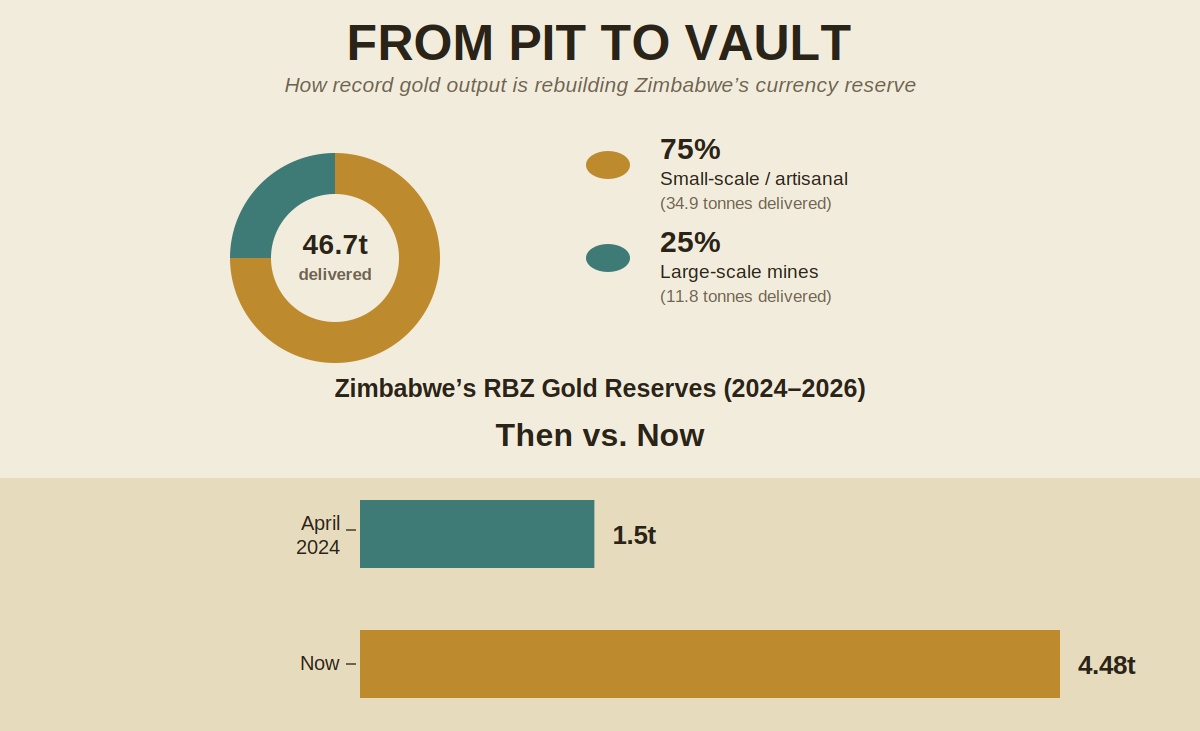
IN the basement vaults of the Reserve Bank of Zimbabwe (RBZ), there are now roughly 4,48 tonnes of gold – up from just 1,5 tonnes in April 2024, a jump built directly on the back of a record year at the country’s mines, where deliveries to Fidelity Gold Refinery reached 46,7 tonnes in 2025, well past the Government’s 40-tonne target.
Last week, President Mnangagwa visited the vault in person to verify it.
At a time when most central banks communicate through dry press statements, the symbolism of a Head of State descending into a gold vault was unmistakable: This is real, it is ours, and it is the foundation of a currency the Government is determined to make hold its value.
The visit marked the visible dividend of a policy decision made two years ago, when the authorities stopped taking mineral royalties in cash and instead accumulated them in physical commodities, especially gold. That decision only pays off if the gold is actually being mined – and 2025 is the year production caught up with the ambition.
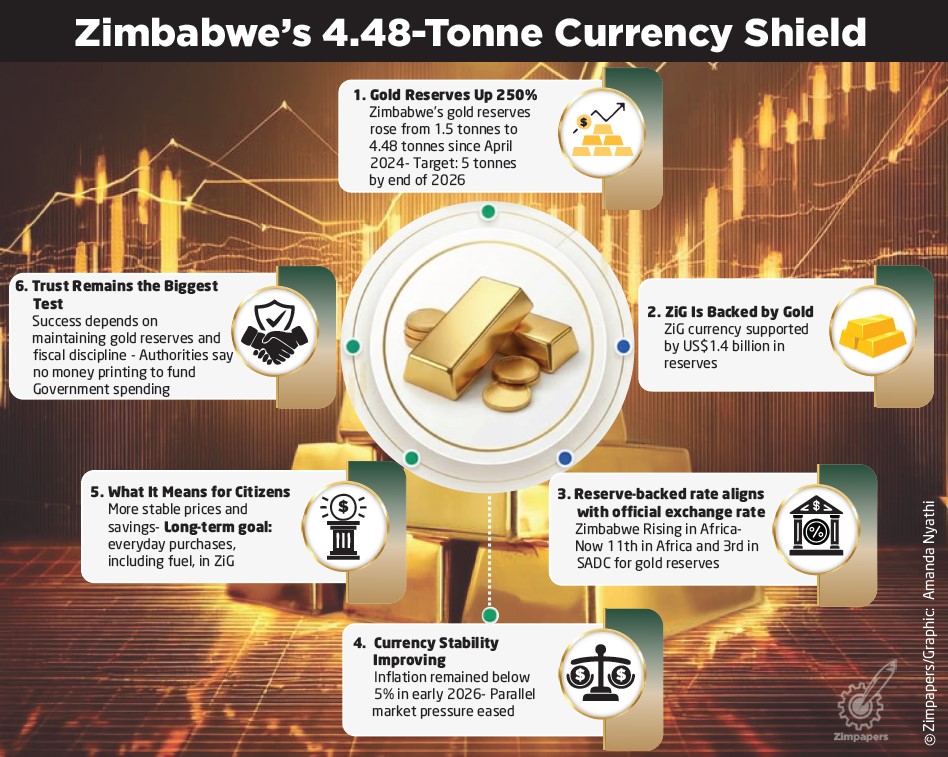
Resultantly, the country’s gold holdings have grown by more than 250 percent since April 2024, jumping from just 1,5 tonnes to 4,03 tonnes by December 2025, and now to 4,48 tonnes.
That puts Zimbabwe on number 11 on the continent in official gold reserves and third in the Southern African Development Community (SADC) region – ahead of most neighbours.
The target is five tonnes before year-end.
That vault target is only credible because of what has been happening several rungs down the supply chain, on the ground at the country’s mines.
A record year underground
Official Government figures show the country blew past its 2025 gold production target, with deliveries to Fidelity Gold Refinery (FGR) reaching 46,7 tonnes by December 31 – well clear of the Government’s 40-tonne benchmark for the year.
What is more striking than the headline number is where it came from.
Small-scale mining accounted for 75 percent of total output, with artisanal and small-scale miners delivering 34,9 tonnes against 11,8 tonnes from the country’s large-scale mines – a nearly three-to-one margin that would have been unthinkable a decade ago, when formalised, capital-intensive operations dominated national output.
It is this shift, more than any single RBZ policy, that has kept the vault filling. Every tonne that lands at FGR from a small-scale miner in Kadoma, Shurugwi or Penhalonga is a tonne that can, in principle, be monetised into the reserve buffer backing the ZiG. The country’s mineral wealth is, at last, doing some work for the people who live nearest to it – and the 2025 numbers suggest that work is accelerating, not slowing.
Why gold?
Because Zimbabwe Gold (ZiG)’s credibility depends on it.
Zimbabwe launched the ZiG currency in April 2024 after a string of failed attempts at introducing a local unit stretching back two decades.
The pitch was different this time: ZiG would be anchored by hard assets – foreign currency and physical gold sitting in an actual vault.
That structure requires the vault to stay full.
When RBZ Governor Dr John Mushayavanhu ran the numbers publicly, the reasoning was clear.
Total ZiG deposits in the banking system stand at around ZiG22 billion.
The reserve buffer backing it is US$1,4 billion – predominantly gold.
Divide one by the other, and the implied exchange rate comes out just under ZiG16 to the dollar.
The official interbank rate currently sits at ZiG25,59.
That means the gold in the vault is not accounting fiction; it is the mathematical floor of the currency.
This matters because the country’s monetary history is defined by currencies that had no such floor.
The old Zimbabwe dollar did not; the bond note did not and the RTGS did not. ZiG, at least in design, does.
But most importantly, it means the RBZ can buy all the ZiG that is presently in circulation with the gold that it has in stock.
In monetary terms, the central bank can easily defend the value of the ZiG in the market, which anchors the value of the two-year-old currency.
The parallel market test
In a country where people instinctively distrust the official rate, the black market premium is seemingly the real credibility gauge.
During the first three months of this year, that premium stayed below 20 percent – a threshold the RBZ has treated as its red line.
When reserves are visibly strong and growing, the incentive to panic-buy US dollars at a premium shrinks.
The governor made this explicit: if all the ZiG in existence could be bought back at just under ZiG26 per dollar, there is no rational basis for parallel rates trading above ZiG30.
This is a materially different situation than in early 2024, when reserves were a thin US$276 million and import cover was less than two weeks.
Today, US$1,4 billion covers about 1,5 months of imports.
The central bank target is three to six months.
The distance still to travel is real, but the trajectory is, for once, going the right way – and a 46,7-tonne delivery year gives the RBZ a fuller pipeline to work with than it has had at any point since dollarisation.
What does this mean for the ordinary Zimbabwean?
Quite a lot, actually, although the connection is not always obvious.
Let us start with inflation.
For the first time in more than 30 years, Zimbabwe achieved single-digit annual local currency inflation in January 2026, at 4,1 percent.
It stayed there: 3,8 percent in February, 4,4 percent in March.
A stable, backed currency holds its value.
When your ZiG savings do not evaporate overnight, you can plan a month ahead. You can price a contract. You can keep money in a bank account without it silently shrinking.
Then there is the import cover question, which has a very direct consequence for consumers.
Every tonne of gold added to the vault is a step towards the day when petrol stations accept the local currency without qualms.
That is the moment when using ZiG for everyday life becomes genuinely practical.
The remaining hurdle
The country’s monetary institutions have broken trust before.
The gold in the vault is reassuring, but it requires ongoing political commitment to keep it there and to resist the temptation to finance Government spending by other means.
And assuringly this has been the hallmark of the Second Republic.
The RBZ’s 2026 Monetary Policy Statement is explicit on one condition: no central bank financing of Government expenditure.
The first quarter data from the central bank confirms that condition is being met.
So is the International Monetary Fund (IMF)’s Staff-Monitored Programme, which benchmarks Zimbabwe against exactly this kind of discipline.
Four-and-a-half tonnes of gold cannot rewrite history.
But paired with a record 46,7-tonne production year – three-quarters of it coming from small-scale miners who, a generation ago, operated entirely outside the formal system – it is the most tangible evidence in decades that something different is being attempted, from the pit to the vault.
For the ordinary Zimbabwean, the bet is simple: If the vault stays full, the currency will finally hold.