Nduduzo Tshuma in NAIROBI, Kenya
ZIMBABWE and Kenya yesterday formally established a Bi-National Commission (BNC), elevating bilateral relations to the highest level of political engagement as both nations seek to translate longstanding diplomatic goodwill into increased trade, investment and industrial development.
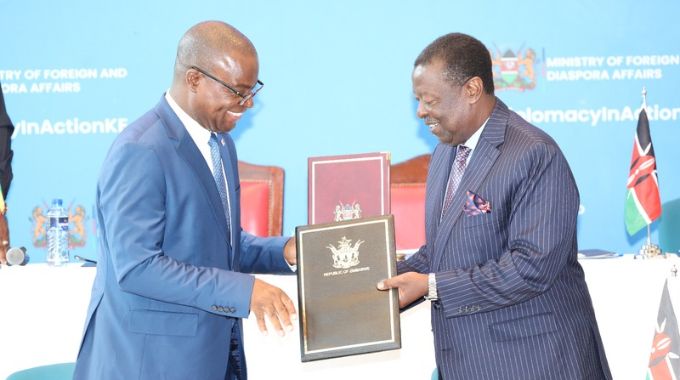
The milestone followed the signing of a Memorandum of Understanding (MoU) at the Ministerial Session of the Fifth Session of the Joint Permanent Commission on Cooperation (JPCC) in Nairobi yesterday.
Preceded by a two-day senior officials’ meeting that began on Monday — co-chaired by Permanent Secretary for Foreign Affairs and International Trade Ambassador Albert Chimbindi and Kenya’s Principal Secretary for Foreign Affairs Dr Korir Sing’Oei — the session culminated in the MoU signing by Foreign Affairs and International Trade Minister Professor Amon Murwira and Kenya’s Prime Cabinet Secretary and Cabinet Secretary for Foreign and Diaspora Affairs Dr Musalia Mudavadi.
Formalising the upgrade from the JPCC to a BNC, the agreement creates a structured framework for joint development under President Emmerson Mnangagwa — who arrives in Nairobi today — and Kenyan President William Ruto. The two leaders will co-chair the inaugural BNC tomorrow, building on 17 bilateral instruments spanning defence, agriculture, health, investment, tourism, sports, transport, education and public-service capacity development.
Addressing the ministerial session, Prof Murwira said the BNC must convert diplomatic warmth into tangible commercial returns.
“Our principal objective through this BNC is to transform political goodwill into robust commercial exchanges, thereby enhancing the integrity, dignity and prosperity of our two peoples,” he said.
Reiterating Zimbabwe’s policy on local value addition, Prof Murwira added: “Zimbabwe no longer exports raw minerals as a matter of policy, conviction and practice. We prioritise value addition and beneficiation to drive minerals-based industrialisation, create jobs and enhance economic growth.”
He urged Zimbabwean entrepreneurs to tap into Kenyan opportunities while welcoming growing Kenyan investment in Zimbabwe through ongoing collaboration between the Zimbabwe Investment and Development Agency (ZIDA) and the Kenya Investment Authority (KenInvest), alongside talks on standardisation to cut technical trade barriers.
To ease logistics for small-scale farmers and small and medium-sized enterprises, Zimbabwe has proposed establishing an in-market warehouse in Kenya. Additional priorities include concluding an Agreement on the Avoidance of Double Taxation, deepening agricultural and livestock cooperation — building on Zimbabwe’s cattle exports to Kenya following President Ruto’s April 2024 State Visit to Harare — and advancing pacts in mining, energy, transport, tourism, wildlife conservation, maritime affairs and fisheries.
Aviation connectivity remains a central pillar, with Kenya Airways operating daily flights to Harare and Victoria Falls while seeking approval for scheduled passenger and cargo services, including Fifth Freedom traffic rights on the Harare–Johannesburg route.
Speaking at the same meeting, Dr Mudavadi noted that bilateral trade rose by roughly 63 percent from US$35,3 million in 2024 to US$57,6 million in 2025, adding that reaching the shared US$70 million target by year-end is achievable through stronger logistics and private-sector participation.
“Our shared target of US$70 million in annual trade by 2026 is within reach and should serve as a milestone towards even greater commercial engagement,” Dr Mudavadi said, urging structured involvement by micro, small and medium-sized enterprises and manufacturers.
The ZimTrade Zimbabwe-Kenya Trade Brief 2026 highlights significant room to diversify Zimbabwe’s export basket beyond tobacco (US$12 million in 2025) and sugar (US$7 million), which currently account for roughly 95 percent of exports to Kenya. With Kenya importing US$22 billion in goods in 2025 — including US$360,63 million in sugar and confectionery, compared with Zimbabwe’s US$50,32 million share in 2024 — local producers have strong growth prospects in raw and refined sugar, maize and cereals, Eastern Highlands tea, coffee, spices, edible fruit and nuts.
With a population of 56,4 million, a gross domestic product (GDP) of US$120,34 billion and the strategic Port of Mombasa serving as a gateway to East Africa, Kenya offers a vital regional distribution hub for Zimbabwean exporters.
Dr Mudavadi expressed appreciation for Zimbabwe’s support for Kenya Airways, including corporate tax exemptions and ongoing tax refund processing by the Zimbabwe Revenue Authority (ZIMRA), as both countries reaffirmed their commitment to regional integration under the Common Market for Eastern and Southern Africa (COMESA).