Oliver Kazunga
Senior Reporter
ZIMBABWE has risen to become Africa’s 14th largest economy, with the International Monetary Fund projecting its Gross Domestic Product at US$65,92 billion in 2026, in a development Government says reflects progress in economic transformation and international re-engagement.
The IMF’s October 2026 World Economic Outlook places Zimbabwe ahead of Cameroon, whose economy is projected at US$64,81 billion and Tunisia at US$62,74 billion.
The Fund forecasts Zimbabwe’s economy to grow by 5 percent this year.
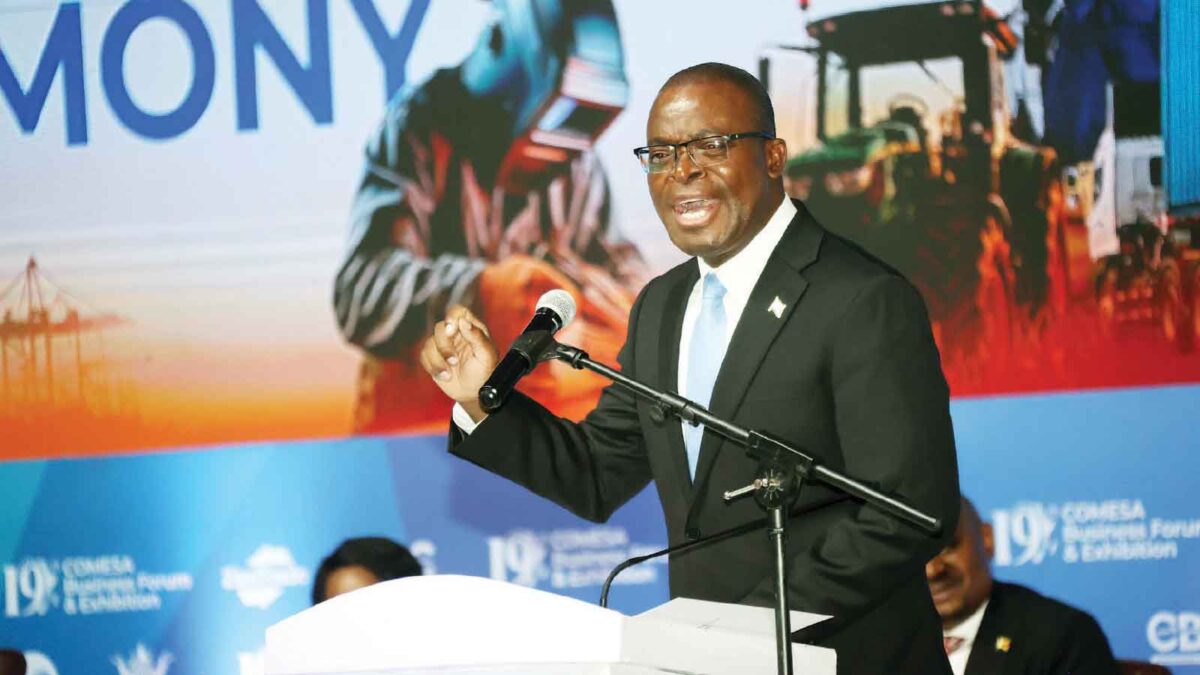
Speaking at the 19th Comesa Business Forum in Harare yesterday, Foreign Affairs and International Trade Minister Professor Amon Murwira attributed the country’s expanding economic base, declining inflation and growing diplomatic standing to President Mnangagwa’s leadership and the engagement and re-engagement policy.
“Zimbabwe’s GDP today (yesterday), 20 October 2026, is over US$65 billion,” he said.
“Zimbabwe’s GDP per capita has reached US$4 000, up from an earlier estimate of US$3 500, while the President had set a target of US$4 500 by 2030.
“Our Minister of Finance (Professor Mthuli Ncube) was updating us at some point that our GDP per capita used to be US$3 500 in September.
“The President’s aim is that by 2030, it should be at US$4 500 per capita. I can tell you, it’s going there.”
The latest ranking marks an improvement from 17th position in 2025, with the IMF’s updated projections reflecting a larger estimated economy in nominal US-dollar terms.
The Fund expects growth to be supported by economic activity across key sectors, including mining and agriculture.
However, nominal GDP measures the total value of goods and services produced in an economy at current prices.
Its value in US dollars can also be affected by exchange-rate movements, price changes and revisions to economic estimates, meaning a higher ranking does not automatically translate into improved household incomes or living standards.
Prof Murwira also cited the decline in inflation as evidence of progress in stabilising the economy.
“At some point, we didn’t measure inflation, there was no need. Today, it is below 3 percent,” he said.
He said Government was pursuing a development agenda combining economic growth with industrialisation, improved public-sector performance and expanded international trade.
Prof Murwira attributed Zimbabwe’s growing diplomatic engagement to its foreign policy principle of being “a friend to all and an enemy to none”, saying the approach had helped rebuild relations with international partners.
He cited Zimbabwe’s election to a United Nations Security Council seat on June 3, this year when 182 of the 190 countries present voted in favour of the country.
The result, he said, demonstrated Zimbabwe’s ability to secure international support despite years of diplomatic tensions and sanctions.
He also pointed to improved relations with the European Union and efforts to attract investment under the “Zimbabwe is open for business” policy.
On domestic reforms, Prof Murwira highlighted the African Peer Review Mechanism’s assessment of Zimbabwe, saying the African Union had recognised governance reforms, performance contracting and the country’s Heritage-Based Education 5.0 model.
The model seeks to link education with innovation, production and industrialisation, while the land reform programme remains central to the country’s stated goals of national sovereignty and economic empowerment.
Prof Murwira said economic indicators and international assessments provided measurable benchmarks for tracking progress towards Vision 2030, the national ambition to achieve upper-middle-income economy status by the end of the decade.