admin
admin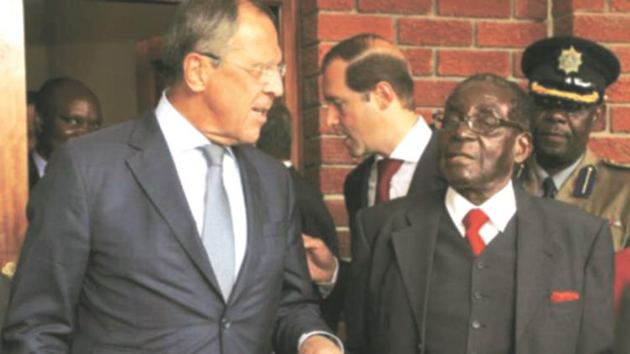
As President Mugabe recently stood next to Russia’s Foreign Minister, Sergey Lavrov, and weighed in on the US$3 billion agreement between Zimbabwe and Russia, the international community had an opportunity to observe history and diplomacy come full circle.
This was reminiscent of a very crucial point that was brilliantly illustrated in the epic book “The Struggle for Zimbabwe” by David Martin and Phyllis Johnson.
For Zimbabweans and their neighbours in the Sadc region, it is a well-known fact that at the height of the Second Chimurenga, the Soviet Union did not consider President Mugabe and Zanu as an authentic liberation movement, a term the Soviets used to describe Zapu, Frelimo (Mozambique), ANC (South Africa), Swapo (Namibia), MPLA (Angola), Molinaco in Comoros Islands and the PAIGC in Guinea Bissau.
While Zimbabweans and Africans have become accustomed to President Mugabe’s ability to forgive, they have had to wait for the rest of the world to recognise this aspect of his political character.
If President Mugabe could pardon Ian Smith and his Rhodesian Front for their shameful war crimes against Zimbabwe, then clearly the former Soviet Union’s refusal to recognise ZANU as the fighting force they were can be treated like water rolling off a duck’s back.
This aspect of Zimbabwe’s history is extremely important for two specific reasons.
First, President Mugabe and Zanu -PF have the special distinction of being the only liberation movement in the Sadc region to seize power without the blessing of the former Soviet Union, and the second is, while the late Vice President and national hero Joshua Nkomo and Zapu were not the outright choice of the Zimbabwean people to lead the country in 1980, their ability to maintain and solidify relations with the Russians has paid great dividends, to say the least.
When President Mugabe described Russia and China as Zimbabwe’s most formidable allies, the historical record clearly demonstrates this was not a political bluff, or that President Mugabe is guilty of being a prisoner of the moment, the ties between Zapu and Russia and the relations Zanu had with China demonstrate to all Africans that the Patriotic Front was light years ahead of its time.
In 2008 both China and Russia sent an emphatic statement to US-EU imperialism by vetoing their attempt to persuade the UN Security Council to impose additional sanctions on Zimbabwe.
Because it took President Mugabe and Zanu-PF 14 years to bury the MDC, which ironically is about the time Zimbabwe took to defeat the British and Rhodesians on the battlefield of the Second Chimurenga, the Russians have had time to acknowledge the collective brilliance and resolve of not only President Mugabe and Zanu-PF but Zimbabweans as a whole.
The Russians, along with everyone who currently occupy what Christians commonly refer to as God’s green earth, now recognise when Zimbabwe announced its Look East policy they were not thinking of the Asian subcontinent exclusively.
It is safe to say when the former Soviet Union disbanded in the early ‘90s, the US-EU alliance prematurely celebrated, as their propaganda outlets began to eulogise pro-imperialist forces in Eastern Europe.
This is very similar to how US-EU imperialism treated the deaths of Mao Tse Tung in China and Ho Chi Minh in Vietnam, due to their arrogant and racist disposition.
They presented the patriotic masses of these nations as robots incapable of thinking on their own.
For this reason, the US government’s debt to China could very well tempt Zimbabweans to say, as a rebuttal to numerous unproved attacks from the Obama administration: “Our comrades are your landlords; concentrate on paying them instead of meddling in our affairs!”
Since the Obama administration imposed sanctions on Russia, it was truly epic listening to President Mugabe provide their high-powered delegation with a narrative of how 13 million Zimbabweans have weathered the storm during the 13 years ZDERA has been in existence.
At the height of the Soviet Union when it came to Africa we were led to believe if you did not treat Marxism-Leninism as the political gospel, you felt the cold shoulder of the mighty Kremlin.
In Guinea, the pan-African giant, Ahmed Sekou Toure, felt the need to expel the Russian ambassadors from the country for having a dogmatic attitude to the PDG.
Because of that episode in African-Russian relations, it was fantastic to hear Cde Lavrov refer to President Mugabe as a living legend. On the surface, this was stating the obvious. However, it clearly illustrates that Zimbabwean/Russian diplomatic relations have reached new unprecedented heights.
- Obi Egbuna Jnr is the US correspondent to The Herald and a US-based member of the Zimbabwe-Cuba Friendship Association. His email is [email protected]


 Online Reporter