admin
admin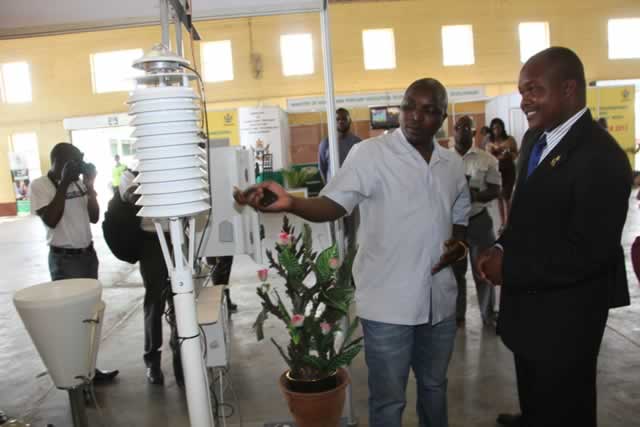
Sarudzai Mupangi Features Writer
Despite the challenges Zimbabwe is facing politically, socially and economically, its scientists have defied odds and continue to shine on the regional and international arena in science and technology.
Only this year 37-year-old Dr Maxwell Barson, a senior lecturer at the University of Zimbabwe, scooped the African Union 3rd World Academy of Sciences Award, beating other scientists from across the continent.
Dr Barson, whose passion is into fish farming, is credited with the discovery of a new tapeworm species in catfish from Lake Chivero and given the name Barsonella lafoni in 2009.
He was presented with the award during the recent Science, Engineering and Technology Week held at the Harare Exhibition Park.
The scientist has worked for local, regional international universities and organisations and he is currently furthering his studies in the United States of America.
The awarding of Dr Barson was the right tonic for the exhibition week ran under the theme “Science Technology and Innovation”.
The Science Technology and Innovation Week celebrates local scientific advancement and research in colleges and industry.
This augurs well with the country’s economic thrust based on the Zanu-PF manifesto. The Zanu-PF policy document encourages the indigenisation of Zimbabwe’s natural resources for people’s economic empowerment.
Amazing scientific discoveries in the areas of agriculture, technology and nutrition among others meant to improve the lives of the ordinary Zimbabweans were on display at the exhibition. Among the exhibitors was the Meteorological Services Department, which displayed the automatic weather station being installed in Zimbabwe.
Met officer Mr Barnabas Mugadza said the computerised machine would complement the old manual stations.
“We are in the process of installing the 16 automatic weather stations around the country. They are computerised and are more efficient as compared to the version that we used before now,” Mr Mugadza said.
“Our department is efficient as we depend on readings from ground stations, buoys (water) and ships and Met balloons.”
He said the objectives of the agro meteorological stations were meant to avoid weather-related calamities thus help improve the nation’s food security through the provision of advanced information on crop and weather data.
He, however, noted that more needs to be done as some farmers had no access to weather information while others have limited or no understanding of the data.
Harare Polytechnic College displayed an automatic energy management system, motor safety device and an automated vehicle safety device .
The biotechnology students had found ways of recycling mine slug and kaylites to produce glue, all of which were on show.
Mufakose 1 High School pupils developed a sunlight tracking solar device, which tracks the sun’s movement making it more efficient than the ordinary solar panel.
The school was the runner-up in the schools section after Nyatsime College, whose urban litter collection device, won the first prize.
Cornway College received second prize for devising a mobile phone-controlled remote system. St Mary’s School’s water purification device won the third place.
All the exhibitions were relevant solutions in the day-to-day lives of the ordinary Zimbabwean. No abstract work was considered.
Bindura University of Science Education devised a safer way of extracting gold using granular activated carbon.
The discovery may soon see the use of mercury being halted as the latter has a variety of environmental side effects.
New local scientific innovations can be used to extract minerals in a cost-effective and more efficient way that enables more indigenous people to become active players in that sector.
These were just but a few of the works of local young scientists that were on display, evidence that Zimbabweans have not ceased to better their lives in every way possible.
They have the ability to adapt to challenges and conquer them.
Deputy Minister of Higher and Tertiary Education, Science and Technology Dr Godfrey Gandawa urged researchers and development institutions to find solutions to appropriate safe and affordable technology that can be used to extract and process the country’s raw materials.
“Science and technology has to find practical solutions to value addition for both minerals and agricultural produce for economic growth if Zimbabwe is to develop. When technology becomes affordable, it helps empower the majority as many people become entrepreneurs in the manufacturing sector,” he said.
He, however, bemoaned the loss of natural resources by developing countries for decades to the First World.
“Many developing countries like Zimbabwe have been losing a lot of mineral wealth for decades if not centuries to companies from countries with advanced mining technology which continue to extract our minerals for a song. This must stop forthwith,” Dr Gandawa said.
Zimbabwe’s agricultural sector alone has a potential to absorb millions of people as a result of downstream industries that can be created through value addition.
The same applies to the mining sector.
Dr Gandawa said: “When all these ingredients have been synthesised, the effect is phenomenal economic growth that every country cherishes.”
He said the country spends millions dollars on importing machinery and technology for use in its industries, mines and farms and this needs to be stopped. According to the United Nations Conference on Trade and Development, Zimbabwe spends an average of 10 percent of its Gross Domestic Product annually on machinery imports while around 5 percent of GDP is spent on chemical imports.
Imports of vehicles, telecoms and electrical bring the total percentage of the country’s GDP gobbled by such imports to an average of 20 percent, which is worrisome.
“If this could be halted that money could go a long way towards developing the country. I am aware that this trend is similar in many developing countries in the region and the developing world at large.”
An Upper Six science pupil at Churchill Boys High, Adrian Ndoro, said science was an interesting subject but it is disappointing that science classes were small in most schools while other schools in the areas did not offer science subjects.
“Something should be done to increase the number of students who are into science subjects. They are interesting and mostly provide solutions to challenges being faced by people on a day-to-day basis,” said Adrian.
The exhibition attracted all polytechnic colleges and universities in Zimbabwe and the local industry. It had one foreign exhibitor from South Africa, Limpopo College of Science. The exhibition was the second edition in Zimbabwe. The inaugural SET week for the Sadc region was launched in Mauritius in 2009.
Feedback: [email protected]



 Online Reporter