admin
admin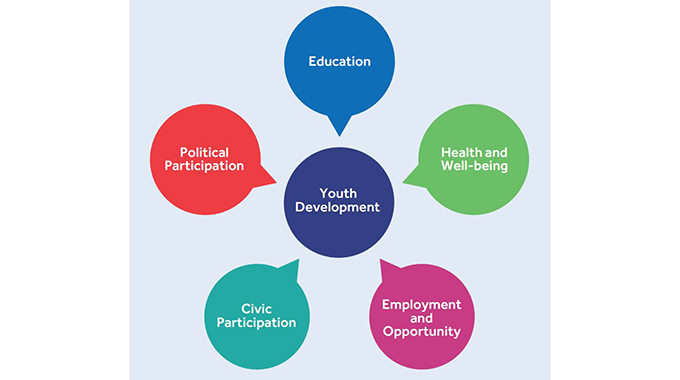
Business Writer
Zimbabwe ranked 159 out of 181 countries in the global youth development index (YDI) 2020, which tracks the progress on the Sustainable Development Goals (SDGs) associated with youth development.
The youth population refers to persons between 15 and 29 years old, according to the YDI report which is produced by the Commonwealth Secretariat and there is huge concern that the future generations are not prepared to take their countries forward.
On the assumption that the youth require a “politically stable, economically viable, and legally supportive environment” to fully leverage their skills, the YDI is measured over six areas that would indicate such an environment.
Among these is the area of employment and opportunity. This includes measurements for youths not in education, employment or training.
It also includes a measurement indicating persons who have an account (by themselves or together with someone else) at a bank or other financial institution or used mobile money in the past 12 months. On this measure, Zimbabwe is ranked number 178 with a score of 0.47.
The YDI score is a number between 0 and 1, with 1 representing the highest possible level of youth development attainable across all indicators.
A score of 0, therefore, reflects little to no youth development.
On the measure of equality and inclusion, Zimbabwe ranks number 151 with a score of 0,678. This also measures gender parity in safety and security, literacy, and early marriage. On health and wellbeing, was ranked 177 with a very low score of 0,399. This includes measurements for the mortality rate, HIV rate, self-harm, mental health, and drug/alcohol abuse, as well as tobacco consumption.
Also included under this category are measurements for the literacy rate, school completion, and digital experience (which includes access to the internet).
In all, there were 27 indicators, which had to be sourced in all 181 countries.
Where data was not available, this was statistically imputed. However, for Zimbabwe, the report shows real data was 100 percent.
The highest-ranking for Zimbabwe was political and civic participation at 43 although it also had the lowest score at 0,345. The highest score for Zimbabwe was for equality and inclusion at 0,678.
In Africa, some of the countries that ranked below Zimbabwe include Nigeria, Angola, Malawi, Mozambique, Cameroon among others.
Zambia, South Africa, Namibia, Botswana and Mauritius all did better.
Globally, Singapore was top of the list, followed by Slovenia, Norway, Malta and Sweden.
Niger, Afghanistan, South Sudan, Central African Republic and Chad, were at the bottom. The report highlights that continued recognition of the contributions of young people, who are taking charge of our future through their own small initiatives with big impact, is an important policy priority, against a background of declining satisfaction and participation in formal institutions of governance.
It recommends deeper research and evaluation of participation at local, national, regional and international levels. This is required to obtain a more comprehensive picture of youth engagement in political and civic life and guidance on principles, processes and structures that prove effective.
“Now, in the context of a pandemic that has had a direct and negative impact on young people, there is a need to ensure that we are able to prioritise policy action in areas that specifically affect young people”, reads part of the YDI report.
The impact of the pandemic has not been measured, and it is anticipated that this would have caused disparities across areas crucial to youth development.


 Online Reporter