admin
admin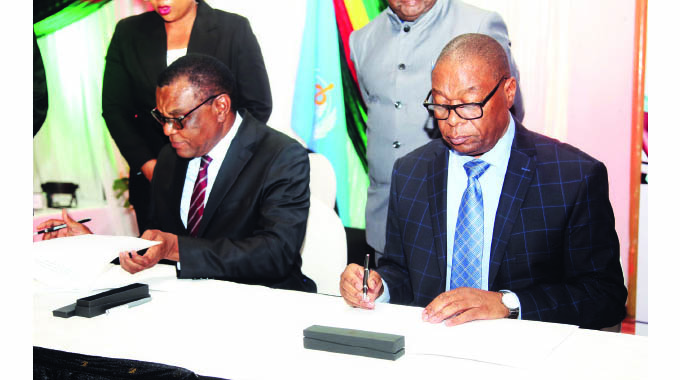
Rumbidzayi Zinyuke-Senior Health Reporter
Zimbabwe is set to raise at least 75 percent of the US$1,6 billion needed to address critical gaps in the health workforce to create a sustainable healthcare system offering the highest quality of life for all Zimbabweans, with development partners coming in for some of the remainder.
The gaps were identified in the Health Workforce Strategy (2023-2030), was launched yesterday in conjunction with the signing of the Health Workforce Compact (2024-2026) between several Government ministries and development partners. An additional US$475 million is required to meet the objectives outlined in the investment compact.
The compact, developed jointly by the Government and development partners with technical support from the World Health Organisation, aims to accelerate the country’s aspiration of attaining a Universal Health Coverage of at least 80 index points and ensure the availability of a resilient, motivated, and fit-for-purpose health workforce.
Speaking at a ceremony to mark the launch of the strategy and the signing of the compact, Health and Child Care Minister Dr Douglas Mombeshora said the occasion was a pivotal step in translating Government’s commitment to enhance the country’s health workforce into action.
“Through this compact, the Government commits to allocating 75 percent of the required resources, ensuring that these funds are ring-fenced, thereby inviting collaboration from development partners and the private sector,” he said.
He said the health workforce was the most significant, yet costly asset, critical to the achievement of health outcomes.
The Zimbabwe Health Workforce Strategy outlines five strategic areas that are expected to guide the country’s efforts to strengthen its health workforce: planning and financing; production, training and development; deployment, use and governance; retention and migration management; and monitoring and evaluation, ICT and research.
Dr Mombeshora said in the short term, Government was working on increasing capacity of the health workforce.
“These Government endeavours seem hampered by the limited fiscal space. However, our anxieties are minimised by our commitments to the investment compact. Leadership from Government, partners and the private sector in providing an enabling environment for the implementation of the Health Workforce strategy will be mostly what is desired.
“I am confident that the national health sector leadership and our partners here present will join hands in ensuring that the strategy becomes a living document which is revised from time to time based on the changes experienced on the ground.”
Skills Audit and Development Minister, Professor Paul Mavima, said the overall performance of the economy was hinged on skills development.
“The development of appropriate skills is important in improving the well-being of all and also the productivity and competitiveness of our economy. We are cognisant of the contributions of the health sector in achieving all this.”
He called for continued collaborative work to ensure that the objectives of the strategy and investment compact could be achieved.
The country’s health sector has been faced with various challenges ranging from inadequate staffing levels to skills gaps. The health workforce currently stands at 47,5 percent of the optimal capacity which has been compounded by the ongoing outward migration to other countries.
Data shows that at least one out of five doctors trained in Zimbabwe is working abroad with nearly 7 550 Zimbabwean nurses, 35 percent of the registered nursing workforce, employed in other countries.
Health Service Commission chairperson Dr Vincent Hungwe said the strategy and its corresponding investment compact were responses to these realities.
“They are a testament to our unwavering commitment to building a robust, well-supported health workforce that can deliver equitable, high-quality health care for all Zimbabweans. Our vision thus is to have a health workforce that is adequate in terms of numbers, diversified in terms of skills, and motivated to deliver quality health services for all Zimbabweans,” he said.
His commission was committed to scaling up the recruitment of health workers to close the staffing gaps that had long hindered service delivery.
This would see the commission doubling the workforce by creating and sustaining at least 32 000 additional jobs, while reducing health workforce attrition by half through several interventions.
“By creating 32 000 public health jobs by 2030, we can potentially stimulate an additional 100 000 jobs in the broader economy. These posts with treasury concurrence will be progressively funded and filled as outlined in our health resource strategy,” said Dr Hungwe.
Health workers representative Mr James Sibanda welcomed the launch of the strategy and the compact.
“On the remuneration of the health workforce, we salute both the Health Workforce Strategy and the Health Workforce Investment Compact for clearly spelling out the steps to be taken to improve our welfare.
“The need to speedily investigate non-monetary incentives such as reasonable motor vehicle rebate values, housing loans, car loans and land allocation to the serving members cannot be over-emphasised,” he said.
World Health Organisation acting representative for Zimbabwe Dr Sarah Wanyoike said investment in workforce education and retention was essential to sustain healthcare services in Zimbabwe and other countries.
She commended Zimbabwe for being among the first countries to turn the political commitment it made to the Africa Health Workforce Investment Charter, adopted earlier this year, into action.
“Let us unite in our efforts to support this compact, as it will significantly improve our collective impact, reduce infant mortality and infectious diseases, and ensure that essential services, such as vaccinations, are accessible to all Zimbabweans,” she said.
United Nations interim resident and humanitarian coordinator Dr Ayodele Odusola said the UN was steadfast in supporting the implementation of the investment compact.
“I call on all partners to align with the Zimbabwe Health Workforce Investment Compact. Together, we can enhance our collective impact supporting Zimbabwe to deliver universal health coverage and ensure health security for a healthier Zimbabwean population,” he said.



 Online Reporter