Online Reporter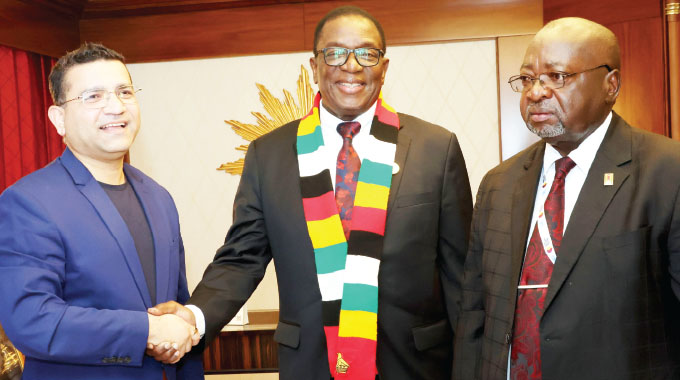
Fungi Kwaramba in DOHA, Qatar
PRESIDENT Mnangagwa has reaffirmed the Government’s commitment to social inclusion and equality, describing them as constitutional and moral imperatives being advanced through national policies on social protection, disability, and gender to ensure sustainable community empowerment and that no one and no place is left behind.
Contributing to a roundtable indaba held under the theme “Strengthening the three pillars of social development: poverty eradication, full and productive employment and decent work for all, and social inclusion” on Tuesday, the President said that despite being constrained by punitive economic sanctions and the devastating effects of climate change, Zimbabwe continues to uplift its people in pursuit of Vision 2030, which aims to transform the country into an upper-middle-income economy.
“Through our Heritage-Based Education 5.0 Model, we are promoting innovation and entrepreneurship, while the Women’s Bank and Youth Empowerment Bank provide concessional finance. Women now hold leadership roles in every sector of society, reflecting progress towards gender parity.

“Our development philosophy, which entrenches the belief that the duty to build, modernise and industrialise our country is the responsibility of all citizens, continues to inspire national unity and stewardship, a shared vision, hard work and collective responsibility,” he said. The National Social Protection Policy Framework (NSPPF) is a strategy designed to create a unified system for social protection, aimed at reducing poverty and vulnerability. It seeks to address weaknesses such as fragmentation and poor coordination by establishing a more consistent, transparent, and accountable system.
The framework guides Government programmes and is aligned with the Constitution and the Sustainable Development Goals, acting as an accelerator towards the realisation of Vision 2030.
In 2021, President Mnangagwa launched the National Disability Policy — another key pillar in addressing challenges faced by persons with disabilities. The policy aims to promote equal opportunities, accessibility, and empowerment for persons with disabilities across all sectors of society.
Building on this initiative, the Government established the Technical National Coordination Committee in 2022 to oversee and guide the implementation of the policy. Crucially, the Committee plays a vital role in ensuring that the objectives outlined in the policy translate into tangible improvements in the lives of persons with disabilities.
“On social inclusion, Zimbabwe is strengthening legal and institutional frameworks that promote equality, non-discrimination and participation. We are ensuring the inclusion of persons with disabilities, the elderly, rural communities and other marginalised groups. Traditional leadership structures are also being engaged to promote community-led development and uphold our shared values of Ubuntu,” said the President.
He added that although Zimbabwe has been impeded by unjust economic sanctions and climate change, it views these obstacles as opportunities.
“We are ready to work with all stakeholders to scale up employment-intensive infrastructure, green jobs, and resilient and adaptive social protection systems that safeguard livelihoods in the face of economic and environmental shocks,” he said.
The President’s delegation included the Minister of Women Affairs, Community, Small and Medium Enterprises Development, Monica Mutsvangwa, who told reporters that the Second World Summit for Social Development provided a platform for Zimbabwe to showcase its efforts in empowering women and cooperatives. Cooperatives have been identified as vital to poverty eradication, with the United Nations declaring 2025 as the Year of Cooperatives.
“Cooperatives are playing a critical role in eradicating poverty. When we look at women in rural areas, for example, they are thriving through these cooperatives. The cooperatives in our country are very viable, which is why we were invited here to speak on cooperatives,” she said.
Public Service, Labour and Social Welfare Minister Edgar Moyo outlined how programmes such as the Basic Education Assistance Model (BEAM) have kept thousands of children in school, providing social protection for vulnerable groups.
“We have about 1.5 million people under BEAM; the impact is huge. Otherwise, quite a high percentage of children would be out of school. At one time, many children were out of school, and the Government stepped in,” he said.
Special Advisor to the President on Disability Issues, Rose Mpofu, was also part of the delegation.
In an interview, she said Zimbabwe was ahead of its peers in implementing inclusive policies that improve the livelihoods of people with disabilities.
“When I was listening during the session, I realised that as a country, we are doing well in terms of taking care of people with disabilities. People like me are here today in Qatar to attend this summit. The President is also making key appointments, selecting individuals from among people with disabilities, and we are grateful for that,” she said.
Against a backdrop of escalating geopolitical tensions and widening social divides, global leaders at the Second World Summit for Social Development adopted the Doha Political Declaration, signalling renewed resolve to advance justice and inclusion worldwide.
The Doha Political Declaration reaffirms leaders’ commitment to the 1995 Copenhagen Declaration and the 2030 Agenda, placing social development at the centre of three mutually reinforcing pillars: poverty eradication, full and productive employment and decent work for all, and social inclusion. It links social justice to peace, security and human rights, pledges to leave no one behind, and calls for urgent climate action under the UN Framework Convention on Climate Change (UNFCCC) and the Paris Agreement.
Yesterday, the President courted investors during his visit, holding several engagements, including with the founder of Delta Green Global, Mr Mahalanobis Shubhojit, who expressed interest in establishing operations in Zimbabwe, focusing on green energy, tourism, and transport infrastructure.
“We are exploring good opportunities to bring in technology related to green energy to Zimbabwe, plus a lot of other infrastructure development projects. It was a very productive meeting, and hopefully we will meet again after a week or ten days to substantiate whatever we have discussed,” he said.
Mr Shubhojit, who met the President yesterday, added that he is also interested in the country’s tourism sector, particularly after Zimbabwe was voted Best Tourism Destination by the acclaimed magazine Forbes.
“We are planning to have some hospitality interests there, then some solar farms we are planning to invest in, and some other projects related to infrastructure and development,” he said.