Online Reporter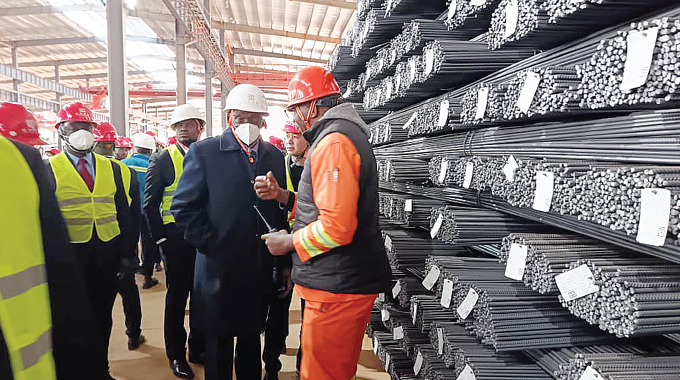
Patrick Chitumba, [email protected]
ZIMBABWE is reclaiming its space as a giant steel producer and supplier of value added products in Africa as evidenced by the progressive transformation of the Dinson Iron and Steel Company (Disco) Manhize Steel Plant in Mvuma, Midlands province, which continues to expand its production levels while creating jobs for thousands of locals.
Commissioned in 2022, the US$1.5 billion investment is a shining example of the pro-business reforms ushered in by the Second Republic led by President Mnangagwa, buttressing the re-industrialisation drive anchored on higher domestic production, value addition and beneficiation.

Since its operationalisation, Disco now employs over 2 000 people and is now producing steel in various forms, such as iron bars and deformed bars.
Notably, some of its output is being exported, generating the much needed foreign currency for the economy.
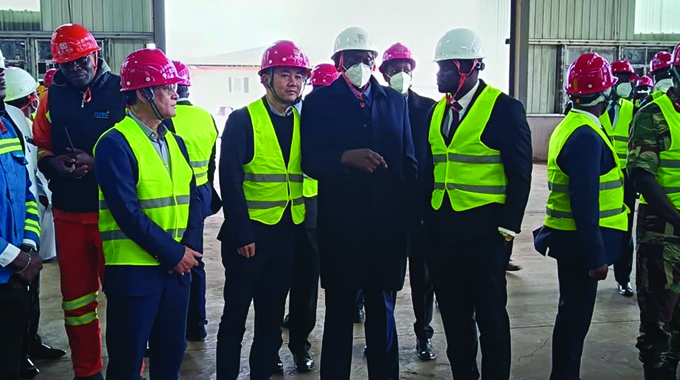
Yesterday, Vice President, Kembo Mohadi, conducted a tour of the massive steel plant in the company of the Minister of State for Midlands Provincial Affairs and Devolution, Owen Ncube, and Disco chairman, Mr Cheng Tsong.
VP Mohadi witnessed the massive production processes of steel such as the 16mm and 25mm deformed bars, which are final products suitable for construction purposes.
Disco is producing about 300 tonnes of deformed bars per day, with an annual target of 600 000 tonnes. The company’s vibrant steel operations are expected to contribute to increased steel production capacity in Zimbabwe, thereby reducing reliance on imports and enhancing domestic self-sufficiency and economic resilience.
Already, the young business has stimulated business activity across the economic value chain with immediate benefits to the local community through various infrastructure and social services investments.
“The Disco Manhize Steel Plant progress is really tremendous,given the fact that they have been in operation for about three years.
“It was commissioned in the year 2022. So they are three years in production and they are doing wonders, they are even doing beneficiation,” said VP Mohadi in an interview after the tour.
He said the progress at the plant is a prime example of what the country aims to achieve with companies establishing themselves in the country, driving production and contributing to the development.
“They are producing steel in the form of iron bars, deformed bars, among others.
They are even exporting some of the steel,” said VP Mohadi.
“So, this is an example of what we want. We want companies that come to Zimbabwe, establish themselves in Zimbabwe and do the production for the benefit of the country and they are still expanding by the way.
“We are going to be a giant in steel production, not only in the region but in Africa, considering the magnitude of this plant.”
A subsidiary of the Tsingshan Group of China’s mining projects in Zimbabwe, Manhize is one of the biggest business ventures alongside others such as Afrochine Smelting (Pvt) Ltd in Selous, Mashonaland West, which is into chrome smelting and Dinson Colliery (Pvt) Ltd in Hwange, Matabeleland North, which is into coke production.
All these projects are interlinked as both ferrochrome and coke are required in steel production.
VP Mohadi commended the company’s impact on employment and its commitment to sustainable industrial production practices. He said the Government values such partnerships with thriving industries like Dinson, which play a pivotal role in nation-building and economic development.
“I have no doubts that Dinson Iron and Steel Company will contribute substantially to meeting local demand and position Zimbabwe in the global steel industry,” said VP Mohadi.
Zimbabwe had not been producing steel since the demise of Ziscosteel Company, which led to increased import dependence.
Now that Disco is operating at a higher scale, this should quickly lead to the establishment of Manhize Smart City, said VP Mohadi, which will further enhance economic growth, infrastructure development, and quality of life in the province and the whole country.
“Through training and capacity building, I urge Dinson to enhance the skills and capabilities of Zimbabweans, contributing to the development of a skilled workforce in the steel industry and beyond,” he said.
“By adopting this approach, the company would be better positioned to navigate in regulatory frameworks, leverage Government support, and contribute effectively to national development objectives, and ultimately enhancing the impact of investment on Zimbabwe’s economy and communities.”
VP Mohadi said the successful project implementation demonstrates the cordial mutually beneficial bilateral relationship between Zimbabwe and China.
In his remarks, Mr Cheng said they were proud to showcase their operations and demonstrate commitment to value addition, beneficiation and import substitution.
“We would also like to take this opportunity to express our sincere gratitude to Zimbabwe through various ministries for their support, which has been rendered to Dinson Iron and Steel Company through an inter-ministerial approach. We appreciate the Government’s ease of doing business approach, which has greatly helped us achieve tremendous results in a short space of time,” he said.
“In just two years, we have started producing steel, which is now being marketed locally.”
Mr Cheng said their aim is to satisfy local demand, especially considering that Zimbabwe should no longer be importing steel, which the company can produce locally.
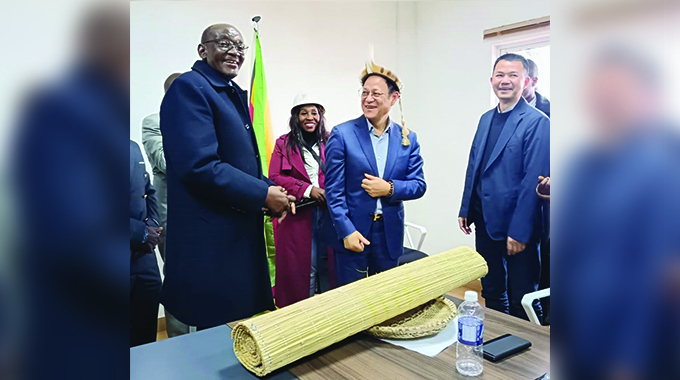
“We are proud to be contributing to the country’s economic growth and industrialisation,” he said.
“The collaboration between Dinson Group and Zimbabwe stands as a testament to the mutually beneficial co-operation between our two nations.”
Furthermore, we would like to highlight that Disco is much more than a private enterprise, it is a cornerstone of Zimbabwe’s national industrial strategy and a flagship project in line with the ambitious goals of Vision 2030.”
Mr Cheng said the project stands as a direct and powerful response to the national imperative of import substitution.
With Zimbabwe historically spending an estimated US$1 billion annually on steel related imports, Disco’s domestic production is set to eliminate this dependency, conserve vital foreign currency, and strengthen the country’s economic sovereignty.
“The project has already created about 2 000 direct jobs. Its scale is immense, commencing with an annual output of 600 000 tonnes, in the form of products such as pig iron, billets, rebar, wire, rods, steel balls and so forth,” said Mr Cheng.
He also said Disco has since obtained ISO 9001 certification through Standards Association of Zimbabwe (SAZ), which signifies their commitment to product quality in the production processes.
The company has further embarked on a product certification journey for all the steel products with the SAZ, as well as the South African Bureau of Standards (Sabs).