Online Reporter
Precious Manomano, Harare Bureau
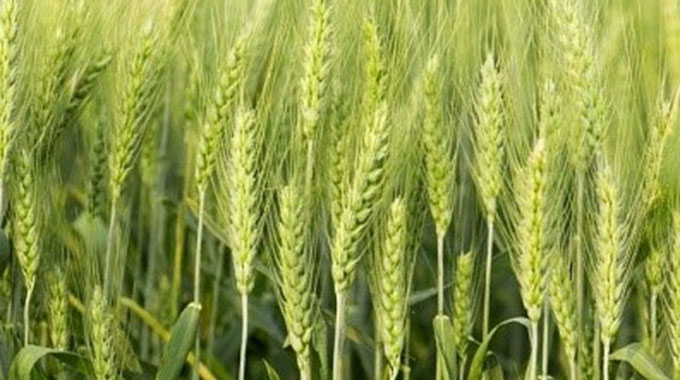
Zimbabwe is on track for a record-breaking wheat harvest this season, with farmers reporting remarkable advancements in crop development.
And thanks to favourable growing conditions and the adoption of best agronomic practices, the nation is solidifying its self-sufficiency in wheat production with 122 142 hectares planted this year amid high expectations for yields around 600 000 tonnes.
A significant portion of the crop is reportedly at the tillering stage, accounting for 38 percent of the planted area, which translates to approximately 47 000ha, with the development of side shoots promising to enhance overall yields.
During this critical phase, the plants develop side shoots known as tillers, enhancing the number of stems and ultimately, the yield.

The Agricultural Rural Development Advisory Services (Ardas) reports that 24 percent of the crop is at the vegetative stage, where seedlings establish their root systems and begin to develop leaves.
Additionally, 22 percent of the crop is said to be at the stem elongation stage, 14 percent at booting, and two percent at the heading stage, where the developing heads emerge from the flag leaf sheath.
The irrigation situation this year is promising, with adequate water available from various sources to support the crop’s growth.
Large dams will irrigate 82 800ha, representing 69 percent of the crop, while on-farm dams will provide irrigation for 15 600 hectares, which is 13 percent. Rivers contribute to the irrigation of 9 800ha, which is 8,2 percent, boreholes will cover 10 800ha, which is nine percent with vleis catering for 1 000 hectares, which is 0,8 percent.
In terms of regional distribution, Mashonaland West leads with 35 107ha planted, followed by Mashonaland Central at 27 910ha, and Mashonaland East with 22 866ha. Other provinces, including Manicaland, Midlands, Masvingo, Matabeleland North, and Matabeleland South, have also made notable contributions to the overall planted area.

To ensure the success of this year’s crop, farmers are being urged to adopt best agronomic practices. Adequate top dressing and pest control measures, particularly against aphids and fall armyworm, are essential to maximise yields.
Proper irrigation scheduling is critical, especially in sandy soils that require more frequent watering. Early weed management is necessary to prevent competition for resources, ensuring optimal growth conditions.
The Government is taking proactive steps to bolster wheat production, co-ordinating with Zesa and Zimbabwe Water Authority (Zinwa) to ensure an uninterrupted power and water supply for irrigation.
A substantial 15 000 tonnes of seed have been provided to meet production targets.
Last week, Mashonaland West Provincial Affairs and Devolution Minister Marian Chombo emphasised the need to install more drying facilities at Grain Marketing Board (GMB) depots to ensure a smooth transition between summer and winter crops.
“As the breadbasket of the country, Mashonaland West Province should be prioritised so that our farmers can continue to produce,” she said.
Meanwhile, Mashonaland West Ardas provincial director, Mrs Medlinah Magwenzi, has also urged farmers who planted late to increase their fertiliser applications to ensure better yields.
Her Mashonaland Central counterpart, Mrs Phillipa Rwambiwa, also noted that most of the crop in her province was in good condition, although challenges remain for those who did not apply sufficient fertilisers.
“So far, the condition is good. The challenge is only seen where farmers did not apply enough fertilisers,” she remarked.
Ardas acting chief director Mr Leonard Munamati reiterated the importance of proper irrigation scheduling and weed control.
“Most of the crop has passed the vegetative stage. Late-planted crops are at the emergence to hardening stage. Farmers should control weeds early as well as do split applications of adequate top dressing fertiliser,” he advised.
He stressed that the ministry’s targets should not only be met but exceeded, highlighting the overall good condition of wheat across all provinces.
Lands, Agriculture, Fisheries, Water and Rural Development permanent secretary Professor Obert Jiri, indicated that good agronomic practices were essential for unlocking the massive potential of wheat production.
“Good agronomic practices are the only way to increase productivity. It is important to employ good agronomic practices in any cropping venture to unlock the full value,” he said.
With a concerted effort towards sound agricultural practices and robust support systems, Zimbabwe is well on course to achieving its set target of 600 000 tonnes this season.
This progress not only paves the way for sustained food self-sufficiency but also addresses the rising consumer demand for wheat products.
Zimbabwe Commercial Farmers Union (ZCFU) president Dr Shadreck Makombe emphasised the need for correct irrigation and water preservation methods to achieve another bumper wheat harvest.
The outlook for Zimbabwe’s wheat production is bright and with continued dedication from farmers and support from the Government, the nation is set to secure its place as a leader in wheat production, ensuring food security for the future, he observed.