admin
admin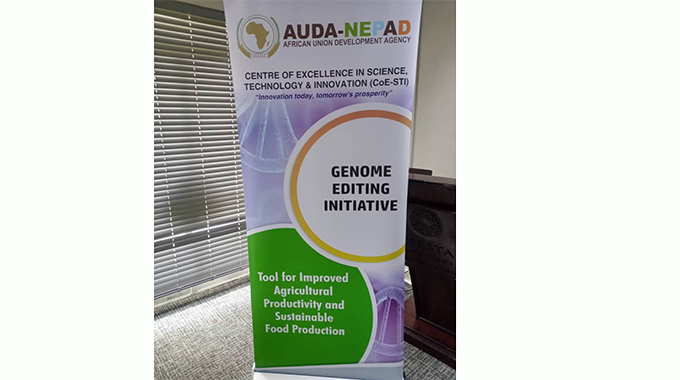
Sifelani Tsiko Agric, Environment & lnnovations Editor
Zimbabwe should take advantage of new and emerging technologies that offer immense future possibilities to the development of the country’s agricultural and health sectors, a senior government official says.
Higher and Tertiary Education, lnnovation, Science and Technology Development Permanent Secretary Prof Fanuel Tagwira said the country needed to adapt to realities of the growing modern biotechnologies and leverage on the platform to enhance productivity, enhance economic inclusion and promote innovation.
He said genome editing is one of the new technologies that falls under the biotechnology umbrella with a potential to improve crop productivity, resistance to pests and adverse environmental conditions.
“ln line with Zimbabwe’s current drive under Education 5.0, it is time for Zimbabwe to consider the use of latest technologies, such as genome editing, to revive our industries and our economy,” he said.
“We must use resources at our disposal to align with the industrial revolution. It is imperative for us as a nation to have home-grown solutions to boost our economy.”

The African Union Development Agency (AUDA-NEPAD) and the National Biotechnology Authority were organising the workshop to help the country to increase and scale up the use of biotechnology, in particular genome editing.
Zimbabwe is among other selected countries such as Burkina Faso, Ghana, Ethiopia, Nigeria, Mozambique, Kenya and Malawi that were chosen to pilot the application of genome editing research towards product development.
Speaking at the same event, Florence Nazare, acting director of AUDA-NEPAD for knowledge management said African countries must harness modern biotechnology applications to drive industrialisation and inclusive growth that improves livelihoods on the continent.
“The essence of this workshop is to help African countries to realise socio-economic transformation and attain Agenda 2063 goals,” she said.
“With science, technology and innovation as the driver, the AUDA-NEPAD is supporting and putting more effort to promote the wider utilisation modern biotechnology.
“Gene editing is one of the tools of biotechnology to optimise agriculture and food systems in Africa.”
She said African countries must fully embrace new technologies to improve all facets of agriculture, medical and other critical sectors.
“lt is quite important for us to improve Africa’s capabilities in science, research and development to strengthen utilisation and improve safety of new technologies,” Nazare said.
“We have to address security issues for the continent. We have to be the producers of biotechnology and not just be consumers.
“Our scientists have to be knowledgeable and globally competitive. This can be done through training.”
The workshop has attracted academics, plant breeders and researchers from various institutions in the country.
Zimbabwe has set up Genomics Centre at the University of Zimbabwe Innovation Hub that has a state of the art sequencing unit.
The NBA regulates the use and application of modern biotechnologies to minimise the impact of these on human and animal health as well as the environment.
The Zimbabwean economy is well positioned to benefit from rapidly accelerating technological change and has established industrial and innovation hubs to harness new technological innovations to find solutions to the country’s problems.



 Online Reporter